

Why Media Technology Standards are Important
Paul Treleaven, Technology Specialist Consultant, IAMT
It may be tempting to look at the AI-based products that drive today’s Media workflows and ask what relevance standards from SMPTE, AES and others now have. My answer is in two parts:
- Firstly, the way we work has evolved and is still based on video format standards from SD to HD to UHD defined by SMPTE and audio transports such as AES3 and AES67 defined by the AES. Today’s workflows still use SMPTE timecode for editing and MXF for media files.
- Secondly, many new application areas are brought to these bodies for standardization – such as the Catena control system and work to carry Content Provenance and Authenticity manifests through the media production process.
Later in this article, I will give updates on SMPTE and AES projects and I have also included projects from other organizations that contribute valuable standards-like work to our industry.
Media Standards Landscape
For many years, media standards have adopted a “layered” approach. This means that, instead of defining everything from scratch when new technology is introduced, a standard will reference existing standards, if possible, and build on them to add the needed functionality.
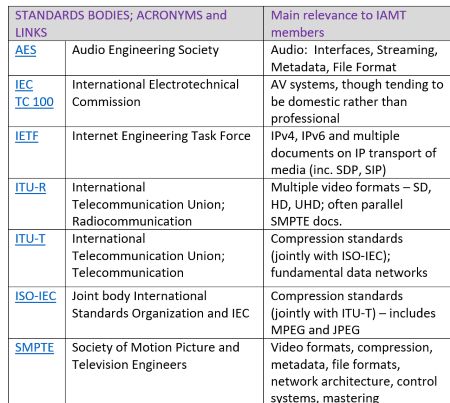
So, for the benefit of media technologists just entering our industry, I have included a table that lists standards organizations that they may come across in documents they are working with. For instance, modern media transport standards such as ST 2110 still reference the IETF’s Internet Protocol that has been in use since 1993.
Some Important New Developments
Here I mention a few media technology standards projects that are underway or that have recently completed.
SMPTE: The Catena Control System for Media Devices and Services
The SMPTE Standards group that focuses on Media Systems, Control and Services has developed a suite of Catena standards, consisting of:
- ST 2138-00: Catena Overview
- ST 2138-10: Catena Model
- ST 2138-11: gRPC Connection Type
- ST 2138-12: REST Connection Type
- ST 2138-19: Protocol Objects
- ST 2138-50: Catena Authenticity, Integrity, Access Control, Confidentiality & Availability (Security aspects)
Catena is an Open-Source, Vendor- and Platform-Agnostic Solution, Catena Delivers Single Secure Protocol for Control of Media Devices and Services.
Most new documents that are developed as SMPTE standards are made available to the public for a Public Committee Draft period – PCD.
The six Catena documents are currently available for download – see this SMPTE page.
EBU and AMWA: The Dynamic Media Facility (DMF) and Media Exchange Layer (MXL).
This Dynamic Media Facility Joint Task Force project aims to exploit the move to IP connectivity and software-based media production applications to make much more efficient use of resources by dynamically reconfiguring them to the needs of each production rather than having dedicated equipment that stands idle until the next production that needs it. An analogy might be the home kitchen – its appliances don’t just cook one kind of meal but can be used for whatever is on today’s menu.
Four “tracks” have been defined:
1. End-to-End Synchronization Working Group
Creating a unified model for timing and synchronization across dynamic, distributed facilities.
2. Compute Resources Management Working Group
Defining how compute, storage, networking, and specialized media functions can be provisioned, orchestrated, scaled, and released.
3. Flow Connection Working Group
Establishing how media flows are discovered, described, negotiated, and connected within a dynamic environment.
4. Business Activity
Identifying the business drivers, commercial models, and organizational changes required to adopt dynamic media architectures.
More DMF information from EBU, EBU’s DMF reference architecture, and from AMWA.
The Media Exchange Layer work has developed a method that allows media applications to share direct access to media storage. This speeds up the workflow by avoiding the need to pass large files between applications.
The EBU, together with industry organizations, has developed an open-source solution for MXL – the first official release is published here.
SMPTE: Content Provenance and Authenticity
With the rise of deep fakes and media piracy, there has been a big push to use manifests bound to content in order to prove provenance and authenticity. SMPTE began a project called Descriptive Metadata Scheme for Identity and Integrity (DMSII), to define how to carry this data in MXF files. It soon became clear that work was needed to support CPA throughout the media workflow, so a Study Group on Content Provenance and Authenticity was formed.
Study Group on Content Provenance and Authenticity
This group is researching requirements for all stages of media workflow to ensure that all use cases can be included. A survey was launched just before IBC 2025 and it has received 126 responses with 79 use-cases (user stories). Responses are being analyzed both by humans and by AI to make the data more manageable and the conclusions clearer. The report is expected shortly.
Descriptive Metadata Scheme for Identity and Integrity
This project is developing and documenting an architecture, a data model and a detailed specification to carry Identity and Integrity metadata in MXF files. A UML diagram of the data model has been developed. Very recently, the group decided that the work should be expanded into four documents:
- Part 1 – the original document, now Core Architecture
- Part 2 – KLV Framework (KLV is the data encoding used in MXF)
- Part 3 – JUMBF approach (JPEG Universal Metadata Box Format)
- Part 4 – KLV bindings
- Part 5 – Identity (support for participant identity)
AES: The AES70 Audio Control System
AES70 is a document suite on audio applications of networks, Open Control Architecture. It comprises:
- Part 1 – Framework
- Part 2 – Class Structure
- Part 3 – OCP.1: Binary Protocol
- Part 4 – OCP.2: JSON-based Protocol (recently approved for publication)
- Part 21 – Using AES70 to manage AES67 and SMPTE ST 2110-30 media transport (being revised in line of public call-for-comment suggestions)
- Part 22 – Using AES70 to manage Milan media transport
- Part 23 – Using AES70 to manage Dante® media transport
SMPTE: Study Group on AI in Media
This study group has produced two reports on AI, and particularly issues when used in media. They are ER 1010 and the newer ER 1011, available on this page along with a variety of other SMPTE reports.
The study group has also spawned three standards projects:
- AI Model Metadata and Creation of a Centralized Model Registry (draft nearing completion)
- Metadata Generated by LLMs: Contextual and Versioning Standards (awaiting completion of first part)
- Embeddings as Metadata: Contextual and Non-Human Readable Fields (awaiting completion of first part)
IAMT Standards Resources
The IAMT supports the development of standards that underpin the technologies used in Broadcast and Media. This section will help members to navigate our standards resources on the new website.
Start by selecting “IAMT Tech Office” from the Main Menu, then “About IAMT Tech Office. Scrolling down, you’ll see “Standards Reports and Updates”. That’s where you’ll see:
Standards Meeting Reports
We attend AES and SMPTE meetings and produce reports covering all the projects that we think members may find relevant.
You can find the most recent quarterly SMPTE report and the most recent twice-yearly AES report (or click here).
The IAMT Standards Monitoring Group (SMG)
The SMG is a forum where members can comment on the provisions contained in draft standards documents and the IAMT can submit those comments as part of the consensus-building process in the drafting group, whose participants are encouraged to consult with their colleagues to review and improve the provisions of documents.
For this activity, we have selected SMPTE and AES project groups (often with members’ recommendations) and we participate in their regular teleconferences. This provides an up-to-date picture of the state of their documents and development work.
Technologists in our member organizations can access the Standards Monitoring Group from the link on our standards page.
SMPTE projects currently monitored by the SMG:
- Microservices in Media (ten standards projects, including Catena)
- Projects related to Content Provenance and Authenticity (six standards projects)
- Dynamic Metadata for Color Volume Transformation (two standards projects)
- Network-based Media Synchronization – (three projects)
- AI and Media (task force plus three standards projects)
- Extensible Time Label (four parts)
- Study Group on Sustainability in Media
- Measurement Methods for Resolution Characteristics of Camera Systems
- Media over Managed IP Networks – ST 2110 suite
AES projects currently monitored by the SMG:
- Streaming audio metadata over IP (report)
- Streaming audio-over-IP interoperability – AES67 (continuing revision and associated work)
- Open Control Architecture – AES70 (includes revision and adaptations for connection management of AES67 and other formats)
- UWB Hi Res, Low Latency Audio Interface
- Projects on EMC mitigation and audio interconnections
The IAMT Tech Office is happy to help with any standards-related queries you have – contact us.
Latest IAMT News
Globecast Demonstrates Content Exchange Latest Capabilities at SPORTEL Monaco 2026

Beam Dynamics Appoints Brian Mauger as Regional Sales Manager, North America

Sign-Up Here
Industry news, event updates and more. Sign-up for the IAMT Newsletter.