Saranyu Technologies – From DRM to Content Protection: Securing the Modern Content Chain

Suresh BG, Founder and Chairman, Saranyu Technologies
As streaming platforms continue to expand globally, content security has evolved from a technical requirement into a business-critical component of resilience. Media companies invest heavily in premium content, making it one of their most valuable assets. At the same time, piracy ecosystems have become increasingly sophisticated, leveraging automation, credential sharing, rogue media services, and large-scale content redistribution.
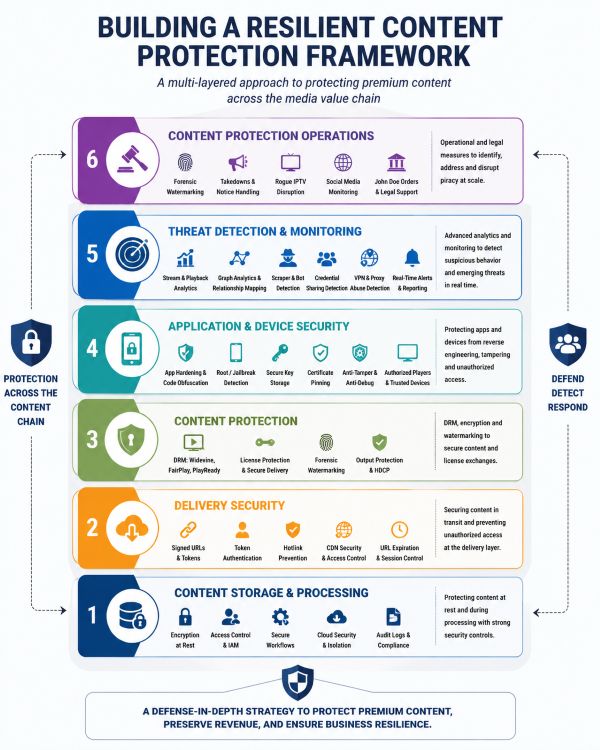
Traditionally, content security discussions focused primarily on Digital Rights Management (DRM). While DRM remains an essential component of any protection strategy, experience has shown that no single technology can address the entire spectrum of threats facing modern streaming platforms. Effective content protection requires a multi-layered approach spanning the entire content chain—from storage and processing to playback, monitoring, detection, and response. Figure 1 summarizes the key protection layers for streaming platforms.
Content Security Starts Before Content Delivery
The security journey begins long before content reaches viewers. Source content stored in media repositories, processing pipelines, and transcoding environments must be protected against unauthorized access. Encryption, access controls, and secure workflows help protect content throughout its lifecycle. As media workflows become increasingly cloud-native, securing assets during processing is as important as securing them during delivery.
Once content is prepared for distribution, the focus shifts to the delivery infrastructure. Content Delivery Networks (CDNs) play a critical role in streaming architectures, but they are also frequent targets for misuse. Signed URLs, token-based authentication, URL expiration policies, and hotlink prevention mechanisms help prevent unauthorized access to streams. These controls restrict content access to authorized applications and platforms.
Streaming operators are increasingly analyzing CDN access patterns to identify automated scraping and content harvesting attempts. Detecting and blocking such activity at the edge provides an additional layer of defense against large-scale content extraction.
DRM Remains the Foundation, But Not the Complete Solution
DRM remains the cornerstone of premium content protection. Most OTT platforms rely on a combination of Google Widevine, Apple FairPlay, and Microsoft PlayReady to support the diverse device ecosystem used by viewers today.
DRM protection varies by implementation. Widevine L1 uses hardware-backed security suitable for premium content, while Widevine L3 relies primarily on software protection. Content owners should align DRM policies with content value and piracy risk, applying stronger protection to premium content and live events.
Operators are increasingly protecting DRM license exchanges through encrypted license delivery and key protection mechanisms.
Modern Piracy Requires New Detection Approaches
Despite strong DRM, piracy continues to evolve. Today’s attackers rarely target encrypted video directly. Instead, they focus on exploiting weaknesses in workflows, applications, devices, user credentials, and delivery mechanisms.
Video downloader tools and stream scrapers attempt to capture playlist files and rapidly download video segments for offline redistribution. Credential-sharing has evolved into organized account-rental operations, while unauthorized OTT aggregators combine content from multiple providers into illegal services.
Traditional rule-based monitoring is often insufficient. New approaches use behavioral and relationship-based analytics to identify suspicious patterns across users, devices, sessions, IP addresses, and content requests.
Emerging systems use graph-based analysis of CDN logs and playback activity to detect credential sharing, stream scraping, bot abuse, VPN-based session splitting, and other coordinated piracy behaviors. Such approaches enable proactive threat detection and real-time alerting.
Stream Sentinel from Saranyu Technologies uses graph analytics and behavioral intelligence to detect suspicious OTT activity by correlating users, devices, sessions, and content-access patterns. It helps operators identify piracy threats earlier and respond more effectively.
Protecting the Last Mile: Applications, Devices and User Access
OTT applications are a major attack surface. Piracy groups frequently reverse-engineer apps to bypass entitlement checks, extract streaming URLs, or intercept auth-tokens. Modified applications are then redistributed through unofficial stores or sideloaded onto consumer devices.
Protection measures such as code obfuscation, runtime integrity verification, certificate pinning, root detection, anti-debugging techniques, and secure key storage significantly increase the difficulty of creating compromised applications.
Rogue IPTV boxes and unauthorized playback applications present another challenge. These devices frequently aggregate content from legitimate services and redistribute it without authorization. Detecting unauthorized players and correlating playback behavior with legitimate application activity can help operators identify and disrupt such abuse.
Beyond Detection: Content Protection Operations
Technology alone cannot eliminate piracy. Effective content protection requires ongoing operational processes and response mechanisms.
Forensic watermarking plays a crucial role by embedding invisible identifiers within streams. When leaked content appears on pirate platforms, operators can trace the source back to specific subscribers, devices, sessions, or distribution partners. This provides both traceability and deterrence.
Content protection operations also include monitoring social media platforms, identifying infringing streams, issuing takedown requests, pursuing search engine delisting, removing unauthorized mobile applications, and disrupting rogue IPTV services. In many jurisdictions, legal mechanisms such as John Doe orders can support website blocking against persistent offenders.
Dedicated anti-piracy teams provide surveillance, rapid response, and reporting on piracy incidents.
Turning Content Security into a Business Strategy
Content protection requirements vary significantly across platforms. Security investments should therefore be aligned with content value, audience scale, and business objectives.
With over 15 years of media platform experience, Saranyu Technologies helps customers implement content protection strategies aligned with content value, risk profile, and budget, ranging from foundational DRM and CDN security to advanced deployments incorporating watermarking, application hardening, and piracy monitoring.
Figure 1 illustrates this approach.
Building a Resilient Content Protection Strategy
As streaming businesses continue to scale, content security can no longer be viewed as a standalone technical function. It is a core business resilience strategy.
The most effective protection frameworks combine secure storage, CDN security, DRM, watermarking, application hardening, behavioral analytics, piracy monitoring, and operational response. Together, these layers defend against evolving threats.
Resilience is no longer defined solely by uptime and scalability. It also depends on an organization’s ability to protect content investments, preserve revenue streams, safeguard distribution rights, and respond rapidly to emerging threats. In today’s media ecosystem, securing the content chain from source to screen is fundamental to business success.
Latest IAMT News
Globecast Demonstrates Content Exchange Latest Capabilities at SPORTEL Monaco 2026

Beam Dynamics Appoints Brian Mauger as Regional Sales Manager, North America

Sign-Up Here
Industry news, event updates and more. Sign-up for the IAMT Newsletter.