
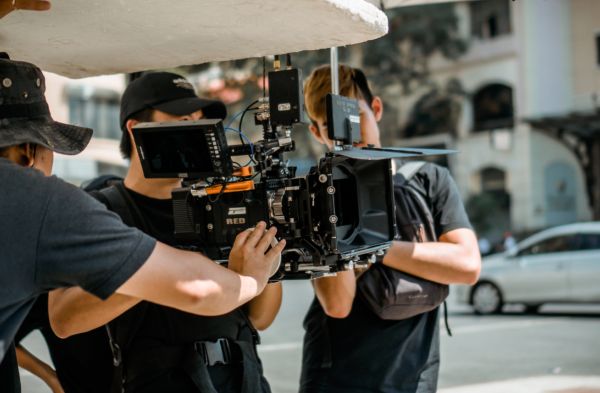
Imagine Products – Managing Complexity at Ingest: Preparing RAW Media for a Resilient Content Chain

Luke Erny, Product Marketing & Partnerships Lead, Imagine Products
Managing Complexity at Ingest: Preparing RAW Media for a Resilient Content Chain
The media industry has always embraced innovation at the point of acquisition, with higher resolutions, greater dynamic range, and more sophisticated codecs continuing to push image quality forward. Yet while camera technology has evolved rapidly, the challenge of preparing content for the next stage of production has become more and more complex.
This complexity is particularly evident as productions adopt advanced formats such as Apple ProRes RAW™. Designed to preserve maximum image information and creative flexibility, ProRes RAW provides significant advantages during image finishing and color grading. But the benefits of RAW acquisition often introduce new challenges when media must be delivered quickly and consistently. For organizations focused on resilience, this raises the important question of how increasingly sophisticated source media can be standardized without creating bottlenecks.
The answer may lie less in the acquisition format itself and more in how organizations automate and standardize the preparation of content immediately after ingest, with recent developments
in platforms such as ShotPut Studio reflecting a broader shift occurring across the industry. As organizations look to reduce friction between acquisition and delivery, media management systems are increasingly expanding beyond file transfer and verification to include automated content preparation, transcoding, and format normalization.
Complexity Is Increasing
The traditional distinction between production formats and delivery formats has become less clear over time. Modern productions routinely involve multiple camera systems, each generating media with unique characteristics, metadata structures, and workflow requirements. A single project may combine footage from digital cinema cameras, mirrorless systems, drones, action cameras, and increasingly, smartphones capable of producing professional-quality images. This diversity provides creative flexibility but also creates operational complexity.
The growth of vertical-first content provides a useful example. New content models, including episodic productions designed specifically for mobile viewing, have accelerated the use of unconventional acquisition tools and workflows. Productions are no longer constrained by a single camera ecosystem or delivery path but instead operate within mixed-camera environments where content must move quickly between acquisition, editorial, review, and distribution. As a result, media operations teams are increasingly responsible for normalizing a wide variety of source formats before content can continue through the production pipeline, shifting the challenge from simply capturing media to preparing it for movement throughout the content chain.
Resilience Depends on Predictability
When a workflow depends on manual intervention, specialized knowledge, or multiple disconnected tools to move content from one stage to the next, it can become fragile, with every additional handoff introduced adding another opportunity for error.
This challenge becomes particularly visible when working with formats such as ProRes RAW. While RAW media offers tremendous creative latitude, many editorial and review environments do not require direct access to the original RAW files. Instead, teams often need proxies and standardized deliverables that can be accessed quickly and consistently across multiple systems. Preparing these deliverables has frequently required separate applications, dedicated operators, or additional processing steps, but organizations seeking greater resilience should view content preparation not as an isolated technical task but as a strategic opportunity to reduce inconsistencies in their workflow.
Modern workflow platforms such as ShotPut Studio increasingly address this challenge by integrating multiple preparation tasks into a single automated workflow. Rather than requiring separate tools for media ingest, transcoding, and delivery, organizations can reduce operational complexity by consolidating these processes within a unified application. And with the introduction of certified Apple ProRes RAW decoding, ShotPut Studio extends this approach to one of the industry’s most flexible acquisition formats.
Moving Content Faster Means Preparing It Earlier
A significant shift occurring across modern media operations is the movement of content preparation closer to ingest. Traditionally, transcoding and deliverable generation were often treated as post-production activities. Content would be copied and transported first, and then later transformed into formats required by editorial or distribution teams.
That model is becoming increasingly difficult to sustain as production schedules compress, editorial teams need access to material sooner, and remote collaboration requires media to be available immediately. In this environment, waiting until later stages of the workflow to prepare content introduces unnecessary friction. Instead, many organizations are integrating transcoding and deliverable creation directly into automated ingest and media management processes. By generating proxies and standardized deliverables at the earliest practical point in the workflow, teams can eliminate downstream bottlenecks and accelerate content availability.
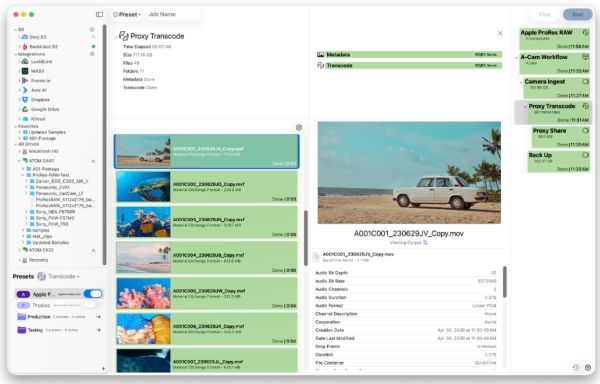
View of a ShotPut Studio Transcode job within an Automation Pipeline.
Standardization Without Sacrificing Flexibility
A common concern when discussing standardization is that it may limit creative flexibility. In practice, a balance can be struck between the two that benefits everyone in production. Creative teams can continue capturing media using the formats best suited to the project, while automated workflows can generate consistent deliverables tailored to editorial, review, archive, or distribution requirements. This approach allows organizations to embrace innovation at the acquisition stage while maintaining predictable and repeatable operational processes. In other words, standardization should occur at ingest rather than at the camera.
A challenge is not simply decoding RAW media, but doing so in a way that preserves creative intent while supporting operational consistency. Modern implementations, including ShotPut Studio’s RAW workflows, allow media teams to make adjustments such as ISO, exposure bias, color temperature, and RAW-to-Log conversions during content preparation. This enables organizations to generate deliverables tailored to editorial and review without introducing additional processing stages or specialized software into the workflow.
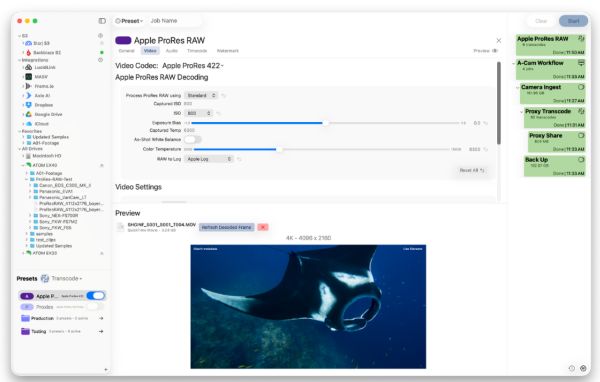
ShotPut Studio Transcode Settings page showing color adjustments for a ProRes RAW file.
The Future of RAW Workflows
As acquisition technologies become more accessible and more capable, advanced imaging formats will continue to expand beyond traditional high-end cinema productions. Professional creators now have access to tools that would have been considered specialized only a few years ago. Smartphones, compact cameras, and hybrid production environments are increasingly capable of generating content that must coexist alongside footage from dedicated cinema systems. As media ecosystems become more diverse, the organizations that thrive will not necessarily be those that limit acquisition to a single format, but those that build workflows capable of handling many while consistently producing predictable outputs.
Luke Erny, Product Marketing & Partnerships Lead
Latest IAMT News
Globecast Demonstrates Content Exchange Latest Capabilities at SPORTEL Monaco 2026

Beam Dynamics Appoints Brian Mauger as Regional Sales Manager, North America

Sign-Up Here
Industry news, event updates and more. Sign-up for the IAMT Newsletter.