Grabyo – Resilience is the operating model

Gareth Capon, CEO, Grabyo
Why modern media organizations need to stop preparing for disruption and start operating inside it
Resilience in media used to mean a second data center, an extra switcher panel or a generator in the basement. It now means something different. The industry isn’t preparing for the occasional disruption anymore. Disruption is everywhere.
That shift changes what resilience means in practice, and it changes the technology choices the industry needs to be confident enough to make.
What Has Changed
Three forces have collapsed the old definition.
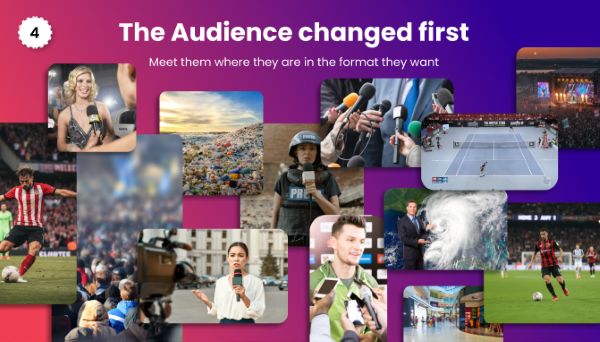
The first is audience behavior. Viewers no longer wait. They no longer accept being told where to watch, what format to watch in, or which platform to use. A live moment that doesn’t reach TikTok, YouTube, Instagram and a connected TV app within minutes has effectively not happened for a meaningful share of the audience. The production model has to keep up with that pace. A failover system in another country is great for TV, but might mean little to a viewer on a social feed.
The second is economics.
Production teams are being asked to produce more content for more platforms with fewer people and shorter timelines. The cost base of traditional broadcast infrastructure is increasingly out of step with the operational model that surrounds it. Resilience used to be a justification for spending more. It now has to be a reason for spending less.
The third is the technology stack itself.
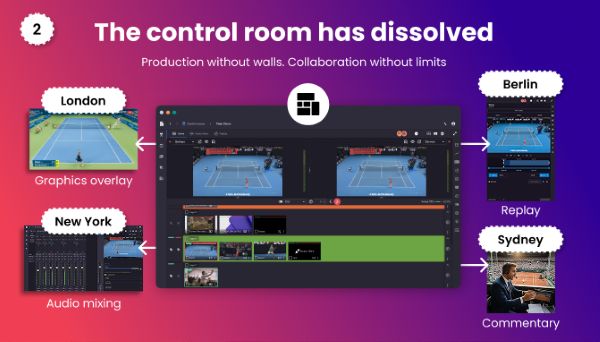
Production environments are no longer built around a single vendor and a single building. They are stitched together from cloud and software platforms, AI services, IP transport networks, connected APIs and a myriad of publishing endpoints. The points of failure have multiplied. So has the ability to route around them.
Together these forces push resilience out of the IT department and into the operating fabric of the enterprise. It means more than contingency. It is the way modern media businesses need to work.
Cloud Technologies Are the Connective Tissue
The reason cloud production has moved from innovation projects to mainstream deployment is not novelty. It is structural.
A browser-based, software-defined production environment can be deployed in thirty minutes. It can be located in multiple regions, or accessed by teams from multiple locations, if a venue, a network or a workforce becomes unavailable. It can scale up for an event and scale back down immediately on the final whistle. None of that is possible with fixed infrastructure inside, in a fixed facility, with an inflexible workforce.
The point is not that cloud is better than on-premise on every metric. The point is that the cloud absorbs change. On-premise resists it. In a market where change is the constant, the production model that evolves for change will win.
The biggest question is how quickly the rest of the organization can be reshaped around them.
Process Once, Publish Everywhere
Multi-platform distribution is the most visible test of resilience right now.
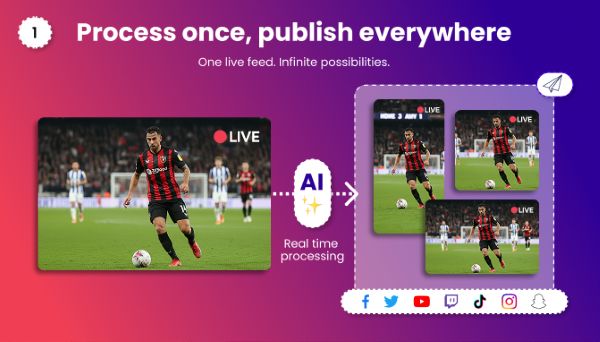
A live event that has to be delivered simultaneously to broadcast, OTT, FAST and three or four social platforms, each with its own format, aspect ratio and target audience, is not solved by adding more people. It is solved by changing the architecture.
AI-assisted production tools are the practical answer.
Automated reframing, real-time clipping, captioning and metadata generation turn a single live feed into a portfolio of platform-ready outputs without proportionally increasing headcount. The production cost of vertical video does not require a parallel production. It is a derivative of the main one.
Process once, publish everywhere feels like a slogan, but it defines what the audience wants – less exclusivity and more accessibility.
Interoperability Is Procurement, Not Preference
Modern media production workflows are inherently complex, combining live production, media transport, graphics, clipping, localization, captioning, metadata, distribution, and analytics.
For smaller teams there are significant benefits to all-in-one production tools – simplifying operations, reducing friction, and boosting speed – it is clear that organizations must maintain the flexibility to choose specialized components.
No platform will cover every requirement for every customer. That is where open APIs and cloud-platform integrations earn their place. Production teams can plug in the tools they already use, swap in specialist components where they need to, and keep their existing workflows intact.
The platforms that win do both.
They take the operational complexity out of the core workflow and stay open at the edges. The ones that force a binary choice, closed suite on one side, integration-only on the other, lose either flexibility or coherence. By enabling seamless, cloud-native integrations with specialized third-party tools, media organizations can build the most effective production systems without unnecessary complexity, costs and risk.
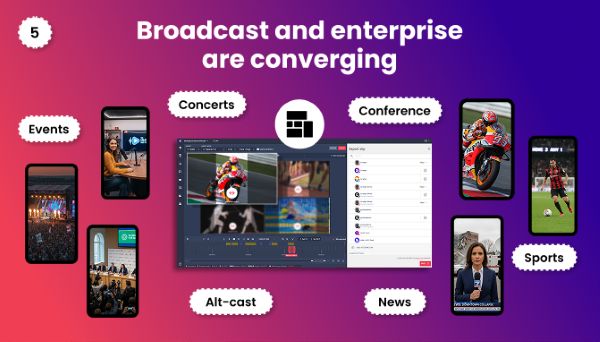
The Line Between Broadcasting And Enterprise Video Has Gone
The same logic explains why broadcast-grade production technology is now showing up in enterprise communications, education, sports federations and brand marketing teams.
These organizations have the same needs as broadcasters.
Live video is a strategic channel and the most engaging format for the audience. Enterprise customers need fast, reliable, multi-platform output. Many enterprise companies do not have a broadcast facility or a thirty-person production crew to deliver it.
Cloud-native production technologies close that gap. The distinction between professional broadcasting and professional video for everyone else is dissolving. What matters now is access to tools that are intuitive enough for smaller teams to operate and powerful enough to scale to broadcast-grade production values when they need to.
Sustainability Is a Cloud Benefit, Not a Cost
Sustainability has often been treated as a parallel agenda. It isn’t.
Remote and cloud-based workflows reduce travel, shrink physical infrastructure and lower the energy footprint of the production model. The same architectural choices that make a media business more resilient also make it more sustainable and more cost-efficient.
The Conclusion
The companies best positioned for the next decade are not the ones with the most redundant infrastructure. They are the ones that have built the ability to change as fast as their audiences and platforms do.
Resilience is not about backups, it’s about business models.
Latest IAMT News
Globecast Demonstrates Content Exchange Latest Capabilities at SPORTEL Monaco 2026

Beam Dynamics Appoints Brian Mauger as Regional Sales Manager, North America

Sign-Up Here
Industry news, event updates and more. Sign-up for the IAMT Newsletter.