
ContentWise – Why Your Voice Agent Needs a Content Brain, Not Just a Microphone

Renato Bonomini, VP Sales Engineering, ContentWise by Moviri
Most voice AI demos in media look convincing. A user says something vague (“show me something funny”) and the system returns a plausible-sounding list. Confident, fluent, immediate. In production, the cracks show: titles that don’t exist in your catalog, preferences the user never expressed, editorial rules that break when strategy shifts. The demo runs on an LLM. Production resilience needs more.
I built a voice agent on ContentWise’s UX Engine, fitting it between conferences, demos, and proofs of concept. The goal: find what breaks before it breaks in front of a customer. Four patterns shaped everything, and each is a resilience argument.
Grounding: The Foundation of Operational Reliability
The most common failure mode in voice AI for media is the ungrounded agent. A large language model doesn’t know your catalog, your users’ watch history, or which titles are licensed right now. Left alone, it invents. Confidently and wrongly.
Grounding means the agent can only name something after it has looked it up. In the system I built, every title comes from a tool call to UX Engine. The catalog is the source of truth; the LLM only translates what the user said into the right query. User preferences work the same way. Asked “why would I like this?”, the agent drew its answer from UX Engine’s user model, not inference: it cited the user’s most-watched actor, backed by 12 confirmed signals. The LLM didn’t infer that. It read it from a system that had been watching for months.
Two-sided grounding, catalog and profile, separates a reliable production system from one that sounds good until it doesn’t. No grounding, no business continuity when an operator has to stand behind what the agent says.
Data Architecture: You Control What Leaves Your Environment
The voice stack involves multiple third-party layers: speech-to-text, LLM, text-to-speech, each an external cloud service. That creates a data-governance question many implementations skip past.
In the architecture I built, the browser is the orchestrator; the AI provider never talks to UX Engine directly. When the LLM issues a tool call, it returns to the client, which turns it into an HTTPS request to UX Engine. UX Engine stays inside your environment, never exposed to the provider cloud. Your full catalog and user store stay where they are.
What the provider sees is deliberately scoped: the spoken query, a per-session context payload, and the results the agent reads back. You decide what goes in. Pass a user’s top preferences to personalize, or pass nothing and keep the session anonymous. Exposure is a per-session choice, not a standing data pipe into your subscriber base. The commodity AI layer processes language over a minimized, operator-controlled slice, not your content library or behavioral data at rest.
For operators handling subscriber data under GDPR, this is the difference that matters. Data minimization and purpose limitation are enforced in code, by the architecture, not delegated to a third party’s contract. You can point to exactly what left your environment and why.
Editorial Decoupling: Changing Strategy Without Changing Code
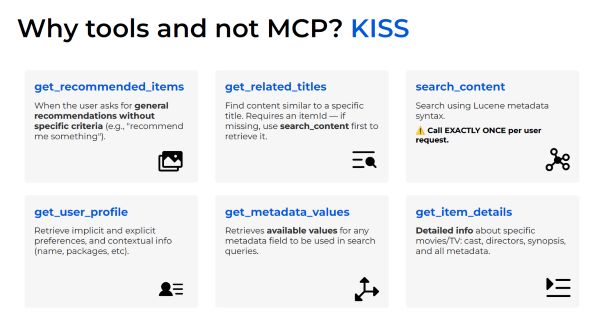
Video operators change priorities constantly. A title gets boosted to first position. Expiring content gets suppressed. A partner deal shifts what surfaces in which markets. These are editorial decisions, made at editorial speed: daily, sometimes hourly.
If those decisions live in the LLM prompt, every change is a software change: rewrite, test, deploy. The gap between editorial intent and what users see can be days. So can the opportunity for divergence.
The resilient answer is to keep business logic where it lives: in the recommendation engine. The LLM never sees the editorial rules. It calls UX Engine, which applies them and returns filtered results. When editorial changes a boost, it takes effect immediately across every surface, with no code change and no engineer in the loop.
This is a direct answer to the disruption problem. When conditions change, business rules update in one place and propagate everywhere. The voice agent doesn’t need to know they changed; it just gets different results.
The Work is in the Teaching, Not the Building
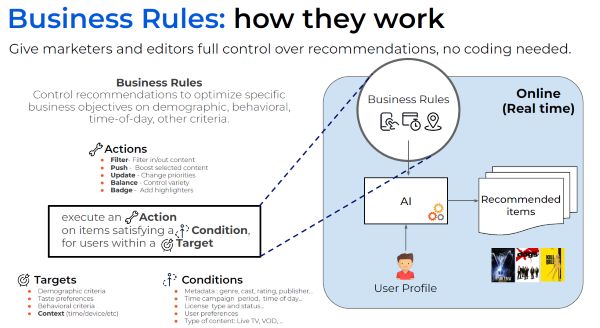
Wiring these layers together took days. Teaching the agent to behave took the rest of the time. A language model is fluent but knows nothing about how your users actually phrase things. Early on, “show me something funny” routed to the generic recommender instead of a mood search: the model read “something” as open-ended and ignored “funny.” The fix was a worked example telling the agent that a mood word outranks a hedge. Most of the build was this: watching the agent get something subtly wrong, then encoding the institutional knowledge a human operator takes for granted. The durable asset isn’t the integration. It’s the accumulated corrections that make the agent sound like it understands your audience.
Layer Replaceability: Supply Chain Resilience for AI Infrastructure
A working voice stack has four layers: speech-to-text, LLM reasoning, content brain, text-to-speech. STT and TTS are commodity layers, mature and interchangeable, chosen on accuracy and latency. The LLM handles intent translation, tool routing, and response narration. It doesn’t rank content. It doesn’t hold business rules. It doesn’t know your users.
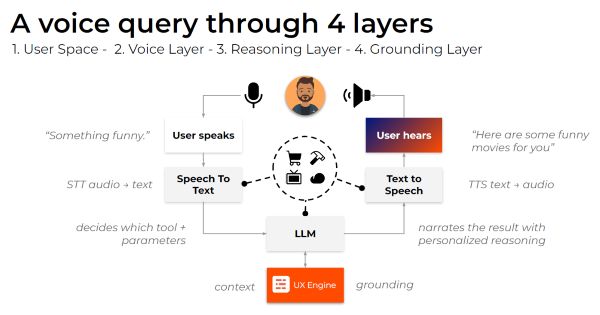
Because the LLM’s job is tightly scoped, you can swap the model without rebuilding the system. In testing, a latency-optimized smaller model answered in 233 milliseconds, against 1.2 seconds for a premium reasoning model. The quality difference on this task was undetectable; the cost difference was roughly 30x. That choice was available because the model wasn’t doing the hard work. The hard work lives in UX Engine: personalization, catalog query, business rules. None of it changed between tests.
When your LLM vendor changes pricing, terms, or availability, you swap the model against the same content brain, and the system continues. When a better, cheaper, faster model appears, and one does roughly every quarter, you evaluate it without disrupting anything upstream.
This is supply chain resilience for AI infrastructure: the commodity layers are interchangeable, the proprietary layer stable.
The Question That Precedes All the Others
The right starting question isn’t which LLM to use. It’s what the LLM can reach when it needs to answer. A model with access to a grounded content brain, a user model built from real behavior, and a rules layer maintained by editorial will outperform a more capable model operating alone. Every time.
The LLM is the voice. Build the brain first.
Renato Bonomini is VP of Sales Engineering at ContentWise by Moviri. He runs workshops on AI architecture for media operators and builds proofs of concept to find what breaks before it meets a customer.
Latest IAMT News
Globecast Demonstrates Content Exchange Latest Capabilities at SPORTEL Monaco 2026

Beam Dynamics Appoints Brian Mauger as Regional Sales Manager, North America

Sign-Up Here
Industry news, event updates and more. Sign-up for the IAMT Newsletter.