Accedo – ECOFLOW: Bridging the Gap Between Understanding, Knowing and Doing on Sustainability in Streaming

François Polarczyk, Sustainability Director, Accedo
It’s fair to say that the more complex an organization’s supply chain, the more difficult it becomes to track and manage its sustainability performance. This is certainly true for media organizations which typically have highly complex supply chains often involving multiple third-party suppliers. This makes understanding and addressing their environmental impact a real challenge because obtaining reliable and comprehensive data from suppliers is difficult to say the least. Additionally, even where data is available, the lack of universally accepted sustainability metrics also makes it difficult to compare performance and identify areas of improvement.
The ECOFLOW (Energy-Conserving Optimization for Future-ready, Low-impact Online Workflows) project, which began in 2024, seeks to make progress on addressing these challenges, driving real-world reductions in the environmental impact of the streaming industry. Ultimately, the project aims to support the industry’s transition to a more sustainable future.
Those readers lucky enough to have good memories may recall reading about year one of the project in IABM Journal November 2024 and the aims for year two in IABM Journal October 2025. The second phase of the project is now complete, and the project team are in the process of developing ECOFLOW 3 which will build on the work done previously.
Laying the Groundwork
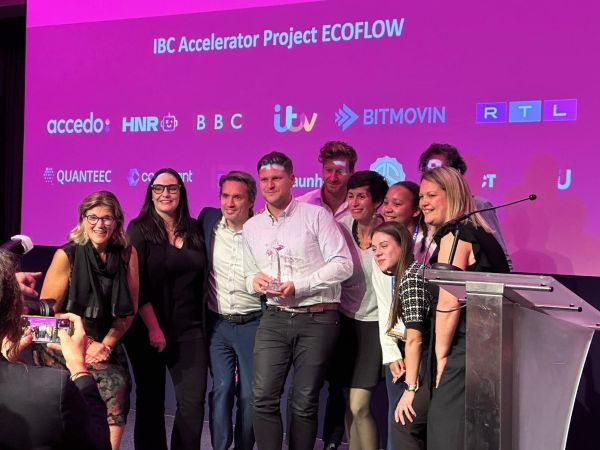
As a recap, the first phase of the project was part of the IBC 2024 Accelerator program and was co-led by Accedo and Humans Not Robots (HNR). The initial phase set out to understand energy use of key components in the streaming value chain and find out how they react under different conditions. It focused on end user devices because preliminary research suggested that these components had the largest impact on energy consumption. The project delivered groundbreaking findings around the energy usage of these devices and as such demonstrated proof-of-concept optimizations.
Accedo and HNR returned as leading participants for phase 2 of the ECOFLOW project, which again was accepted by the IBC Accelerator program (IBC 2025). This phase of the project shifted the focus from end user devices to the content distribution chain, looking at the IP distribution network, from origin server to receiving device. It aimed to build on the progress of the first phase of the project with a sharper focus on data visibility and real-world engagement. It sought to enable more reliable and comparable assessments of how different infrastructure choices affect energy consumption. These are indeed ambitious goals, so how did we do and what did we find out?
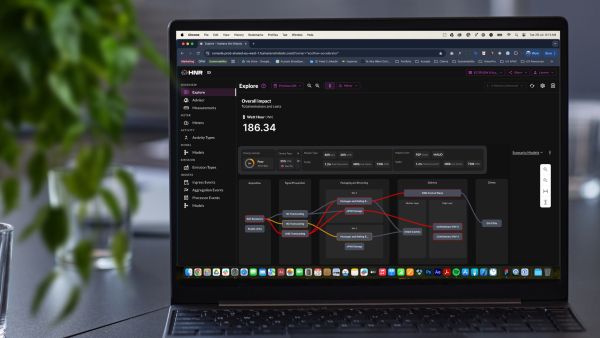
Key Findings from ECOFLOW 2
The project was highly collaborative with participation from across the industry with Accedo, Bouygues Telecom, Bitmovin, BT Media & Broadcast, DIMPACT, EBU, Greening of Streaming, HNR, the IET, ITV, and Quanteec all working together. To fill in the gaps where real data is still limited, the project team, a cross-disciplinary group bridging software engineering, product delivery and sustainability, created a digital twin of the streaming ecosystem.
This digital twin approach enabled the team to model streaming pipelines and compare alternate live streaming scenarios, namely Adaptive Bit Rate (ABR), Multicast ABR (MABR) and peer-to-peer (P2P) file delivery. These models were used to compare how streaming technologies perform in terms of energy usage with different types of content, from a major sports event, to a live entertainment premier, and a periodic entertainment program. The project team used real-world data provided by participating broadcasters to inform and validate the model’s behavior.
A critical realization was that the energy required to keep the distribution technology always on and provisioned for peaks, dwarfs the energy required for a single stream. The findings demonstrated that the biggest energy saving comes from completely turning off infrastructure during troughs rather than just putting it in low-energy modes. The enemy of effectiveness and efficiency is idle power consumption: there is a clear need to minimize idle/standby mode as much as possible.
Having multiple infrastructures for delivery of content is another issue when it comes to energy efficiency; significant energy savings can be had by moving to only streaming using a multi-purpose network.
Looking Ahead to ECOFLOW Phase 3
With phase 2 of the project now complete, attention has turned to the next stage. Phase 3 is an open, cross-industry experimentation program that closes the gap between knowing and doing on sustainability in streaming. Building on ECOFLOW 1 and 2, it shifts from primarily developing measurement foundations to validating actionable optimizations levers across devices, UX and distribution.
It will combine real-world experiments with modelling, forecasting/nearcasting and comparison of differing model results to increase confidence in outcomes, even when data is incomplete. Results will be translated in reusable assets and standards-ready outputs that partners can build on to make better operational and product decisions, delivering measurable environmental impact alongside clear business value.
ECOFLOW 3 will pioneer applied sustainability optimization through a new decision layer for streaming: experiments, models and advisory workflows that translate sustainability signals into recommended actions. Innovations include agentic AI-enabled decision-support to run scenario tests, reconcile differing model outputs via forecasting/near-casting, and propose optimization options with quantified trade-offs. The intention here is that the output is not another static framework, but repeatable, action-oriented approaches enabling partners can apply to their own data to improve impact and business outcomes.
The ECOFLOW 3 project was recently pitched as part of the IBC Accelerator 2026 program’s Kickstart day. Watch this space for project updates!
Latest IAMT News
Meet the Emerging Talent Behind the IAMT Talent Portal

NDTV Adopts Amagi’s AdFlow Orchestrator, Unlocking Monetization Opportunities on FAST and Connected TV

Sign-Up Here
Industry news, event updates and more. Sign-up for the IAMT Newsletter.