
Wowza – Adding Intelligence to Live Video Without Adding a Second Pipeline

Jon Corley, Chief Technology Officer, Wowza Media Systems
Most live video in the world is never actually watched. Not because it doesn’t matter, because it can’t be. Hardware and bandwidth got cheaper. Human attention didn’t.
AI analysis is the obvious lever. The common mistake we see with broadcasters and content providers, though, is that they often try building a second video pipeline for it. A parallel path pulls streams out to a separate service, runs inference elsewhere, and returns results to a dashboard. It adds infrastructure, integration work, and recurring cost before it saves a single operator hour.
Efficiency in live video intelligence comes from two decisions. The first: match the analysis method to the operational decision it supports. The second: run analysis inside the video infrastructure already carrying the stream.
Start With The Decision, Not The Model
The decision your video needs to support determines what analysis method, model, output, and compute you need. Working backward from a model creates complexity the use case never asked for.
The shape of the answer matters most. Do you need a bounding box around an object? Maybe you want a confidence score against a defined description. You can generate a natural-language interpretation of the events you are capturing. Or, are you assessing the likelihood that a video has been AI-generated? We built the Wowza Video Intelligence Framework (VIF) to support each of these, directly inside Wowza Streaming Engine.
Where The Value In AI Video Actually Comes From
Object detection returns a class, a confidence score, and bounding box coordinates for every detected object. A conventional object detector is deterministic. It’s fast and cheap per-frame, making it the right choice when you know exactly what you are looking for.
Scene analysis classifies a sampled frame against natural-language scene descriptions that the operator configures. Scene-analysis models trade some of that speed for broader classification. That fits repeated checks like camera health monitoring.
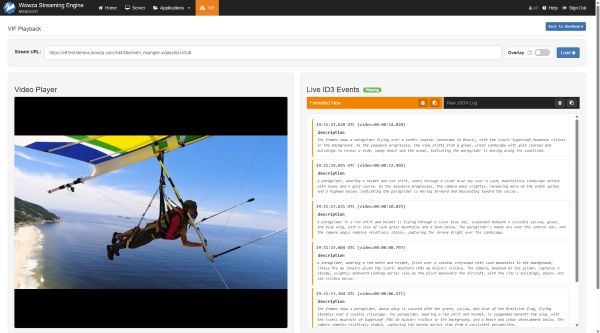
Vision-language model analysis answers open-vocabulary questions in plain language. VLMs offer natural-language flexibility and richer reasoning at higher compute cost per evaluation. You describe what matters and can ask it to identify things like, “Tell me when smoke appears.” Metadata generation, content discovery, and clip and highlight workflows sit here.
Synthetic video is becoming easier to create, plus it’s getting harder to tell what’s AI-generated from what’s real. VIF can run NVIDIA Synthetic Video Detector (SVD) to return a per-window score against a configurable threshold. SVD then gives you an indicator as to whether a live window shows signs of AI-generated or manipulated video.
No single model class wins across use cases. Pretending otherwise is how platforms trap customers. Each path carries its own cost profile and its own failure mode. Production systems often combine them, using object detection for precise localization and a vision-language model for validation or additional context.
You can then pass results downstream as enriched HLS with in-band ID3 timed metadata, burned-in overlays, JSONL logs, webhooks, and custom Java listeners. The delivery mechanism stays consistent. The result schema varies by detector.
What matters here most isn’t the single detection. The output of a video pipeline stops being just video and becomes a stream of structured events you can query and act on. Video is finally becoming a reliable source of data for ops teams.
Compute Is The Bill You Can Actually Control
GPU capacity is the operating cost that scales with feed count. Running inference on your own GPUs against sampled frames converts an unbounded cloud inference bill into a budget you can plan around.
Real throughput depends on the GPU, source resolution, sampling rate, concurrent stream count, overlays, and every other workload sharing the system. Our object detection ships in several model sizes. Larger variants improve accuracy, particularly on small objects, at the cost of more GPU memory and time per frame. We recommend testing representative production footage, measuring the errors that matter to the workflow, and selecting the smallest variant that clears the accuracy requirement. Sampling rate is a lever on the same axis. A vision-language model invoked on just one event costs a fraction of one you invoke continuously.
The bill isn’t only GPU time. Signals and events travel upstream instead of continuous raw video, which cuts bandwidth cost and the energy of moving those bits.
Reliability And Control Come First
GPUs spike. Models crash. New model versions misbehave in ways staging never could’ve predicted. When a model endpoint becomes unreachable, live streams continue uninterrupted because inference runs out of band from delivery. We treat stream uptime and analysis completeness as separate service objectives, and operations teams should measure them separately. Anyone who has operated always-on video services knows why this separation is non-negotiable.
Deployment control follows the same logic. VIF runs wherever Wowza Streaming Engine runs, including on-premises, at the edge, in hybrid topologies, in the cloud, and inside fully air-gapped networks that allow no internet connectivity at runtime. Rights-restricted content and contribution feeds that can’t leave a facility stay inside its walls.
The Practical Recommendation
Choose the analysis path from the decision the operation needs to make. Validate it against the video the operation actually runs rather than a published benchmark. Right-size the model to the accuracy the workflow requires, and keep the analysis inside the infrastructure already carrying the stream.
Systems that understand video won’t (and can’t) replace human judgment. These systems watch every feed continuously, surfacing the moments that deserve attention. The value comes from removing steps, not removing humans.
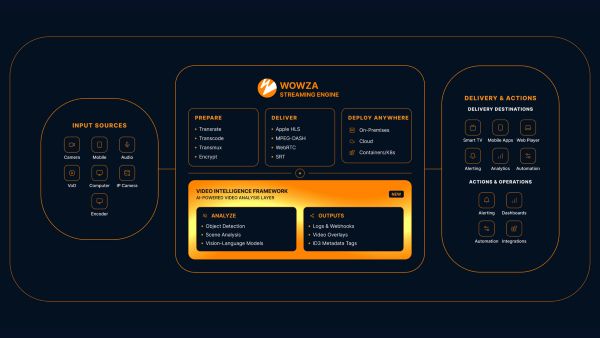
The Wowza Streaming Engine and Video Intelligence Framework architecture at a glance.
Using Wowza’s Video Intelligence Framework with a vision-language model (VLM) to generate descriptions of video feeds in natural language.
Latest IAMT News

Globecast Brings Media Orchestration and C-Band Transition Expertise to NAB Show New York 2026
IAMT™ CEO Update: – MediaTech Redefined: Driving Member Momentum and Impact into IBC 2026

Sign-Up Here
Industry news, event updates and more. Sign-up for the IAMT Newsletter.