WideOrbit – Efficiency by Design: Radio Automation Enters Its Cloud-Powered Era
Efficiency has become the defining constraint on radio operations. Multi-market groups are running more stations with leaner teams. Talent works from home studios, remote venues, and shared regional hubs rather than a single flagship building. And technology leaders across the industry are being asked the same question: how can we do more without doing more manually?
The answer taking shape across the industry is a shift toward end-to-end, cloud-based workflows; radio automation platforms that consolidate what was previously a patchwork of hardware, software, and on-call engineering support into a single managed service. It’s a shift that improves the speed at which a station can launch, how quickly talent can get on air from anywhere, and how much of an engineering team’s time goes toward strategic work rather than maintenance.
Reduce Technical Overhead, Improve Efficiency
Many broadcasters have already moved away from the fully equipped, single-building station model, distributing operations instead across smaller footprints or shared hubs. But even a pared-down setup still depends on a surprising amount of infrastructure running behind the scenes — automation software installed locally, mixing consoles and supporting fabric, dedicated codecs to move audio between locations, and racks of servers that need patching, monitoring, and troubleshooting.
None of that overhead disappears just because the physical footprint shrinks. Engineering teams remain on call around the clock to keep everything running, even as they’re asked to support more stations with fewer people. That’s the efficiency gap cloud-powered automation is designed to close. Instead of just shifting the burden to a central location or asking broadcasters to do more with less, cloud-powered automation removes layers of infrastructure that consume time, attention, and effort that could be better spent improving the listener experience.
Automation as an End-to-End Workflow, Not a Point Solution
The industry’s approach to automation has historically been a patchwork of “best-of-breed” point solutions – mixing consoles from one vendor, codecs from another, and automation software from a third, all integrated and maintained separately. That approach still has a place, particularly for stations with specific regulatory, data-residency, or infrastructure requirements that favour on-premises control. But for a growing number of broadcasters, the priority has shifted toward consolidation, requiring fewer systems to integrate, fewer vendors to coordinate, and fewer points of failure to troubleshoot when something goes wrong at 3:00 a.m.
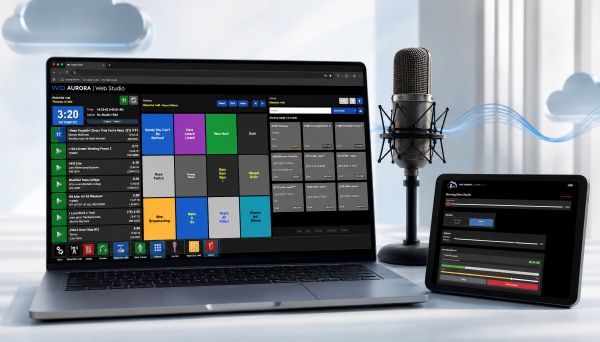
WideOrbit’s WO Aurora platform is one example of how vendors are responding to that shift. Rather than retrofitting existing on-premises software for the cloud, WO Aurora was built as a cloud-powered SaaS platform from the outset, with automation, mixing, and audio transmission handled natively within the service rather than bolted on through separate hardware. Its Web Studio interface brings core automation functions into a browser, removing the need for locally installed software or VPN access for remote work. A companion capability, Live Mic, extends that further by letting talent broadcast live from anywhere — from a festival stage, a press conference, or a town square — using just a microphone, a laptop, and an internet connection, with no codec, separate mixing console, or engineering support required.
The operational impact is speed and efficiency: stations can be provisioned and on air faster than a traditional infrastructure build would allow, and updates or patches roll out automatically across every location at once rather than requiring a site-by-site maintenance schedule.
Deployment Flexibility Matters as Much as the Technology
No single deployment model fits every broadcaster, and platforms need to account for that. WO Aurora, for instance, supports three paths: staying fully on-premises for stations with existing infrastructure investments or regulatory constraints; a hybrid approach that runs on-premises and cloud infrastructure side by side, useful for broadcasters looking to test cloud hosting before committing fully, or for multi-market groups modernizing at different speeds across the organization; and fully cloud-hosted for broadcasters ready to embrace modernization. That flexibility allows efficiency gains to be phased in rather than being forced through an all-or-nothing migration.
Efficiency, Cost, and Sustainability Converge
The efficiency case for cloud-based automation is closely tied to the financial one. Moving from CapEx-heavy, on-premises builds to an OpEx-based subscription model reduces the upfront capital investment required to launch a station, while also insulating operators from hardware price volatility, a real concern as global demand for computing infrastructure has pushed server and component costs upward. There’s a sustainability dimension as well, since consolidating infrastructure onto shared, professionally managed cloud environments uses hardware more efficiently than individual on-premises server rooms that typically run below capacity.
Where This Leaves Broadcasters
The through-line across these developments isn’t simply that cloud-powered radio automation is cheaper, though it often is. It’s that efficiency, in this context, means redirecting time and capital away from maintaining infrastructure and toward the work that truly differentiates a station: programming, content, and audience engagement. As the technology stack becomes managed rather than built and maintained in-house, teams are free to focus less on day-to-day operations and maintenance, and more on the strategic decisions that shape what listeners hear.
For an industry under sustained pressure in terms of both revenue and cost, that reallocation of time and attention may prove to be the more durable efficiency gain, one that compounds with every station migrated to the cloud.
Latest IAMT News
Globecast Brings Media Orchestration and C-Band Transition Expertise to NAB Show New York 2026
IAMT™ CEO Update: – MediaTech Redefined: Driving Member Momentum and Impact into IBC 2026

Sign-Up Here
Industry news, event updates and more. Sign-up for the IAMT Newsletter.