Saranyu – The Media Engineer of Tomorrow: Building the Talent Stack for Intelligent Media

Suresh B G, Chairman, Founder, Saranyu Technologies Pvt. Ltd.
Media engineering is evolving from specialized technology silos into an interdisciplinary discipline spanning applications, cloud, video, data, AI, security and monetization. The media engineer of tomorrow must combine deep expertise with broad systems understanding, while applying FURPS principles across the entire technology stack. AI will reduce routine coding but increase the importance of architecture, judgment, troubleshooting and AI economics. Drawing on 15+ years of media engineering, Saranyu Technologies develops engineers through structured coursework, assignments, internships, product development, customer-facing projects, cross-functional rotations, AI-assisted development, rigorous code review, deployment and field support. The objective is to build adaptable media technologists capable of designing, operating and continuously improving intelligent media systems.
Media technology has evolved from discrete broadcast and streaming functions into a deeply interconnected engineering discipline. Yet many media organizations still operate in silos. An Android developer may understand mobile development but not Android TV; a frontend engineer may consume APIs without understanding the media backend; application developers may have limited exposure to deployment, CDN behavior, cloud economics or field troubleshooting. Specialists can be effective within their domains, while gaps between them create complexity, delays and cost.
The media engineer of tomorrow needs to be different.
From Technology Silos to Media Engineering
Specialization will remain important. But the modern media engineer needs to be T-shaped: deep in one discipline while understanding how the surrounding technology stack works together. Media engineering now spans operating systems, programming languages, applications, backend services, cloud, data, video technologies, AI/ML, cybersecurity, content management and monetization.
Engineering must also address FURPS: Functionality, Usability, Reliability, Performance, Scalability and Security. These cannot be late-stage checks; they must influence architecture from the beginning.
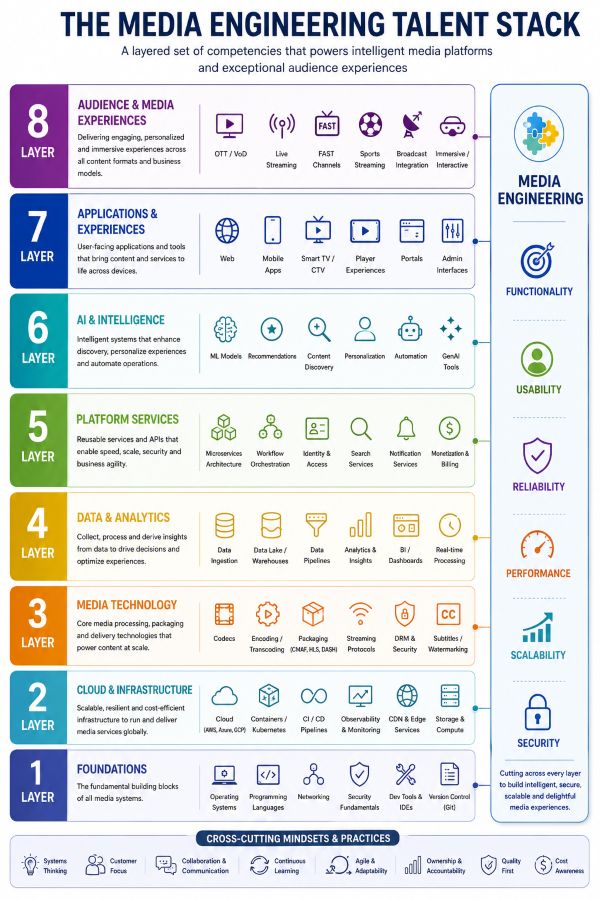
The talent stack therefore needs to be layered, from computing foundations and infrastructure through media processing, data, platform services, applications, intelligence and audience experience.
Figure 1. The Media Engineering Talent Stack
The diagram illustrates this breadth, with media engineering cutting across every layer and FURPS guiding decisions throughout.
AI Changes the Engineer, Not the Need for Engineers
Generative AI is reducing routine coding. Engineers can generate code, tests, documentation, prototypes and queries faster, helping them explore unfamiliar frameworks and adjacent technologies.
But AI does not remove the need for engineering understanding. It changes where that understanding is applied. Engineers need to know what should be built, what should be delegated to AI, how to validate generated output and when conventional engineering is better. They must understand architecture, security, reliability, performance and dependencies well enough to challenge AI-generated solutions.
AI also introduces an economic dimension. Model selection, token usage, inference cost, latency, caching and workload routing affect product economics. Knowing where AI creates value—and where it does not—is becoming a core engineering skill.
Learning to Build, Not Merely to Code
This evolution requires a different approach to developing talent. At Saranyu Technologies, this approach has emerged from more than 15 years of building and operating media platforms for real customers.
An engineer’s development is treated as a journey. It begins with structured coursework covering computing fundamentals, operating systems, networks, databases and media technology, followed by assignments and practical problems. Internships provide exposure to real systems and development practices.
Engineers then move into product development and customer-facing projects, learning requirements, trade-offs and the consequences of engineering decisions. They rotate through design, development and testing, creating ownership of the complete product lifecycle. They also gain deployment knowledge and experience handling field issues, because writing code without understanding production is incomplete engineering.
AI tools are incorporated into this journey rather than treated as shortcuts. Engineers learn code generation, test generation, documentation, analysis and productivity workflows alongside disciplined code-generation and review processes. Generated code still undergoes peer review, static analysis, testing and quality gates.
Every engineer therefore needs exposure to coursework, assignments, internships, product development, customer-facing projects, design, development, testing, AI-assisted engineering, code review, deployment and field troubleshooting.
This clarity comes from 15 years of media engineering. Building real products and supporting them in production has demonstrated that technical depth alone is insufficient; engineers need breadth, ownership and practical exposure.
Troubleshooting Remains a Critical Human Skill
AI can be an excellent copilot when a problem is clearly described. Production troubleshooting, however, often begins with incomplete information: an intermittent playback failure, device-specific issue, latency spike, CDN anomaly or unexpected cloud cost.
Engineers need to observe systems, reproduce problems, isolate variables, examine logs, form hypotheses and communicate clearly. AI can assist, but it cannot replace the underlying ability to reason about complex systems.
The same applies to learning. When answers are instantly available, foundational understanding becomes more important. Continuous learning must include building, breaking, debugging and improving systems—not simply generating solutions.
Cost Is Also an Engineering Responsibility
Media systems operate at enormous scale, making cost optimization an engineering consideration. Compute, storage, CDN delivery, bandwidth, AI inference and operational overhead can materially affect platform economics.
Engineers therefore need to understand the cost consequences of architectural choices and balance functionality, experience, performance and scale against operational economics.
Building the Next-Generation Media Engineer
The media engineer of tomorrow will need familiarity with mobile and Smart TV platforms, broadcasting and streaming architectures, protocols, codecs, encoding and packaging, cloud computing, microservices, data and analytics, AI/ML, content discovery, UI/UX, monetization, cybersecurity, DRM, Anti-piracy solutions and content management.
No individual needs expertise in all these areas. The goal is broad systems understanding combined with deep expertise in a chosen discipline.
Saranyu’s 15 years of media engineering experience has made one lesson clear: the best media engineers are not simply specialists in a technology. They understand how technologies connect, how decisions affect the system, and how to take ownership from design through production.
The future of media engineering will depend not only on better tools, but on a better talent stack—engineers who learn continuously, use AI intelligently, optimize relentlessly, troubleshoot deeply and build systems that are functional, usable, reliable, performant, scalable and secure.
Latest IAMT News

Globecast Brings Media Orchestration and C-Band Transition Expertise to NAB Show New York 2026
IAMT™ CEO Update: – MediaTech Redefined: Driving Member Momentum and Impact into IBC 2026

Sign-Up Here
Industry news, event updates and more. Sign-up for the IAMT Newsletter.