
Mnemonica – The Drama of the KDM that Fails at Showtime
Piero Constantini, Mnemonica
Can a peer-to-peer network fix the problem with cinema projectors’ outdated certificates? Mnemonica launches an innovative model where trust in a certificate is earned through use, not granted by a gatekeeper?
There is a particular kind of failure that everyone in digital cinema distribution knows and dreads: the KDM that doesn’t work. The DCP is ingested, the show is sold out, the audience is filing in — and the key that should unlock it is rejected. A problem invisible for months becomes, minutes before a screening, the most urgent thing in the building.
Trace that failure back far enough and it almost always ends in the same place: the media-block certificate.
A KDM — the Key Delivery Message that carries a film’s decryption keys — is not addressed to a cinema but to a specific piece of hardware: the media block inside a projector, identified by its X.509 certificate. Those certificates are issued by the device manufacturers, and to build a valid KDM a distributor needs the exact current certificate of the device that will play the film. Supply a stale one and the key is useless.
Here is the structural weakness. The certificate databases distributors rely on are effectively anonymous, and almost never current. Media blocks get replaced, certificates renewed, hardware moved between screens — and none of it propagates on its own. The distributor is often working from a snapshot that was already stale when it was taken. The result is that showtime failure, repeated across thousands of screenings a year — support calls, re-issued keys, frayed nerves.
The industry’s response, so far, has been to concentrate the problem rather than solve it. A small number of large facilities take on the job of maintaining the master list by hand — chasing cinemas and keeping a private database current through sheer manual effort. It works, up to a point. But it also quietly turns those facilities into gatekeepers. Whoever holds the most complete database holds a kind of authority over who can reliably deliver content and who cannot. Efficiency bought through manual labour tends to consolidate: the more painful the task, the fewer players willing to do it, and the more the market bends around them.
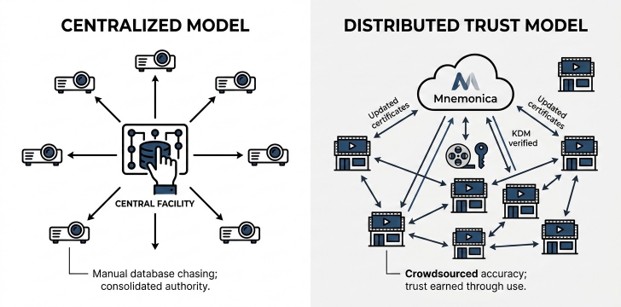
There is another way to think about it, and it starts by asking who actually knows the truth about a cinema’s equipment. Not a distributor. Not a central facility. The cinema itself. It is the only party that always knows, in real time, which media block sits in which screen and which certificate is valid today.
So let the cinema be the source of truth. In Mnemonica’s model, a venue keeps its own certificates current by uploading them directly to its own profile — no ticket, no intermediary, no waiting on someone else’s refresh cycle. The moment a media block is renewed or replaced, the current certificate is available to every Mnemonica user who needs it.
The interesting part is what happens to trust. In the old model, trust is asserted from the top: you trust the list because you trust the facility that maintains it. In the new one, trust is earned from the base. The certificate itself is shared by everyone who works with it; the context around it is not. Each user keeps a private record of which real-world screen a given certificate belongs to — precisely because that hardware can move, so a shared label would soon be wrong. When someone uploads a newer version of a certificate, everyone tracking it is notified, and each decides for themselves whether to adopt it. That choice is guided by the certificate’s visible, timestamped history: how recently it changed, and how many others have used it to deliver working keys. Adoption becomes evidence, not assertion. A certificate that many independent parties have relied on is, in a very practical sense, a trusted one.
Anyone who has encountered a web of trust will recognize the shape of this. Rather than a single authority vouching for every identity, confidence accumulates through use and corroboration across the network. Each successful delivery is a small signature of confidence, and those signatures compound. The cryptography keeps it honest: because a certificate is pinned to the exact key of the exact device, a legitimate renewal is recognized as the same device, and a substitution cannot pass for one.
The efficiency gains run in the right direction. Certificate updates happen at the edge, in real time, by the party with the best information — collapsing the lag that produces showtime failures. Distribution becomes a cloud-native, self-service workflow instead of a chain of emails — and because the knowledge is distributed, it grows more accurate with use, not more brittle.
None of this is meant to unseat the incumbents. The largest distributors will keep working through established gatekeepers, and rationally so — their volume agreements already absorb the cost. The problem falls on everyone else: the independent distributors and rights-holders for whom a full relationship with a central authority is far too costly for the handful of titles they move. They are who Mnemonica is built for — a studio-grade content hub for indies — letting DCPs circulate efficiently, affordably, with no intermediary in the middle.
Festivals feel it most sharply. A single program can gather films from dozens of distributors across as many countries, each with its own certificate to chase and its own keys to line up against an unforgiving schedule. One hub that receives and archives every DCP and issues every key turns that scramble into a routine — for a festival team, the difference between firefighting and programming.
For two decades, the burden of keeping certificates current pushed the industry toward centralization — and whoever held the master list held the power. Mnemonica is built the other way: open and peer-to-peer, where trust in a certificate is earned through use, not granted from above. With Mnemonica Archive, anyone can store and share DCPs in the cloud and generate their KDMs from the same place — no facility to route through, no gatekeeper in the middle. Key delivery, at last, as efficient and open as the supply chain around it.
Latest IAMT News
Globecast Brings Media Orchestration and C-Band Transition Expertise to NAB Show New York 2026
IAMT™ CEO Update: – MediaTech Redefined: Driving Member Momentum and Impact into IBC 2026

Sign-Up Here
Industry news, event updates and more. Sign-up for the IAMT Newsletter.