LOGIC media solutions – The Architecture of Choice
Why the next evolution of the media platform goes beyond interoperability

Thomas Pister, LOGIC media solutions GmbH
The media industry has been going through a technology shift. IP, virtualization, software and cloud infrastructure have loosened the link between broadcast functionality and dedicated hardware.
But the more interesting change is happening one layer deeper. We are no longer only asking where an application should run, but how tightly media, functionality and infrastructure need to be coupled.
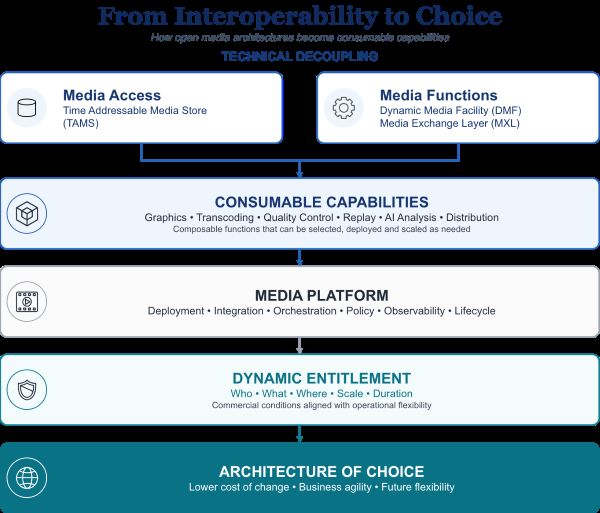
This is where the Time Addressable Media Store (TAMS) and the Dynamic Media Facility (DMF), including its Media Exchange Layer (MXL), become relevant. They address different layers but point in a similar direction: media and media functions can become less constrained by individual products and systems.
That is significant. But I would argue that the real evolution starts with what comes next. If media becomes independently accessible and media functions can work together on shared infrastructure, why should deployment, operations and commercial usage continue to follow the rules of static systems?
A composable media function has limited value if deployment still takes days or weeks, every integration becomes a new project, or its license remains tied to a particular machine. The next step is to turn interoperable media functions into consumable capabilities: deployable, integrable, scalable and commercially usable.
From Systems to Capabilities
Broadcast technology has traditionally been built and purchased as systems. Composable architectures change that unit of choice. Instead of replacing an entire system, an organization may need another capability: transcoding, graphics, quality control, replay, artificial intelligence (AI) analysis or distribution.
TAMS is a good example at the media layer. If time-based media can be addressed independently of the application managing it, that application becomes more of a consumer and processor of media and less its proprietary home. DMF and MXL loosen the fixed relationship between media functions and individual systems.
But technical decoupling alone does not deliver agility. We could recreate the old broadcast-box model in software: fixed software stacks, static deployments and commercial models designed for permanent installations. The technology would look modern. The operating model would be remarkably familiar.
Cloud-Native is Not a Location
Cloud-native should not become shorthand for public cloud. Depending on the workload, latency, security, regulation, data gravity or economics may favor public cloud, private cloud, on-premises or edge infrastructure.
What matters is the ability to choose. Cloud-native should describe how a capability can be deployed and operated, not prescribe where it must run. Deployment becomes less about installing an application and more about deciding which capability is required, where it should run and for how long.
More Composability Requires More Platform
Composable architectures promise greater independence, yet they also create a stronger need for a platform. The more functions can be combined and replaced independently, the more important it becomes to manage the resulting complexity.
The media platform does not need to own every media function. Its job is to make capabilities usable while deployment, integration, security and lifecycle management work consistently in the background.
Infrastructure as Code has shown the value of reproducibility. The same principle should apply to integrations, policies and service configurations. An integration solved once should not become another engineering project six months later. Otherwise we have moved, not removed, complexity.
When the License Cannot Move
Licensing is still surprisingly absent from architecture discussions.
Consider a live production that needs additional processing capacity for three hours. Infrastructure can be provisioned automatically, the media function can start within minutes, and the workflow can adapt dynamically. Then someone discovers that another license file is required, an additional instance must be enabled manually, or the license is tied to a particular host.
The contradiction is clear: the architecture is dynamic, but the commercial model is not. The question is not which licensing model is right, but whether it can move with the architecture.
From a platform perspective, this is where entitlement becomes relevant. The platform needs to understand not only whether a capability can be started, but whether it may be used by this customer, for this workflow, at this scale and for this period.
Deployment makes a capability operationally available. Entitlement makes it commercially available. If only one can respond dynamically, the platform is not as elastic as the architecture suggests.
Perhaps We Are Measuring Efficiency in the Wrong Place
Cloud-efficiency discussions focus on compute utilization, storage and infrastructure spend. Those metrics matter, but another measure may be more strategic: the cost of change.
What happens when a broadcaster wants to introduce a service, add a capability for a one-off event, move a workload or replace part of the supply chain? Does that take hours, days or another six-month integration project? And does the licensing model move with it?
The bigger efficiency gain may not be that today’s production becomes cheaper. It may be that tomorrow’s change no longer requires starting from scratch. Reusable integrations, automated deployment and open interfaces reduce the friction of change.
The Next Evolution is Choice
TAMS, DMF and MXL are important foundations for a new generation of media architectures. They loosen dependencies between media, applications, functions and infrastructure that were almost unavoidable in vertically integrated systems.
But interoperability should not be the end point. The next step is to turn that technical freedom into operational and commercial freedom. A media function needs to be deployable, integrable, scalable and commercially consumable when and where it is needed.
This is not about eliminating every dependency. Complete vendor independence is neither realistic nor desirable. Architecture involves choices and trade-offs. The problem begins when today’s choice unnecessarily becomes tomorrow’s constraint.
Perhaps that is the real meaning of an Architecture of Choice: judging a media platform not by how modern its technology stack looks or how much of it runs in the cloud, but by how many options it leaves open for what comes next.
The defining question for the next generation of media platforms may not be where they run today, but how difficult it will be to make a different decision tomorrow.
If you would like to get involved as an IAMT member or end-user, join our IAMT Dynamic Software Licensing working group – https://theiamt.org/groups/dynamic-software-licensing/”
Latest IAMT News

Globecast Brings Media Orchestration and C-Band Transition Expertise to NAB Show New York 2026
IAMT™ CEO Update: – MediaTech Redefined: Driving Member Momentum and Impact into IBC 2026

Sign-Up Here
Industry news, event updates and more. Sign-up for the IAMT Newsletter.