
EasyTools – Rethinking Video Infrastructure for the Profitability Era

Christophe Massiot, Founder & CEO, EasyTools
Profitability is increasingly important for broadcasters and service providers, but often elusive. Pressures on margins come from every direction: rising costs for both energy and content rights, coupled with the constant demand to maintain exceptional quality and reliability at scale. In this environment, reducing costs can’t simply mean choosing the cheapest components. That often backfires, degrading performance, increasing operational risk, and ultimately costing more when things go wrong.
Instead, we must identify where the real costs lie, then completely rethink how video infrastructure is designed, operated, and evolved. No easy feat, but one that has already been done in the past.
When Video Was Expensive: The Analogue Assumption
Once upon a time, video infrastructure meant dedicated broadcast systems. Analogue signals travelled over dedicated distribution networks such as satellite and cable. Building and operating these networks could cost millions of dollars, because it required large-scale transmission and distribution infrastructure: uplink facilities and managed satellite capacity on one side, and extensive physical network plant (including headends and last‑mile cabling) on the other.
The Digital/IP Turning Point
Then, in the mid-1990s, a small group of engineering students in Paris explored a different route: digital video delivered over IP networks. This idea was already gaining momentum across parts of the industry, but these students made it practical and accessible, turning it into software that people could deploy and use. Out of that work came VLC Media Player, one of the most widely used pieces of software in video technology, which has been downloaded billions of times.
From Appliances to Software-Based Tools
Then came another evolution: the move from appliances to software-based tools. Instead of being locked into fixed, pre-defined feature sets, software tools can grow with your needs. They can add new capabilities when required, without forcing you to replace entire installations.
On top of that, software-based tools enable remote monitoring and control.
This matters because every live event is different. Ingest formats vary. Encoding profiles differ. Timing requirements change. Delivery destinations and distribution constraints shift. Under an appliance model, teams need to go on-site to reconfigure multiple devices, spending valuable time managing event-specific complexity.
With software-based tools, those event-specific differences can be managed centrally and remotely. Beyond simplifying operations and cutting travel costs, this makes it possible to set up live events in completely different geographical areas on the same day.
Silos Are Expensive
Even when teams adopt software tools, cost problems can persist, especially when organizations build their infrastructure as a collection of best-of-breed components.
This approach often creates silos: one set of tools for ingest, another for encoding, another yet for delivery, and yet another for monitoring and management. The resulting integration work becomes a new form of overhead. On top of that, teams may end up having to buy and integrate specialized, niche tools to meet one-off requirements for various live events.
All this leads to increased expenses in procurement, maintenance, integration, training, and troubleshooting.
So the question becomes: how do you adapt to ever-changing requirements without multiplying the number of tools and layers of technology?
Software Frameworks for Tailored Workflows
Many broadcasters and service providers are still struggling with that question.
After going from analogue to digital signals, then from hardware appliances to software-based tools, the next frontier for reducing the cost of video infrastructure takes abstraction one level further. Imagine a software framework that can create tailored workflows using a single API to control tens of functionalities. That way, each workflow can meet a different set of needs, while maintaining simplicity by incorporating only the functionalities it really needs.
Once an event is over, a new workflow can be created quickly, remotely, and with no extra investment, to meet a new set of requirements.
The beauty of such a system is that it also enables broadcasters and service providers to dynamically reallocate licences bought for one functionality to a different functionality as their needs change. Use your licences for encoding today; use that same license for monitoring tomorrow. No extra equipment to be bought. Nothing is wasted.
Making Video Infrastructure Affordable
During my days as an engineering student, I was one of the co-founders of the VLC Media Player project, and the mission was clear: make video infrastructure affordable. Today, I’m continuing that same mission through EasyTools.
EasyTools offers a software framework that lets broadcasters and service providers create tailored workflows. Instead of assembling a patchwork of niche components for every scenario, teams can adapt their video infrastructure as their needs change—so they spend less time integrating, and less money maintaining what they’ve built.
And because our framework is software-first, it can also run in virtualized environments and in the cloud. For some use cases, that further reduces the cost and complexity of scaling infrastructure.
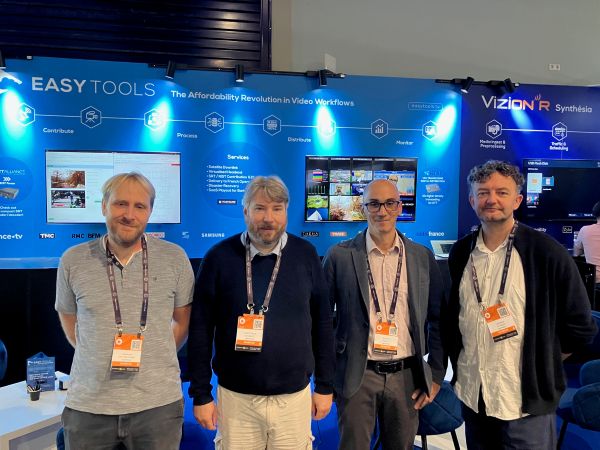
The EasyTools team showcasing its affordability revolution at IBC 2025
Practical Optimization at IBC
At IBC, I often see the industry focus on innovation: new codecs, new formats, new delivery methods. Those are important, of course. But the commercial question I keep coming back to is simpler than that.
Profitability doesn’t come from innovation alone. It comes from flexible execution: running infrastructure efficiently, delivering reliably at scale, and adapting quickly when every event brings a new mix of requirements.
That’s why we built EasyTools. Instead of treating infrastructure as a rigid monolith, we offer a software framework to create tailored workflows: creating the right infrastructure per event while reducing the friction and cost that come from siloed, tool-by-tool integration.
The path to profitability isn’t mysterious. It starts with rethinking video infrastructure as an adaptable system, not a collection of fixed appliances.
EasyTools is bringing that approach to the IAMT community, and I’m looking forward to engaging with peers across the industry at IBC.
Latest IAMT News

Globecast Brings Media Orchestration and C-Band Transition Expertise to NAB Show New York 2026
IAMT™ CEO Update: – MediaTech Redefined: Driving Member Momentum and Impact into IBC 2026

Sign-Up Here
Industry news, event updates and more. Sign-up for the IAMT Newsletter.