dzjinius – Doing More With Less: How Unified Production Management is Reshaping Efficiency in Media and Entertainment
Tighter budgets and fragmented toolchains have made production management an operational question rather than a back-office one. What is driving the shift and what does it take to get the benefit?
The Economics Behind the Efficiency Push
The correction that followed peak TV has settled into a structural condition rather than a passing dip: declining linear advertising, fragmenting audiences and rising content costs are forcing broadcasters and production houses to do more with less.
That overhead is where the argument for platform consolidation begins. Efficiency here rarely comes from making crews work faster on set. It comes from removing friction between departments: the re-keying, the version confusion, the reconciliation of a schedule against a budget against a call sheet, each typically living in a different file owned by a different person.
Where the Friction Actually Sits
A mid-sized drama production still commonly runs on a stack assembled by habit: scheduling in one specialist tool, budgeting in another, scripts in a third, casting in shared drives and email, and spreadsheets bridging the gaps. Each handoff is a manual transcription, and each transcription is an opportunity for divergence. When a location falls through on a Tuesday, the cost of the change is not the rescheduling itself but the cascade — revised strips, revised day-out-of-days, revised cost report, revised call sheets, revised crew notifications — performed by hand, under time pressure, across systems that do not know about each other.
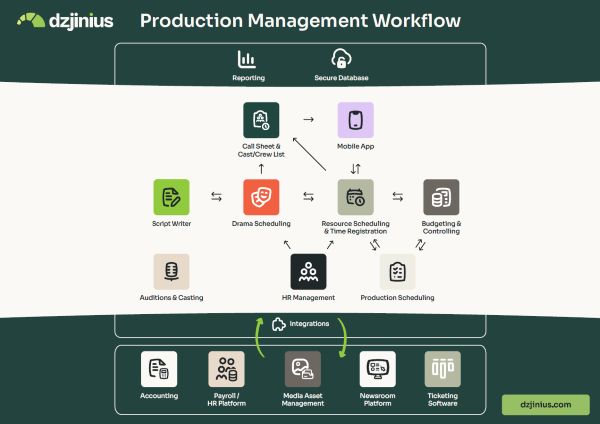
This is the gap that unified production management platforms target. Vendors in the category, among them Belgium-based dzjinius, converge on a similar proposition: bring scheduling, budgeting, scriptwriting, casting, resource planning and reporting into one environment so that a change entered once propagates everywhere it matters. dzjinius positions itself explicitly around this single-source-of-truth model across drama, entertainment, news, sports and live events.
Continuing drama shows the problem at its most extreme. A single soap or daily routinely delivers 200 to 300 episodes a year, the equivalent of around seventy feature-length films, all happening simultaneously. Four to six units may shoot in parallel, sharing talent, sets, crew and equipment; scripts run through five, ten or twenty drafts; rules on minors and turnaround add further constraints. Historically this has been managed with specialist tools plus manual process: scripts in one system, story documents in another, schedules in a third, and in some cases printed scene breakdowns pinned to a wall and re-keyed by hand at the end of a shooting day.
Those workflows were built for a slower cadence. As output has risen, the gaps between systems have become the main source of duplicated effort, and one small error now ripples across every department.
Four Trends Shaping the Response
Consolidation onto a single data model. The clearest shift is away from point solutions toward platforms where scheduling, budgeting, scriptwriting, casting, resource planning and reporting share one dataset, so a change entered once reaches everywhere it matters. Vendors in this category — among them Belgium-based dzjinius, used on continuing dramas including Coronation Street, Emmerdale and Fair City — build their argument on that premise.
Structured metadata as the precondition for AI. Trade analysis agrees that AI has moved from experiment into operational use — metadata tagging, transcript generation, scheduling support. Its value, though, depends entirely on the structure of the underlying production data, which a PDF, an email chain or a spreadsheet does not provide. Capturing script, schedule and resource information as structured data at the moment of creation is becoming an infrastructure decision rather than a reporting nicety.
Closing the office–set gap. Production offices increasingly run on connected data, but that structure is usually lost the moment information reaches the floor, where teams fall back on spreadsheets, messaging apps, PDF mark-up and handwritten notes. Tablet-first, offline-capable capture on set is one of the last places a large manual gap can still be removed, and which dzjinius will cover in S2 2026.
Open architectures and step-by-step adoption. Modular deployment and open APIs are gaining favor, partly on cost grounds and partly to avoid lock-in. Workflows should be assembled from interoperable components sharing common metadata rather than stitched together by hand. Buyers now ask what a system integrates with before they ask what it does.
What Separates Success From Disappointment
The case is strong, but the gain is not automatic. Three things decide whether it materializes.
Capture data where the work happens. A single source of truth only holds if information enters the system where it is created: in the script, in the schedule, on the floor. If one department keeps a parallel spreadsheet because the platform is awkward at their end, the production has two versions of the truth and more work than before. Coverage across the whole chain therefore matters more than depth in any one module.
Look at the data model, not the feature list. Several tools behind one login recreate the old fragmentation with a better interface. What delivers is a shared structure in which a scene, a cast member, a shooting day and a cost line mean the same thing to every department. That structure is what makes accurate reporting, clean handover to post and any serious use of AI possible.
Treat it as an operating-model change, not an IT purchase. Big-bang migrations mid-production fail; modular, department-by-department adoption does not. Software will not repair unclear decision rights or conversations held in private threads. Teams that get results credit the discipline adoption forced on them as much as the tool.
The bottom line
Complexity is now permanent in this industry. More content, more partners, more platforms and none of that is reversing. The efficiency gain therefore comes not from fighting complexity, but from managing it on one shared structure rather than a dozen disconnected ones. That is a change in how a production is organized as much as in what software it runs and best done step by step, with each stage measured against where the team started.
Latest IAMT News
Globecast Brings Media Orchestration and C-Band Transition Expertise to NAB Show New York 2026
IAMT™ CEO Update: – MediaTech Redefined: Driving Member Momentum and Impact into IBC 2026

Sign-Up Here
Industry news, event updates and more. Sign-up for the IAMT Newsletter.