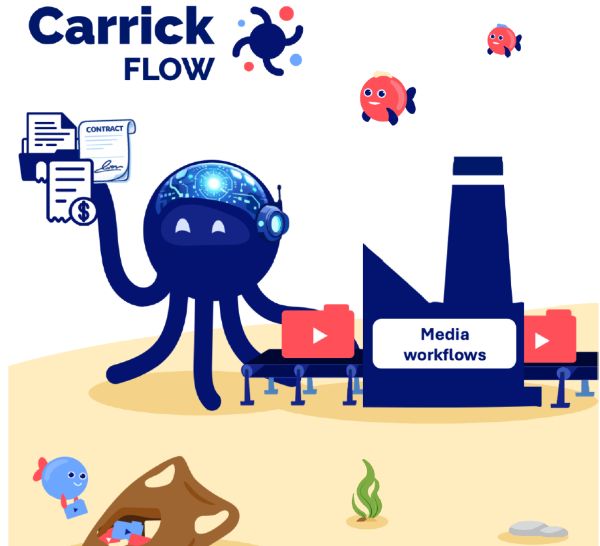
Carrick-Skills – The next step in media workflow Efficiency
For the last ten years, Carrick-Flow has helped media organizations improve operational efficiency by orchestrating complex file-based workflows across the entire media supply
chain.
By connecting heterogeneous systems and automating repetitive operations, from ingest and processing to delivery and archiving, the platform enables organizations to streamline operations across on-premises, cloud and hybrid environments. Over the years, workflow orchestration has significantly reduced manual processing, improved operational visibility and helped teams manage demanding production environments with greater speed and consistency.
The rapid adoption of Artificial Intelligence has opened new opportunities to improve efficiency even further. Today, AI is already embedded in many media workflows, helping automate individual processing tasks such as subtitle generation, metadata enrichment, content analysis and other repetitive operations. These applications deliver clear operational benefits and have become an important part of modern media workflows.
However, we believe AI can contribute to media workflows efficiency in a different way. Rather than focusing solely on individual processing tasks, AI can help optimize how
operational resources are managed and how decisions are made across the entire media supply chain.
Working alongside broadcasters, production companies and media service providers, we observed that sometimes operational challenges also come from making the right decisions at the right time. Some workflows require decisions that depend more on business context than on predefined technical rules. Should a delivery be prioritised because of a specific contractual commitment? Does an ingest require a specific process that was agreed ? Should an exception be applied because of editorial urgency or an internal operational policy?
These information are essential to keep operations running efficiently, yet they may not be registered within systems that trigger the workflows and therefore not submitted to the media supply chain. Instead, companies rely on enterprise knowledge accumulated over time by operational teams. This knowledge may be distributed across systems, contracts, internal documentation or simply exist because of the experience of the people supervising the media supply chain.
Even experienced operators rarely have immediate access to every piece of information that could influence a decision. Relevant knowledge is often fragmented, informal or dispersed across multiple systems, making fast and consistent decision-making difficult.
Carrick-Skills
As organizations grow, this model becomes difficult to scale. More content, more platforms, more delivery requirements and more distributed infrastructures mean that operational teams must process a growing number of exceptions while making faster decisions. Although workflows execute technical tasks e:iciently, enterprise knowledge remains human-driven, creating delays, inconsistencies and unnecessary manual intervention.
This observation led us to explore a different application of artificial intelligence. Rather than using AI solely to automate individual processing tasks, we believe it can play a broader role in improving operational e:iciency by helping workflows access the business knowledge they need to support better decisions.
By interpreting enterprise data and making relevant information available throughout workflow execution, AI can help prioritize operations, provide contextual information and support intelligent arbitration whenever business rules influence how content should move through the media supply chain. The objective is not to replace human expertise, but to make it available where it creates the greatest operational value, directly within the workflow itself.
To address this challenge, Carrick-Skills is introducing AI Copilot. Integrated into Carrick-Flow as a new AI plugin, AI Copilot is designed to leverage enterprise knowledge throughout workflow execution. It interprets enterprise data, enriches workflow context and supports intelligent arbitration, allowing workflows to consider business priorities, contractual obligations and organizational practices alongside technical execution. For us, this represents the next stage in workflow efficiency.
For years, automation has focused on executing tasks faster. The next opportunity is to help organizations make better operational decisions faster, more consistently and with the right business context.
Latest IAMT News
Globecast Brings Media Orchestration and C-Band Transition Expertise to NAB Show New York 2026
IAMT™ CEO Update: – MediaTech Redefined: Driving Member Momentum and Impact into IBC 2026

Sign-Up Here
Industry news, event updates and more. Sign-up for the IAMT Newsletter.