
Ateme – Efficiency Is the New Competitive Advantage in Media
Jean-Louis Lods, Ateme
Efficiency has moved beyond back-office cost control. In today’s media market, it determines how quickly organizations can adapt, scale and compete.
For years, media organizations treated efficiency as a back-office objective. Success was measured by audience growth, content acquisition, channel launches, or technology innovation. Efficiency was important, but rarely strategic.
That has changed.
Today, the most successful media companies are not necessarily the ones with the largest infrastructure, the biggest budgets, or the most channels. They are the organizations that can adapt fastest to changing audience behavior, fluctuating demand, and evolving business models while maintaining quality and controlling costs.
Efficiency has become a competitive advantage.
This shift is being driven by several converging trends. Streaming audiences continue to grow. Distribution architectures are becoming more complex. Content volumes are increasing across linear, on-demand, social, and FAST services. At the same time, financial pressures remain intense as operators seek to balance innovation with profitability.
The challenge facing many organizations is no longer whether they can deliver content. It is whether they can do so efficiently enough to remain competitive.
Infrastructure Is Becoming More Flexible
Media infrastructure is not moving toward a single deployment model. Dedicated, on-premises platforms remain highly effective for predictable, sustained workloads where performance, control, security, and long-term economics are priorities.
The challenge appears when infrastructure designed for the baseline must also absorb exceptional peaks. Major sporting tournaments, elections, breaking news, and seasonal viewing spikes can require substantial additional capacity for relatively short periods.
Software-based technologies and cloud-enabled workflows give operators more choice in how that capacity is deployed.
Rather than choosing between permanent infrastructure and fully elastic services, organizations can match each workload to the most efficient model. Dedicated capacity can support stable day-to-day demand, while private cloud, public cloud, or hybrid resources provide additional scale when demand rises.
This is as much a financial decision as a technology decision.
Capital investment remains compelling for predictable, high-utilization services. Consumption-based capacity can be more efficient for variable, temporary, or fast-growing workloads. The competitive advantage comes from combining these models intelligently rather than treating one as the universal answer.
Efficiency comes from deploying the right capacity, in the right environment, at the right time.
Automation Is Becoming Essential
As workflows become more distributed, operational complexity increases.
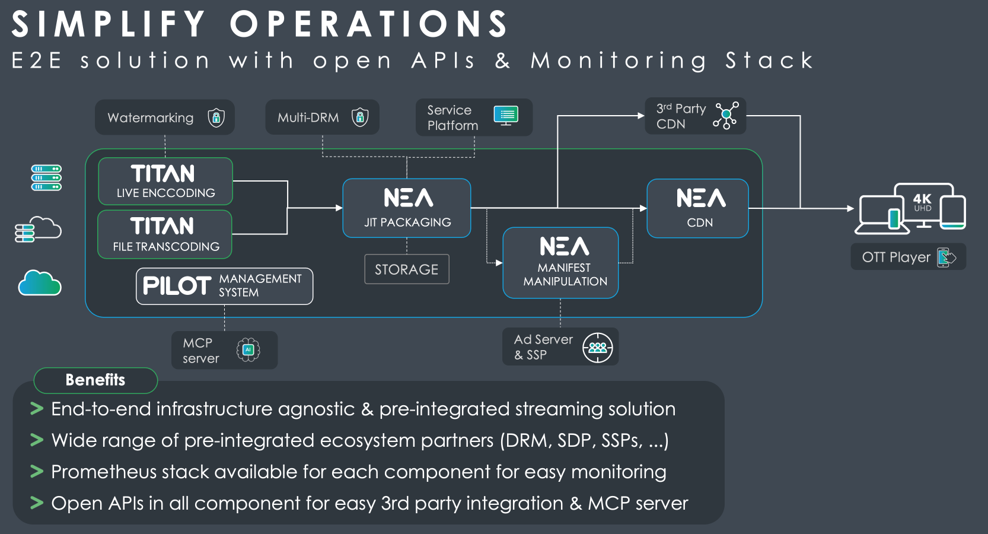
A single service may involve content acquisition, processing, encoding, packaging, origin services, content delivery networks, advertising technologies, analytics platforms, and monitoring systems, often spread across multiple sites and cloud providers.
Managing these environments manually is increasingly impractical.
Automation is rapidly becoming one of the industry’s most important efficiency tools.
Modern media operations are using orchestration, policy-driven management, automated quality monitoring, and AI-assisted decision-making to reduce human intervention and accelerate operational response times.
The objective is not to replace expertise.
The objective is to allow talented teams to focus on high-value activities while routine operational tasks occur automatically.
As content volumes continue to grow, automation will increasingly determine whether organizations can scale efficiently.
Efficiency Extends Beyond Technology
One of the industry’s biggest realizations is that efficiency is not solely a technical conversation.
Understanding audience behavior is becoming just as important.
Viewer consumption patterns continue to evolve. Audiences move fluidly between devices, platforms, and viewing environments. Traffic profiles can change dramatically during major live events. The ability to anticipate those changes enables operators to allocate resources more effectively and optimize delivery costs without compromising quality.
Data-driven decision making is therefore becoming a critical component of operational efficiency.
Organizations that understand audiences in real time can make smarter decisions about content preparation, distribution, infrastructure deployment, and service optimization.
Intelligence is increasingly driving efficiency.
Quality Remains Non-Negotiable
One misconception about efficiency is that it requires compromise.
In reality, the opposite is true.
Modern efficiency initiatives focus on delivering the desired outcome with fewer resources, not delivering a lower-quality experience.
This is clearly visible in video compression technologies. Improvements in encoding efficiency continue to reduce bandwidth consumption while maintaining or improving picture quality. Rather than pursuing higher resolutions at any cost, many operators are prioritizing Quality of Experience across reliability, latency, start-up performance, consistency, and visual quality.
Audiences ultimately judge services on their viewing experience, not on technical specifications alone.
The most efficient workflow is the one that delivers the required experience without unnecessary complexity or expense.
Sustainability and Efficiency Are Converging
Another important development is the growing alignment between sustainability objectives and operational efficiency.
Reducing unnecessary infrastructure, improving resource utilization, and optimizing energy consumption create both environmental and commercial benefits.
The relationship between efficiency and sustainability is becoming increasingly difficult to separate.
An efficiently designed workflow consumes fewer resources. It requires less infrastructure. It generates less waste. It often lowers operational costs while simultaneously reducing environmental impact.
For many media organizations, sustainability initiatives are no longer standalone projects. They are becoming a natural outcome of building more efficient operations.
The Competitive Advantage Is Operational
The media industry has never had access to more technology.
Yet competitive differentiation increasingly comes from how effectively organizations integrate and operate those technologies rather than from any individual product or platform.
The winning organizations are simplifying workflows while increasing flexibility.
They are automating repetitive tasks while empowering skilled teams.
They are scaling resources dynamically rather than permanently.
They are using intelligence to make faster and better operational decisions.
Most importantly, they are treating efficiency as a strategic capability rather than a cost-reduction exercise.
As the media landscape continues to evolve, efficiency will increasingly determine how quickly organizations can launch services, adapt to audience behavior, support new business models, and respond to market opportunities.
In an industry defined by constant change, efficiency is no longer simply about doing more with less.
It is about creating the agility to do more than the competition.
Efficiency is the new competitive advantage in media.
Latest IAMT News

Globecast Brings Media Orchestration and C-Band Transition Expertise to NAB Show New York 2026
IAMT™ CEO Update: – MediaTech Redefined: Driving Member Momentum and Impact into IBC 2026

Sign-Up Here
Industry news, event updates and more. Sign-up for the IAMT Newsletter.