
Xperity – The Missing Intelligence Layer in Modern Media Engineering
As media organizations race to deliver more content, engineering efficiency has become an important competitive advantage. Increasingly, that efficiency depends as much on engineering intelligence as it does on automation.

Amit Yadav, Senior Vice President of Engineering, Xperity
Media organizations are modernizing operations with a clear objective: deliver more content with greater speed, flexibility and operational efficiency.
The European Broadcasting Union has identified cloud technology as a transformational force across the media supply chain, enabling dynamic, software-defined production environments that are more agile, scalable and resilient than traditional broadcast infrastructure.
For companies developing media software, this transformation is changing both what products must do and how they must be engineered. As software becomes more interconnected, engineering teams spend more time locating information, tracing dependencies and reconstructing the reasoning behind prior decisions.
This “work behind the work” has become a significant barrier to engineering efficiency.
Media Software Products Are Built as Interconnected Ecosystems
Media software companies no longer build isolated applications. Their products connect with content management, live production, transcoding, media asset management, cloud services, APIs, monitoring and distribution platforms.
Every feature, integration and release introduces new dependencies. A change to one service may affect APIs, shared components, customer workflows, third-party systems, testing and deployment.
Understanding that impact requires context spread across source code, requirements, architecture decisions, project tickets, technical documentation and team discussions.
The challenge is no longer simply building the next feature. It is understanding enough of the surrounding product and its dependencies to change it safely and confidently.
The Hidden Cost of Fragmented Engineering Knowledge
This challenge is becoming increasingly important as broadcast and streaming platforms adopt software-defined architectures.
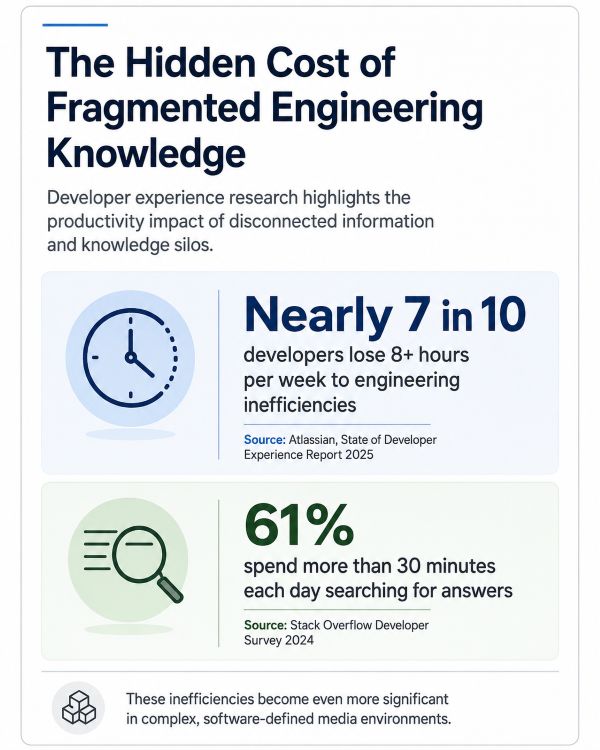
Atlassian found that nearly seven in ten developers lose eight or more hours each week to engineering inefficiencies. Stack Overflow reports that 61% spend more than 30 minutes each day searching for answers, while 30% encounter productivity-impacting knowledge silos ten or more times each week.
For teams building interconnected media software, these inefficiencies delay delivery, increase risk and make even routine changes more difficult to evaluate.
Automation Accelerates Tasks. Understanding Accelerates Engineering.
Automation and AI help engineering teams write code, test, document and troubleshoot more efficiently. But speed alone does not provide a complete understanding of a product or the impact of change.
AI coding tools may analyze source code without knowing the decisions behind it, the workflows it supports or the systems that depend on it. As media software grows more interconnected, teams need connected engineering intelligence to understand how products are built, why decisions were made and what a change could affect.
Enter Delivery Intelligence
Xperity uses the term Delivery Intelligence to describe an emerging approach that continuously connects information across the software delivery lifecycle (SDLC) to create a living understanding of an engineering environment.
Rather than treating source code, documentation, work-management systems, architecture decisions, deployment pipelines and collaboration platforms as isolated repositories, Delivery Intelligence connects the context they contain.
This enables engineers to understand how software components relate to one another, why previous decisions were made and what a proposed change could affect—without manually searching multiple systems and reconstructing the answer.
The result is less time rebuilding context and more time solving engineering problems.
IntelLayer™: Connecting Engineering Context
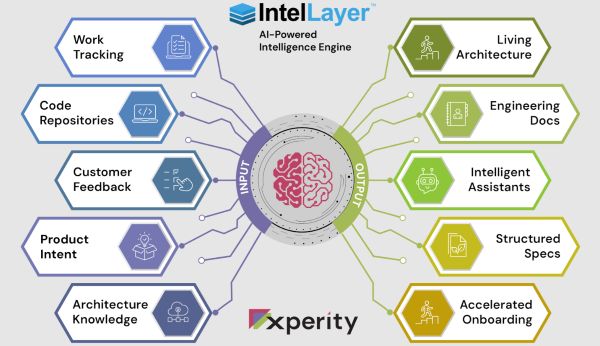
Xperity has applied this approach through IntelLayer, an AI-powered Delivery Intelligence Layer that connects information across software delivery environments.
IntelLayer does not replace existing engineering systems. It connects context from code repositories, work-management platforms, CI/CD pipelines, documentation and collaboration tools to create a continuously evolving understanding of software relationships, dependencies and engineering decisions.
For teams developing media software, IntelLayer helps answer questions such as:
- Which systems could be affected by this change?
- Why was this architectural approach selected?
- Which teams own related services?
- What documentation supports this implementation?
- Which downstream workflows depend on this application?
By making engineering context easier to access, teams can evaluate change more efficiently and make decisions with greater confidence.
Where Teams Can Benefit
Delivery Intelligence can improve engineering efficiency by helping teams:
- Accelerate impact analysis by identifying dependencies before cloud migrations, platform upgrades and workflow modernization.
- Preserve engineering knowledge by connecting software, documentation and technical decisions as teams evolve.
- Speed onboarding by enabling engineers to navigate connected product knowledge instead of relying solely on static documentation or tribal knowledge.
- Improve collaboration by giving engineering teams, product managers and technology partners shared technical context.
- Increase the value of AI by providing reliable organizational context that improves the relevance of AI-generated responses.
The Next Stage of Engineering Efficiency
Automation has helped media engineering teams execute work faster. AI helps them write code, test, document and troubleshoot more efficiently.
Delivery Intelligence addresses a different challenge: understanding increasingly complex software products.
By continuously connecting engineering context across the software delivery lifecycle, Delivery Intelligence helps teams understand how products are built, why engineering decisions were made and how proposed changes could affect interconnected systems. Instead of spending valuable time searching for information and reconstructing technical context, engineers can focus on making faster, better-informed decisions.
For companies building software for broadcast, streaming and digital media, engineering efficiency is no longer defined only by how quickly teams develop software. It also depends on how quickly they can understand their products, preserve engineering knowledge and confidently evaluate change.
As media software ecosystems continue to grow in complexity, Delivery Intelligence extends engineering efficiency beyond automation and AI by providing the connected understanding required for more predictable software delivery.
Supporting Sources
European Broadcasting Union – Strategic Overview of Cloud-Based Production Technologies
https://tech.ebu.ch/publications/strategic-overview-of-cloud-based-production-technologies-for-public-service-media
EBU Dynamic Media Facility Initiative
https://tech.ebu.ch/groups/dynamicmediafacility
Stack Overflow Developer Survey
https://survey.stackoverflow.co/2024/professional-developers/
Atlassian – State of Developer Experience Report 2025
https://www.atlassian.com/blog/developer/developer-experience-report-2025
GitHub & Accenture – Quantifying GitHub Copilot’s Impact in the Enterprise
https://github.blog/news-insights/research/research-quantifying-github-copilots-impact-in-the-enterprise-with-accenture/
TV Technology – Fast Tracks Open for Broadcasters Transitioning to Live IP Production
https://www.tvtechnology.com/news/fast-tracks-open-for-broadcasters-transitioning-to-live-ip-production
Latest IAMT News

IAMT launches new AI Sovereignty Report

MediaTech Has Outgrown Broadcast: So Has the CTO’s Job

Sign-Up Here
Industry news, event updates and more. Sign-up for the IAMT Newsletter.