

The Content Chain Starts Earlier Than We Map It
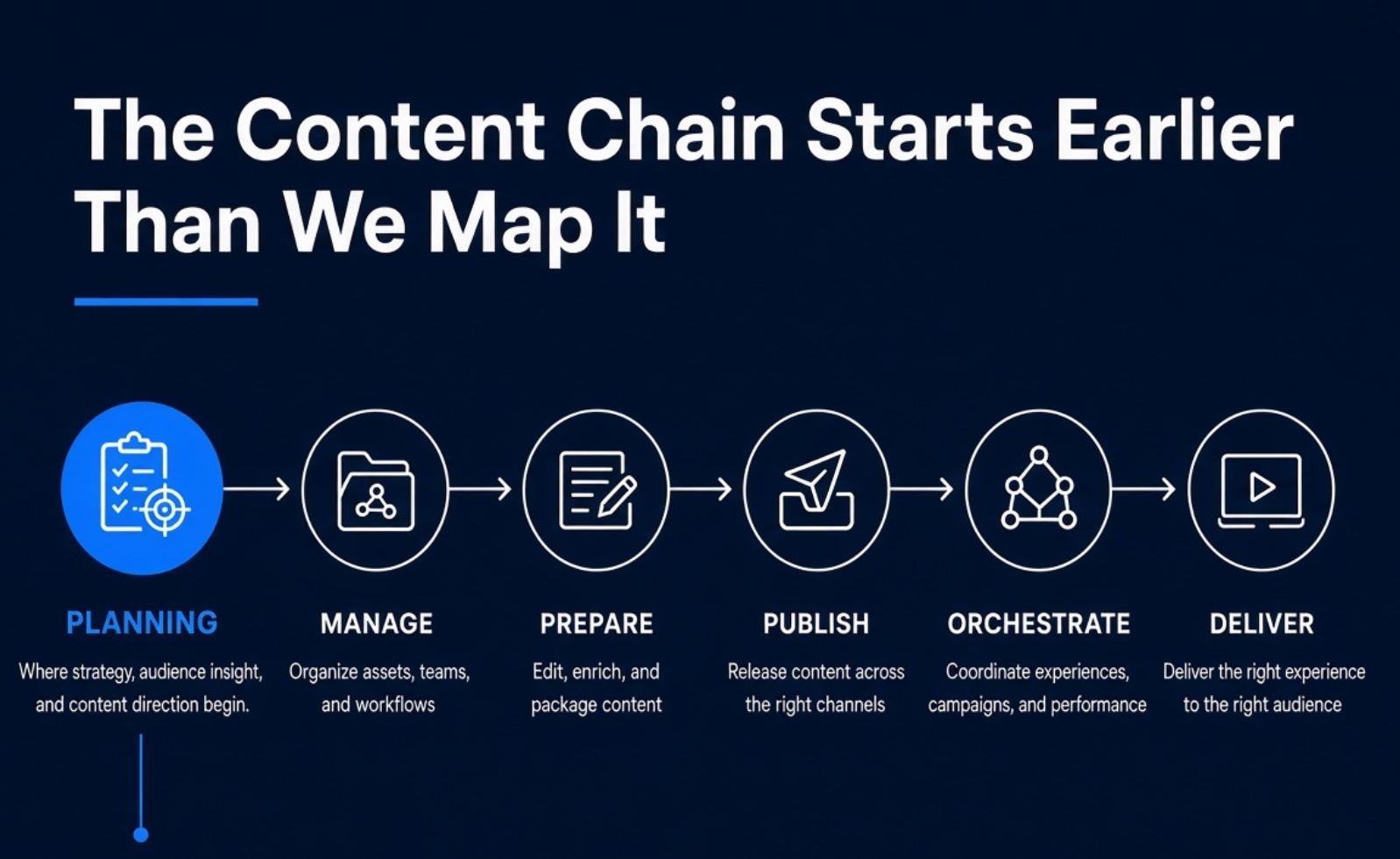 When our industry diagrams the content chain, it almost always begins at the same place: completed content. From there the map is detailed and well served – manage, prepare, publish, orchestrate, deliver. Each link has mature tooling behind it, competitive vendors, established standards and, increasingly, meaningful automation.
There is a link before that one. It rarely appears on the diagram, and in most organisations it is not a system at all.
Before any content is managed or published, someone has decided what should exist in the first place. Which titles the portfolio needs. Which channel or platform each one serves. Which window it airs in, against what competition, for which audience. Whether the rights permit it. What it cost, how long its shelf life runs, and what it is expected to return. Those decisions are made weeks or months upstream, and they determine the shape of everything the rest of the chain then handles with such precision.
This is content planning, and it is worth separating clearly from scheduling. Planning decides what airs and when. Scheduling decides how it airs – the running order, timed to the second, with breaks, promotions and compliance, ready for transmission. Both are essential. They are not the same discipline, and they do not operate on the same horizon, the same granularity, or the same set of variables.
Why the distinction did not matter, and now does
For much of broadcast history, treating them as one process was entirely reasonable. When a portfolio meant a handful of channels, when libraries were smaller and competitive dynamics moved more slowly, the gap between deciding what to air and building the transmission log was largely academic. One team, one system, one continuous workflow. The tooling followed that reality, and it followed it well.
That logic has come under pressure from a direction nobody designed for. Portfolios multiplied. Regional variants, high-definition and standard-definition feeds, FAST channels, thematic pop-ups, digital and on-demand windows – each one adding not just volume but a further set of interdependencies. Rights became more complex to track across more destinations. Content moved between platforms in ways that changed its value depending on where and when it landed.
The downstream chain absorbed this well. Playout automation, orchestration, cloud workflows and resource management have industrialised at pace, and the operational layer today handles a scale and complexity that would have been unthinkable two decades ago.
The upstream decision layer largely did not. In a striking number of organisations, the planning function that feeds this industrialised chain still runs on spreadsheets, email threads, disconnected documents and institutional memory. Not through any failure of attention – planning simply grew more complex faster than anyone built tools specifically for it, while the more visible operational problems attracted the investment they deserved.
The efficiency ceiling
This matters for a reason that connects directly to the efficiency conversation now dominating our industry.
Automation downstream is capped by the quality of what arrives from upstream. A perfectly orchestrated workflow cannot compensate for a plan that arrived late, or one where rights were verified after placement rather than before, or one where a version conflict surfaced at the point of transmission preparation rather than at the point of decision. The rework those situations generate is invisible in most efficiency measurements, because it is absorbed as normal operational effort rather than counted as waste.
There is a pattern worth noticing here. Organisations that have invested heavily in downstream automation frequently report diminishing returns after the first wave of gains. The systems are performing; the inputs are the constraint. When the plan arrives complete and validated, the same operational stack simply runs cleaner – fewer late changes, fewer reconciliations, fewer surprises close to air. The efficiency gain is real, and it originates outside the systems being measured.
Integration is not the same as consolidation
The obvious counterargument deserves a direct answer. If planning and scheduling are interdependent, is the solution not tighter integration rather than separation? 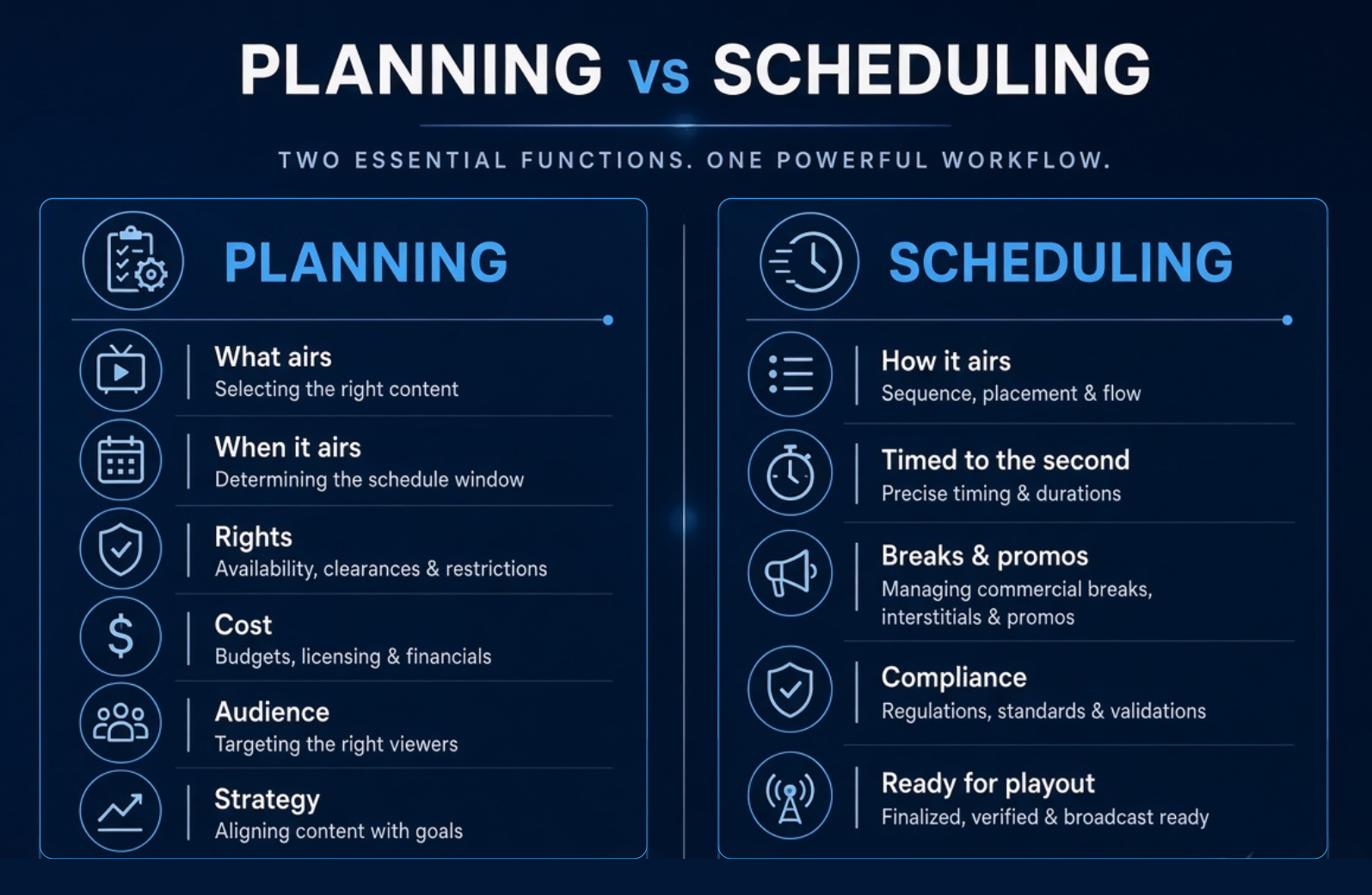
Integration is essential. But integration between two purpose-built layers is a fundamentally different proposition from a single system asked to carry both functions. When planning happens inside tooling designed for transmission preparation, the planning question gets answered in the shape of the scheduling question. Rights are checked at the point of placement rather than informing acquisition strategy. Content utilisation is optimised slot by slot rather than across the whole library and the whole portfolio. Audience and revenue strategy is approximated rather than modelled, because the tool was never built to model it.
The alternative is not two disconnected systems. It is a planning layer that owns the strategic decisions and hands a validated, complete plan to the operational layer that owns execution – a clean boundary with a well-defined interface across it, rather than one tool stretched thin across two jobs.
What this means for the content chain
If the industry’s map of the content chain begins at completed content, it begins one link too late.
The decisions that determine what content exists, where it goes and what it is worth are made before anything reaches management or publication. They are made under more complexity than at any point in broadcast history, and in many organisations they are made with less dedicated tooling than any other link in the chain.
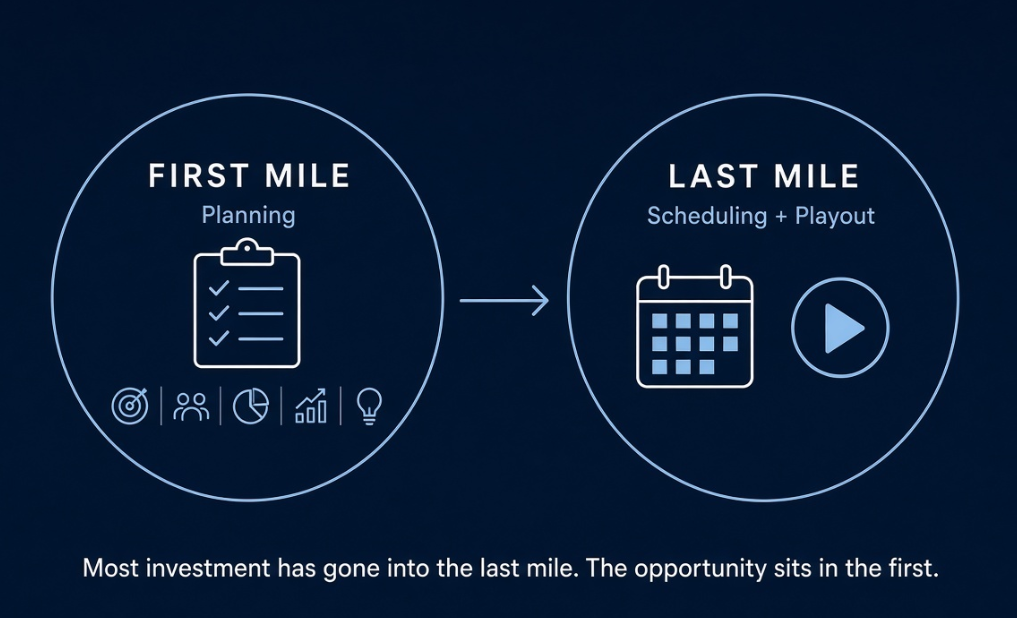
That is not a criticism of how the industry got here. It is an observation about where the remaining opportunity sits. The last mile of the content chain has been engineered to a remarkable standard. The first mile is where the next meaningful gains are available – and increasingly, where competitive advantage is decided.
Because in broadcast, advantage is not created when the schedule reaches air. It is created long before that.
Latest IAMT News

Beam Dynamics Appoints Brian Mauger as Regional Sales Manager, North America
Interra Systems to Showcase Smarter Quality Assurance and Real-Time, Actionable Media Monitoring at NAB Show New York 2026

Sign-Up Here
Industry news, event updates and more. Sign-up for the IAMT Newsletter.