TMT Insights – The Hidden Tax in the Media Supply Chain

Ian McPherson, Head of Business Development, TMT Insights
Real cost reduction starts with controlling how content is stored, managed, and delivered.
Content owners and creators, from studios to streamers, are under rising pressure to reduce costs and increase profitability. No surprise; cost controls and tight budgets have been a concern for producers and filmmakers ever since the first camera started rolling on a set.
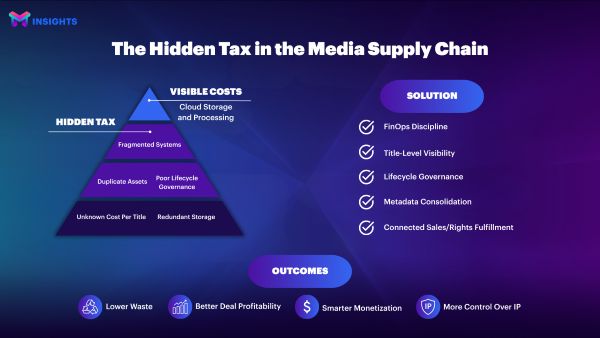
What is surprising is how many organizations are still ignoring the biggest drivers of inefficiency within a digital media supply chain. Redundant storage, duplicated assets, uncontrolled backups, inaccurate siloed data, and fragmented systems can all inflate costs across cloud and on-prem environments. Many media companies still can’t measure the fully loaded cost of preparing, storing, and delivering a title.
These are the areas where a “hidden tax” accumulates across content repositories. Each reflects gaps in an organization’s visibility and control over its own content inventory, which ultimately increases costs and hampers the ability to sell content effectively.
In today’s media and entertainment industry, the ability to survive, and even thrive, lies in consolidated title and descriptive metadata across federated data sets, implementing lifecycle and storage governance, gaining cost visibility per workflow and per title, and embedding financial operations (FinOps) into media operations. It’s all part of an unending loop: without governance, redundancy becomes waste, and without FinOps discipline, cloud elasticity becomes cost volatility.
Achieving this level of operational and financial transparency requires more than isolated tools or manual reporting. Organizations need a unified view of their content, workflows, costs, and business processes across the entire media supply chain. This is where modern supply chain solutions, such as TMT Insights’ Polaris and Focus platforms are helping content owners bridge the gap between operations and business outcomes. By providing title-level visibility across content inventories, fulfilment activities, rights, and costs, these platforms enable organizations to make more informed decisions about how content is stored, managed, delivered, and ultimately monetized.
Managing Costs And Driving Revenue
Increasingly competitive marketplace conditions in the M&E industry are creating intense financial scrutiny on every aspect of media operations. This accelerates the need for efficiency and a clear return on investment, placing greater financial pressure on companies to optimize their operations and justify costs.
Content owners and rights holders need tightly integrated systems that connect sales, rights, and fulfilment to provide a holistic view of deal profitability long before a sale is made.
The M&E industry must challenge itself by moving away from legacy, tactical, asset-level tracking and toward a modern, comprehensive “title-level” view of content libraries. Embracing this mindset shift changes the view of supply chain management from a basic cost center to a strategic cost management tool for both efficiency and revenue growth.
True success in the current media landscape requires a balanced approach focused on both cost reduction through efficiency and automation, as well as maximizing revenue by better understanding and monetizing intellectual property (IP).
One of the first steps in adopting this dual strategy is reducing investment in “undifferentiated heavy lifting.” There are many functions a company must perform that don’t necessarily enhance its competitive advantage in the marketplace. Delegating non-core operational tasks to third parties lets a company focus on the core competencies that contribute to their unique value proposition, for example content creation.
Maximizing the yield of intellectual property begins with gaining a clear, consolidated understanding of all available assets mapped to the packaging requirements of the various content delivery platforms. Without clear visibility into available inventory, content owners cannot fully exploit their IP and risk missing licensing opportunities or committing to deals that are costly to fulfil.
The Cost You Can’t Always See
At first glance, storage and infrastructure costs often appear manageable. Recurring costs for cloud storage, transcoding, and delivery are black-and-white and easy to track, but these are only surface-level metrics.
Across many media organizations, content libraries have evolved without consistent structure or governance. Multiple asset management systems coexist. Separate teams store and process content independently. Variations of the same title, different cuts, formats, language versions, or delivery packages, are created and stored without a clear structure.
Having a consolidated, “title-level” view of assets is a must to properly connect sales, rights, and fulfilment, ultimately ensuring the profitability of content deals. This is the kind of visibility and operations control that TMT’s Polaris and Focus are designed to enable. Modern platforms like these are purpose-built to help content providers of all types modernize and automate their digital media supply chains, by providing single-pane-of-glass transparency into all upstream and downstream business processes.
The Governance Gap
At the core of the challenge facing many content owners is a lack of fiscal and data governance. In the context of the modern media supply chain, governance means more than maintaining compliance or security. It extends to establishing a consistent, authoritative view of content across the enterprise. This includes structuring asset hierarchies and relationships, tracking versions, edits, and derivatives; and managing lifecycle policies for storage and retention
Without these foundations, it’s impossible to accurately assess the costs of going to market, fulfilling customer requirements or scaling operations efficiently.
Why FinOps Must Extend into Media Operations
For all its benefits, the cloud has amplified both the opportunity and the potential risks when it comes to media supply chain management. While cloud platforms enable flexibility and scalability, they also introduce cost volatility when not actively managed. This is where FinOps principles become essential.
Media companies must move towards granular cost visibility, understanding just how much they spend for their workflows, for each title and for each delivery or transaction. Embedding financial accountability into operations changes decision-making behaviour. Teams begin to evaluate whether a deal is profitable based on the actual cost to fulfil it, not just the revenue it generates.
When media companies regain control over their content operations, they unlock both efficiency and growth. Without that visibility, organizations risk selling content that is expensive to produce or deliver, eroding margins instead of increasing them. Companies simply can’t save their way to profitability. True margin improvement doesn’t start with cutting content spending. It starts with controlling how content is stored, managed, and delivered.
Latest IAMT News
Globecast Demonstrates Content Exchange Latest Capabilities at SPORTEL Monaco 2026

Beam Dynamics Appoints Brian Mauger as Regional Sales Manager, North America

Sign-Up Here
Industry news, event updates and more. Sign-up for the IAMT Newsletter.