
Reflections from BroadcastAsia 2026

Riikka Koponen, Principal Analyst, IAMT
The BroadcastAsia 2026 trade show – which took place in on May 20th – 22nd 2026 – reportedly attracted over 1,000 exhibitors globally, the figure being clearly up from 2025 (~ 650 exhibitors) thanks to a combination of several events such as SatelliteAsia, CommunicAsia and the AI Summit. The BroadcastAsia (BCA) show, however, felt more quiet compared to last year, whereas SatelliteAsia – now including new technology segments such as space exploration – absorbed more floor space, not only reflecting the on-going shift from linear broadcasting towards OTT and streaming platforms, but also convergence between broadcast and non-media market verticals, driving demand for new satellite technologies such as low latency and cloud-ready non-geostationary satellite orbit (NGSO) satellites like LEOs, which enable more efficient data throughput and real-time applications such as gaming and private 5G networks now used in live sports. Moreover, Earth Observation (EO) satellites combined with AI-based data analytics – capturing and analyzing detailed imagery and measurement through clouds, thick ice and vegetation – were also attracting visitors, reflecting the increasing investment in government communications due to rising geopolitical tensions.
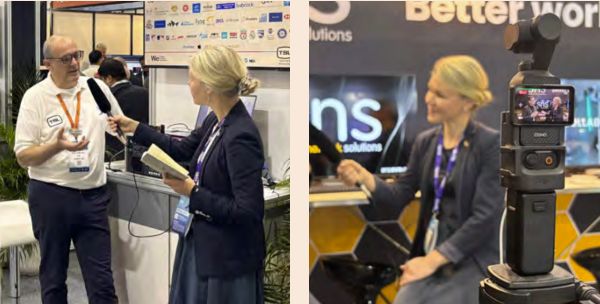
This year, the IAMT Pavilion hosted several members’ stands inside the lounge, creating an open “walk-in” space and a meeting hub for a diverse range of media technology buyers, partners, vendors and other enthusiasts. Interestingly, members said that this year they had more live event companies and stakeholders visiting their booths compared to previous years, when typically the majority of potential customers have consisted of local TV and radio stations, channel partners and local dealers. The more diverse mix of visitors at the booths reflects growing demand for live content in the region as well as improving quality of content and production teams’ skillsets in sports leagues, social media platforms and the mobile-first oriented creator economy in Asia-Pacific.
Despite the identified convergence between broadcast and satellite trade shows organized under the same roof, many media technology suppliers noted that at BCA a dedicated area for Pro AV technologies is still underrepresented in terms of exhibitors and technologies aimed at Pro AV applications that can be found at growing shows like ISE and InfoComm. In terms of geography, a large share of visitors consisted of exhibitors’ customers from Southeast Asia (SEA), including major broadcasters and private operators from Singapore, Thailand, Vietnam, Malaysia, Indonesia and the Philippines. There were reportedly fewer technology buyers from Japan, South Korea and China. However, several country-led pavilions such as the China Pavilion and the UHD World Association Pavilion – both accommodating numerous Chinese exhibitors – and the German, French, Spanish and UK Pavilions, highlighted the origin of the technology suppliers. Rising geopolitical tensions and demand for digital sovereignty are making customers increasingly interested in the country of origin of their technology partners and facilities.
IAMT’s Business Intelligence Unit curated four sessions in the Broadcast Asia conference, including two market insight presentations and two expert panel discussions featuring IAMT Members. IAMT’s market briefings highlighted major market trends and technology adoption in the media and entertainment (M&E) industry as well as analyzed new business opportunities in adjacent markets through the lens of IAMT’s quantitative data, showing a significant diversification of MediaTech suppliers’ revenue to various parallel markets like corporate, government and education.
In terms of major market trends within the M&E segment in Asia-Pacific, demand for IP networking and transport as well as hybrid cloud is growing among public service broadcasters, who are mandated to cut costs and seek cheaper alternatives to satellite distribution. Satellite distribution remains important in the region but is becoming less commercially viable to maintain as audiences shift to OTT and live streaming of sports. Hence, local broadcasters are investing in hybrid SDI/IP and hybrid cloud-based workflows, enabling them to cover more live events and manage the cost of their gradual business transformation towards software-defined workflows. Mature mobile-first streaming and the influence of major social media platforms investing in micro dramas is motivating broadcasters to produce platform-native content designed for vertical viewing on mobile screens.
The AI value chain is also becoming more self-sufficient in the APAC region, as Chinese AI technology firms are heavily investing in AI processing, making AI chips more accessible for local buyers. While Asia-Pacific remains the most important manufacturing hub for graphic processing units (GPUs) and central processing units (CPUs) globally, supply chain disruptions – especially the severe shortage of memory chips – is negatively impacting Asian hardware manufacturers’ business outlook. As a result, local manufacturers have had to delay product launches and raise prices due to the rapidly increasing cost of basic memory.
Overall, both IAMT members and other exhibitors fed back that the BCA show still exceeded their expectations in terms of the quality of booked meetings and that the show still provides a good platform to meet local partners and customers to discuss emerging trends, technologies and evolving customer priorities. Meeting local stakeholders in person on site is crucial for building trust and more transparent vendor-buyer relationships in the context of the ever-accelerating pace of change and development in the industry. IAMT’s presence at BroadcastAsia 2026 confirmed that the APAC region holds a significant growth opportunity for MediaTech vendors, driven by public broadcasters’ growing interest in IP and hybrid cloud adoption. However, converting this opportunity into business growth will require a strong local presence and contact network, an educational and partnership-style approach to sales as well as a deep understanding of region-specific market dynamics, local tech roadmaps and challenges. To support IAMT members in this work, our Business Intelligence unit published the 2026 edition of the IAMT GeoTracker report in June, providing a deep dive into region-specific MediaTech trends in Asia-Pacific. The report is included with Platinum membership and available to purchase as full report or as single chapters. For more information please contact IAMT’s Member Engagement & Growth Team.
Latest IAMT News

Globecast Demonstrates Content Exchange Latest Capabilities at SPORTEL Monaco 2026

Beam Dynamics Appoints Brian Mauger as Regional Sales Manager, North America

Sign-Up Here
Industry news, event updates and more. Sign-up for the IAMT Newsletter.