
Qencode – Make Geographic Reach a Pipeline Setting

Murad Mordukhay, CEO and co-founder, Qencode
For most of the history of digital video, platforms struggled to expand beyond their home country. A few markets were selected, budget was allocated, and the team had to build a supply chain to localize catalogs one title at a time. This kept many companies from moving forward, and the ones that did often drained more time and resources than planned. Today, breakthroughs across the technology stack make the decision matrix look different, and global reach has become essential to building a sustainable business.
A platform that can only serve one market is exposed to conditions in that market. Many things can happen outside its control, including regulatory changes, economic dips, or shifts in the competitive landscape. Infrastructure resilience gets most of the attention, but market resilience matters too. Diversifying across regions has always been the obvious hedge, but until recently it was held back by cost, time, and resource constraints. If localization can be enabled by a few pipeline settings, exploring a new market is no longer a months-long project.
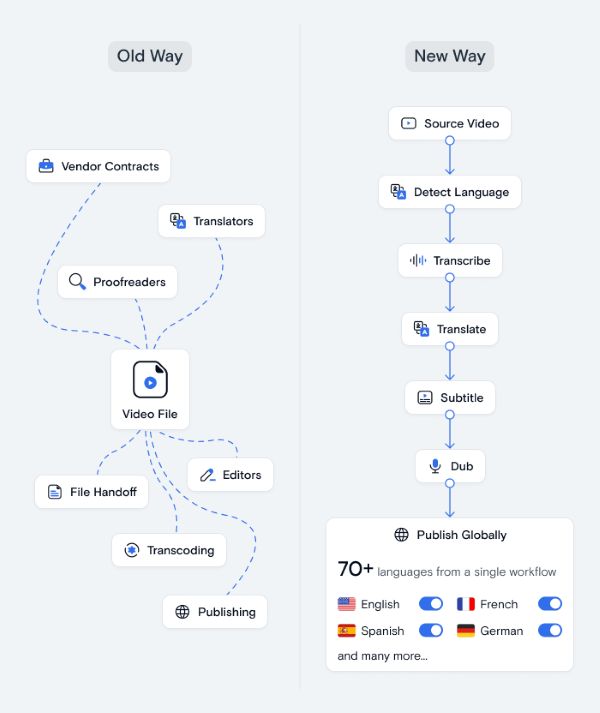
The old way: Working With Vendors to Build an External Supply Chain
For many video platforms, traditional catalog localization is out of reach. Vendors were expensive and slow, making it harder to compete with premium studio and television platforms with limited content and large budgets. This model does not work for platforms with users uploading content all day. These companies needed translators, proofreaders, editors, and project managers, or had to rely on separate third-party tools before uploading finished files to be attached or burned in during transcoding. Those pipelines handled only part of the job, had several points of failure, and depended on suppliers with their own queues.
The issues and costs grew linearly based on the amount of content multiplied by the localizations required, without meaningful economies of scale. Delays from any one vendor could hold up the process. When localizing one market meant a new budget, new vendor contracts, and a longer operational chain, expansion got harder the more of it you did.
The New Way: Using Technology to Enable Automated Localization Workflows
What replaced that chain is a single transcoding job. It detects the source language, transcribes it, and translates into target languages in one pass, handing back subtitles ready to ship. Modern AI-powered localization workflows can now transcribe, translate, subtitle, and soon dub content within one processing pipeline, removing much of the overhead that made expansion expensive. That one job reaches more than 70 languages and writes out the standard subtitle formats nearly every platform already accepts. Dubbing is rolling out next, using voice cloning that carries the original speaker’s tone and rhythm rather than replacing it with a generic read.
What changes is the decision behind it. Say you have a Spanish-language training library and want to know whether it has an audience in the US and Brazil. The old answer was a budget, vendor contracts, and months before you saw a single view. Now the English and Portuguese subtitles get generated in the same job that encodes the video. Both versions can be live in a day, and you can watch how each market responds before committing anything else. If one market responds and the other does not, you follow demand without opening a vendor process just to find out.
One video distribution platform we work with processed more than 350,000 transcription and translation jobs through a single automated pipeline in roughly a year, showing how localization has shifted from a special project to a routine operational function. Geographic diversification used to be expensive enough that only the largest platforms could use it as a hedge. Now a small team can test new markets without building a separate operation for each one.
Latest IAMT News
Globecast Demonstrates Content Exchange Latest Capabilities at SPORTEL Monaco 2026

Beam Dynamics Appoints Brian Mauger as Regional Sales Manager, North America

Sign-Up Here
Industry news, event updates and more. Sign-up for the IAMT Newsletter.