
Digital Joy – The New Economics of Media: Turning Technology Spend into Intelligence

Tracey Shaw, President & Co-Founder, Digital Joy
The media industry has always been good at adapting. We moved from tape to file, hardware to software, on-premises infrastructure to the cloud, and linear television to an ever-growing number of platforms. Each transition delivered greater speed, flexibility and efficiency, but also left us with a technology environment that is more complicated and harder to understand financially.
The business is changing just as quickly. Around the world, media companies are consolidating operations, rethinking workflows and competing for audiences across television, streaming, social media, podcasts and creator content. Deloitte’s 2026 Media and Entertainment Industry Outlook describes a market where traditional media companies increasingly compete with “tech media” companies and where audience data, engagement and speed of innovation are becoming important competitive advantages.[1]
The Economics of Media Technology Have Changed
Media organizations are under pressure to move faster and create more while controlling costs. For years, efficiency often meant automation: removing steps from workflows and producing more with the same resources. Cloud shifted companies from large CAPEX purchases toward more flexible OPEX and consumption-based models. SaaS accelerated that transition. Now AI is doing it again.
A modern production can touch many technologies. A major sporting event might use public cloud infrastructure, SaaS applications, a production platform such as Grass Valley AMPP, and AI services for transcription, translation, summarization or content discovery. Each has its own pricing model and measurement of consumption.
We have become very good at consuming technology. The harder question is whether we understand what it costs, can assign those costs to programs, events and episodes, and know whether we are using that technology efficiently.
FinOps Connects Technology Spend to What We Produce
This is why FinOps is increasingly relevant to media. Originally centered on cloud financial management, its scope has expanded. In 2026, the FinOps Foundation defined FinOps as an operational framework and cultural practice designed to maximize the business value of technology through data-driven decision-making and collaboration between engineering, finance and business teams.[2] The important shift is from managing cloud costs to understanding technology value.
If a production uses cloud infrastructure, SaaS, AI services and specialized media platforms, those costs need to be connected to the activity generating them. The U.S. Government Accountability Office has similarly highlighted the importance of understanding IT costs, resources and solutions to improve insight into technology spending.[3]
With the right tools, instead of knowing a company spent $200,000 across providers, we can ask better questions: What did this event cost? What is our technology cost per episode? Which productions consume more resources? Should a capability be insourced or outsourced? Are we using each resource efficiently?
Turning Visibility into Intelligence
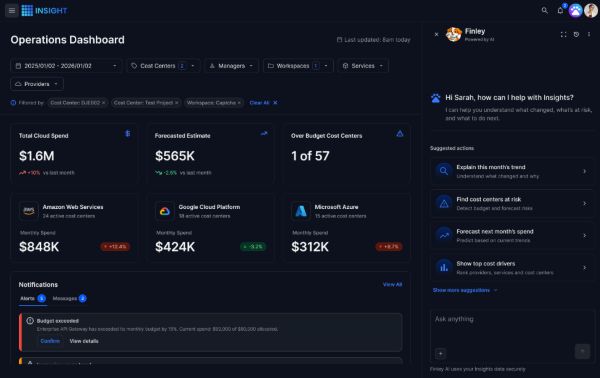
Tools like Digital Joy Insight are evolving to bring cloud, SaaS, AI and other technology costs into a common view and connect them to operations. For media companies, that can include industry-specific costs, such as Grass Valley AMPP, associated with a production, project, episode or event. The goal isn’t another dashboard full of usage and expenses. It is making that data useful across finance, engineering and management.
Annual budgeting was easier when technology investments were largely CAPEX-based and costs were predictable. Consumption-based technology creates greater flexibility, but also more variability. Breaking news happens. A sporting event goes into overtime. Streaming traffic spikes. Engineering teams make real-time changes to meet those demands, and those decisions can immediately affect resources and expenses.
Forecasting therefore needs to be more dynamic. McKinsey reports that 20 to 30 percent of AI spending can go unaccounted for because investments are fragmented across vendors, tools and commercial models, making reliable forecasting more difficult.[4] Historical spending, planned projects, expected usage and anticipated growth can help organizations understand where technology costs may be heading.
Just as important is knowing when something isn’t behaving as expected. Monitoring and anomaly detection can identify unusual changes in spending or usage before the invoice arrives. Deloitte reports that 27% of cloud spending is considered wasted, highlighting the opportunity to identify unnecessary spending earlier.[5] When FinOps tools also provide AI-driven recommendations or allow users to query their data, they can help explain what changed, what is driving it and where opportunities may exist to optimize spending and resources.
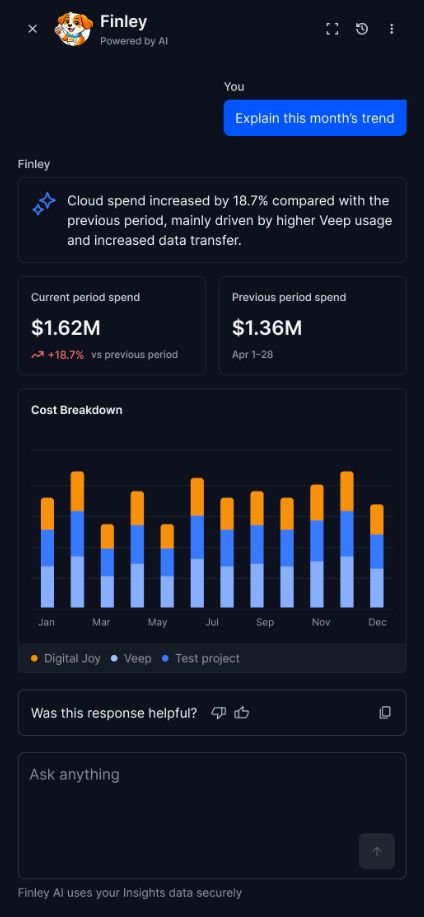
AI itself adds another layer of complexity. Deloitte expects generative AI to become increasingly embedded in media operations, creative workflows, audience analytics and production pipelines.[6] NIST has also emphasized the importance of monitoring AI systems once deployed, particularly as AI becomes integrated into commercial applications.[7]
AI spend can span multiple providers, models, applications and workflows, while some SaaS platforms are also adopting token or consumption-based models. But “we consumed 100 million tokens” means little to a CFO, producer or department head. Translating that consumption into currency allows organizations to understand the actual cost, allocate it to a department, application, project, episode or event, and evaluate it alongside other technology costs.
The next meaningful efficiency gain in media will come from understanding these relationships. We will continue to automate workflows, move between hardware and software, cloud and on-premises infrastructure, and use AI to accelerate production. Those changes create flexibility but can make cost and efficiency harder to measure.
As the media technology supply chain becomes more distributed and consumption-based, financial and engineering visibility must evolve with it. Connecting cloud, SaaS, specialized media platform and AI costs allow companies to move beyond total technology spend and calculate the cost per unit of production, whether that is an episode, event, program, channel or project. That creates a clearer view of what content costs to produce and deliver compared with the revenue or value it generates. Comparing those unit costs over time can help identify inefficiencies, improve forecasts and inform where resources should be invested.
In a global media industry where speed, margins and adaptability increasingly matter, that kind of intelligence isn’t simply about controlling costs. It’s becoming part of how we compete.
Footnotes
- Deloitte, 2026 Media and Entertainment Industry Outlook, Deloitte Center for Technology, Media & Telecommunications, March 3, 2026.
- FinOps Foundation, What is FinOps?, updated 2026.
- U.S. Government Accountability Office, Technology Business Management: Critical Go or No Go Action Required on Federal Agency Adoption of IT Spending Framework, GAO-25-106488, July 17, 2025.
- McKinsey, The Cost of Intelligence: How CIOs Can Manage AI Demand at Scale, July 2026.
- Deloitte, Cloud Gets Lean: “FinOps” Makes Every Dollar Work Harder, November 2024.
- Deloitte, 2026 Media and Entertainment Industry Outlook, 2026.
- National Institute of Standards and Technology, Challenges to the Monitoring of Deployed AI Systems, NIST AI 800-4, March 2026.
Latest IAMT News

IAMT launches new AI Sovereignty Report
MediaTech Has Outgrown Broadcast: So Has the CTO’s Job

Sign-Up Here
Industry news, event updates and more. Sign-up for the IAMT Newsletter.