
Efficiency – Let’s Focus on What Matters
Every time we talk about efficiency in this industry, the conversation starts in the same place: someone points at a bottleneck. The scheduler can’t turn bookings around fast enough, QC is backed up, or the localization vendor missed another window. We diagnose the issue as a lack of speed, and prescribe going faster.
In my opinion, that’s been the wrong diagnosis for years.
The most expensive problem in media operations isn’t that people work slowly; it’s that we keep doing the same tasks over and over because our systems don’t remember they were already done. Confusing speed with redundancy is why many efficiency initiatives barely make a dent.
Take a single episode of a returning series. Its title, synopsis, credits, and rights windows get entered into the internal catalog. Then someone re-enters them slightly differently for each distribution platform, again for the localization brief, and again in the spreadsheet ad sales keeps because they lack access to the primary system. Meanwhile, a booking for the finishing suite gets set up, rebuilt when the delivery date shifts, and rebuilt again when a colorist calls in sick. None of these tasks take long or are inherently slow. It’s the constant repetition that eats up our time and budget.
This is also why cutting headcount rarely delivers the savings promised on paper. You haven’t removed the workload; you’ve removed the people quietly holding things together. Six months later, that work is still sitting there – just getting done later, and causing more frustration.
Fragmentation is a data problem in an operations costume
The root cause is that many media supply chains are built from systems designed to log work after the fact, not connect it in real time. Each tool works fine on its own, but it’s blind to what’s happening around it. Scheduling tracks resources and hours, the catalog manages titles and territories, finance handles purchase orders. If none of these platforms talk to each other, the connective tissue ends up being a person at a desk, copying information from one screen to another.
That manual handoff is where your real costs live. It’s also where mistakes sneak in, since every re-entry is a chance for error. Losing efficiency and losing quality stem from the same point of friction.
Fortunately, two recent shifts have made this fixable, and both are more practical than the usual automation buzzwords suggest.
First, data improvement can happen right when a record is created, instead of someone chasing down missing details later with a checklist. This was the core design philosophy behind Origin Studio: rich metadata, visuals, and credits are attached up front, turning the main catalog into a genuine source of truth rather than one of several competing records. Instead of re-entering information eleven times, you do it once using the platform’s “Enrichment-First Workflow.” It might not sound flashy, but it’s the real reason it won NAB Show Product of the Year in media supply chain and automation. Not because it relies on novel gimmicks, but because it stops expensive redundancies from happening.
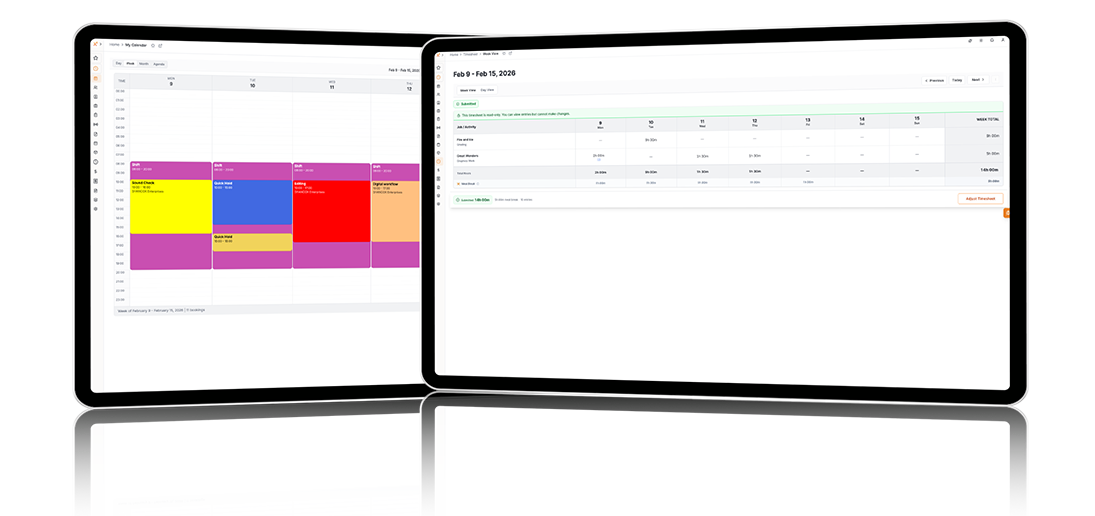
Second, operational intelligence is now built into the workflow, rather than sitting isolated in a separate reporting layer. In X2, our updated interface for the Xytech platform, an operator can ask what resource availability looks like next Tuesday, or check for scheduling conflicts, using plain language – no custom report required. Initial draft schedules can also be generated automatically instead of assembled from scratch. Our internal testing showed roughly a 90 percent reduction in time needed for initial resource allocation. The scheduler still makes the critical decisions but no longer spends the day as a data entry clerk.
Now the interesting part
Here’s something that hasn’t been fully accounted for: if a single scheduler can handle three times the booking volume, the old insourcing-versus-outsourcing math becomes outdated.
That old math was grounded in labor arbitrage: work costs less in certain regions. That logic held up when output scaled directly with headcount and hourly rates were the main knob you could turn. But once structural efficiency enters the equation, hours are no longer the right metric. What matters is how much completed work a person can produce, determined by how much unnecessary duplication their tools eliminate, not how fast they type.
This doesn’t mean every team should bring everything in-house immediately. Specialized expertise, volume spikes, and time zones are still valid reasons to work with external partners. But if you haven’t re-evaluated that balance in the last two or three years, enough has shifted that your conclusions may no longer apply. Plenty of outsourcing decisions that made sense in 2023 are quietly inefficient today, and will keep renewing until someone looks closer.
There’s also a practical detail worth keeping in mind. Modern, cloud-native tools operate as an ongoing operational expense rather than a massive capital project with a multi-year timeline. Because X2 runs on managed AWS infrastructure and receives regular updates, new capabilities land smoothly without a fresh statement of work, just like any standard SaaS platform. You’re no longer locking up a major capital budget on a long-term forecast for a model that might change before the project finishes. That said, usage-based pricing only works in your favor if you actively track which duplicated tasks you’ve eliminated.
What I’d measure instead
It’s time to move away from cost-per-hour as our primary metric. It artificially favors outsourcing, skews how we view internal teams, and offers little insight into whether a supply chain is functioning well.
Instead, focus on three questions: How many times is the same data manually typed across different tools? How long does it take to update a schedule after a change, versus building it from scratch? And how much completed work can an individual team member deliver now compared to a year ago?
These metrics take more effort to track, but they’re harder to game and give an accurate picture of what’s happening. True efficiency has never been about how fast your team can run; it’s about making sure the work only needs to be done once.
Kira Baca, Chief Strategy and Growth Officer
https://www.linkedin.com/in/kirabaca/
Latest IAMT News
IAMT Dynamic Software Licensing Group Launches Public GitHub Repository

IAMT Annual Conference & Awards 2026: first speaker announced

Sign-Up Here
Industry news, event updates and more. Sign-up for the IAMT Newsletter.