
Yospace – Building Resilience Through Standardization: the Next Phase of OTT Advertising

Jade Warne, Marketing and Communications Specialist, Yospace
Ad-supported streaming is growing fast, which creates the challenge of how to deliver addressable advertising, achieve maximum value, and provide accurate measurement within premium viewing experiences across an increasingly complex device ecosystem. Then there are other features to consider, such as new ad formats, low-latency streaming, and extended DVR windows. Dynamic Ad Insertion (DAI) technology is evolving to meet these demands, at scale, and in a more efficient way, but the path to evolution isn’t straightforward.
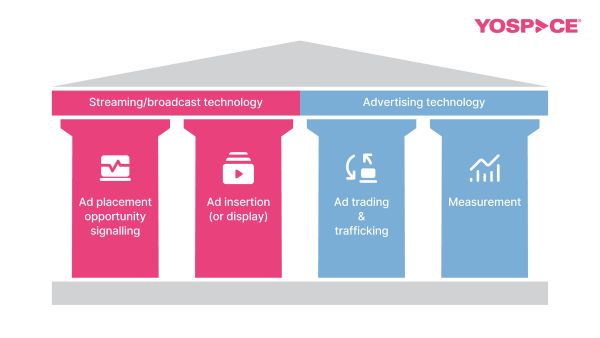
These challenges share a common root. The technologies underpinning OTT monetization have historically evolved on two separate tracks, with streaming on one side and advertising on the other. That separation was manageable while streaming audiences were small. With ad-supported streaming growth showing no signs of slowing, it no longer is.
Now, for the first time, the ad tech and streaming tech worlds are collaborating on shared standards, laying the foundation for a more resilient and scalable OTT advertising ecosystem to address each of these problems.
How Ad Insertion Has Evolved
Dynamic Ad Insertion (DAI) has evolved significantly over the last decade.
Its first iteration, Client-Side Ad Insertion (CSAI), delivers ads directly on the user’s device and initially benefited from precise cookie-based tracking. But it was vulnerable to ad blockers, buffering and inconsistent quality, problems compounded by growing device fragmentation.
Server-Side Ad Insertion (SSAI) emerged in response. It stitches ads into the stream before they reach the viewer, offering seamless, device-agnostic playback that’s less susceptible to ad blockers. SSAI can pose measurement challenges, but hybrid approaches that combine server-side insertion with lightweight client-side tracking help maintain accurate reporting.
The latest development is Server-Guided Ad Insertion (SGAI), which combines CSAI’s flexibility with SSAI’s consistency, delivery quality and privacy benefits. Rather than the server stitching ads into the stream or the device doing all the work, the server identifies ad opportunities and signals the client to fetch and play ads.
What makes SGAI particularly significant is that it’s built directly into modern streaming standards, including HLS Interstitials and MPEG-DASH Events. For the first time, ad insertion is becoming part of the streaming protocol itself, creating the potential for far greater consistency across devices and platforms.
Why Standardization Matters Now
The emergence of SGAI reflects a broader industry shift. Delivering advertising successfully requires both the streaming and ad tech worlds to work together. Ad signaling, insertion, delivery, measurement and reporting all depend on aligned technologies and standards. This recognition has driven collaboration between the organizations leading work on each side.
On the advertising side, the IAB Tech Lab continues to develop standards such as OpenRTB, VAST, VMAP and SIMID, adapting them to support emerging advertising experiences.
Within streaming, the Streaming Video Technology Alliance (SVTA) is helping ensure these capabilities can be implemented consistently across video players and delivery environments, while CTA WAVE is advancing observability and measurement through Common Media Client Data version 2 (CMCDv2).
Together, these organizations are creating a framework for interoperability across the OTT ecosystem. This alignment is essential if broadcasters are to avoid complex bespoke integrations and instead build services that evolve alongside industry standards.
New Capabilities Unlocked by Standardization
The value of standardization goes beyond technical compatibility. It directly addresses the challenges broadcasters face today:
- Extended DVR for live streaming. Long playback buffers are computationally intensive with traditional SSAI. SGAI lets all viewers share one content playlist while ads are resolved independently, making long DVR windows practical and creating new ad opportunities when viewers scrub backwards through a live stream.
- Low-latency streaming. Broadcasters can support one-to-one advertising at broadcast-comparable, glass-to-glass latency measured in seconds rather than tens of seconds. In 2025, Yospace demonstrated this as part of IBC’s Accelerator Programme.
- Faster VOD start-up. SSAI must resolve every ad break before playback can begin, delaying start-up when the ad load is high. With SGAI, ads are resolved as needed, so playback starts sooner and ad load can be varied for each break.
- New ad formats. Overlays, side-by-side and L-shaped ads have long been technically possible, but inconsistent approaches to delivery and measurement have held back wide scale deployment. The IAB Tech Lab’s Ad Format Hero project is establishing the standards needed to scale them, giving broadcasters additional inventory and advertisers more engaging ways to reach audiences. These can be applied to either SSAI or SGAI-powered streams.
Closing the Measurement Gap
One important challenge remains, arguably the most commercially significant. While HLS Interstitials and MPEG-DASH Events support SGAI, they don’t define a standard approach to advertising measurement.
Third-party distribution and syndication exacerbate this. When a broadcaster’s content is carried in another platform, the rights owner has no player control and can’t deploy its own measurement SDK on every device. With connected TVs, mobile devices and set-top boxes to reach, and when even devices from the same manufacturer can behave differently, consistent measurement at scale becomes extremely difficult.
To address this, two sets of standards are taking shape:
- SVTA player-fired tracking: The server signals the measurement events, and the player automatically triggers them.
- CTA WAVE’s CMCDv2: The player reports playback data while the server generates the measurement events on its behalf, so it’s not limited by low-capability devices or third-party players the rights-owner doesn’t control.
A complete solution will likely combine these standards. Together, they provide a flexible framework for consistent measurement across devices with varying capabilities.
Building a More Resilient DAI Ecosystem
Unmonetized DVR windows, latency compromises, slow VOD start-up, bespoke needs for new ad formats and inconsistent measurement all lead to the same thing: revenue left on the table.
Promisingly, the streaming and ad tech industries are now solving these problems together rather than apart. As the shared standards mature, each challenge’s solution is coming to the fore: monetizable DVR windows, personalized ads at broadcast-level latency, faster start-up, scalable ad formats, and consistent measurement wherever content plays.
Work remains, but the direction of travel is clear. The collaboration now underway is laying the foundation for a more standardized and sustainable future for OTT advertising.
Latest IAMT News

Globecast Demonstrates Content Exchange Latest Capabilities at SPORTEL Monaco 2026

Beam Dynamics Appoints Brian Mauger as Regional Sales Manager, North America

Sign-Up Here
Industry news, event updates and more. Sign-up for the IAMT Newsletter.