
Net Insight – Resilience Begins at the Boundary: Why Live Media Needs Controlled Interconnection

Larissa Görner-Meeus, CPO, Net Insight
Imagine arriving at an international airport.
Outside the terminal is the external world. Anyone can arrive from anywhere, carrying different identities, documents, luggage and intentions. Before entering the country, every traveler reaches a checkpoint: customs and passport control.

This is the trust boundary.
At this point, authorities do more than simply open or close a gate. They verify identity, inspect luggage, remove what is not allowed, and ensure that each traveler complies with the country’s entry requirements. But the checkpoint also does something more subtle. It transforms the traveler from an unknown external entity into someone the country can understand, trust and govern. Once admitted, they have a verified identity, a defined status and permission to operate according to the rules inside the secure domain.
That is the principle behind a Trust Boundary in live media.
As live workflows become more distributed, media no longer stays within one clearly controlled environment. It moves across venues, production centers, studios, service providers, cloud platforms, rights holders, partners and distribution networks. This creates enormous flexibility, but it also changes what resilience requires.

Every time a live media flow crosses from one operational domain into another, there is a boundary. It may be a venue connecting to a remote production hub, a broadcaster exchanging content with a partner network, or a workflow extending into the cloud. Each boundary enables collaboration, but it also introduces questions that must be answered in real time. Is this the right flow? Is it coming from the expected source? Is it using the correct format? Is it behaving within agreed service parameters? Can the receiving domain be protected if something goes wrong?
Without control at these points, interconnection can become a source of uncertainty. Unexpected traffic, configuration errors, temporary workarounds, service overload or limited visibility can quickly become production issues. And when the content is live, whether premium sports, breaking news or a major event, the margin for uncertainty is extremely small.
From Network Security to Media-Aware Control
As media workflows move deeper into IP, cloud and software-defined environments, established IT security models remain important. Firewalls, segmentation, encryption and access control help protect systems, users and networks from unauthorized access and external threats.
However, live media introduces a more specific operational challenge. A live media flow is not just data in transit; it is a real-time service with strict requirements for latency, synchronization, bandwidth, format integrity, quality and predictable behavior. The question is therefore not only whether traffic should be allowed or blocked, but whether the connection supports the operational intent of the live service.
A general-purpose firewall may enforce access rules, but it is not designed to understand the full context of a media workflow: whether a flow belongs to the correct service, whether it is using the expected format, whether bandwidth is being consumed as planned, or whether a signal has changed in a way that could affect production.
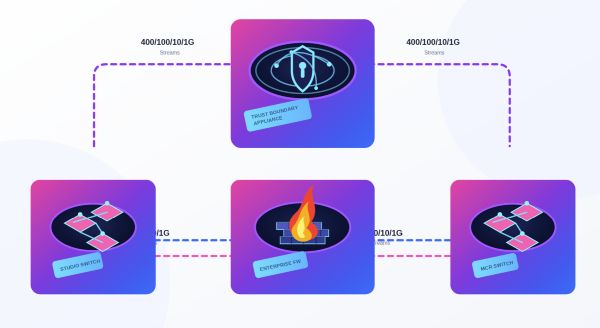
This is where the airport analogy matters. The Trust Boundary is not only there to reject what should not enter. It is there to inspect, verify, adapt and normalize what is allowed to cross. In standards-based IP media environments, it becomes the controlled handoff point where live flows can be secured, verified, adapted and monitored before they enter or leave a domain.
For file-based workflows, some uncertainty can often be absorbed. A transfer can be retried, a delay managed or a failed process restarted. Live production does not offer the same margin. A wrongly routed flow, an unexpected burst of traffic, a mismatch between domains or a lack of visibility can affect the viewer experience almost immediately.
For live media, resilience therefore increasingly depends on media-aware control at the boundary itself.
The Boundary as an Operational Asset
A Trust Boundary allows organizations to collaborate across venues, broadcast facilities, service providers, production partners and cloud platforms without giving up control at the point of interconnection. The boundary becomes the place where policies are applied, flows are governed, and operational attention is focused.
In practical terms, this helps prevent faults, misconfigurations or unwanted traffic from spreading across domains. It also gives operators visibility where visibility is often most needed: at the handoff between environments.
Seen this way, the Trust Boundary is more than a security mechanism. It is a resilience model for live media, turning the boundary from a potential weak point into a controlled operational asset.

This matters because resilience in live media is not only a technical requirement; it is a business requirement. Premium sports, major events, breaking news and high-value entertainment services depend on uninterrupted delivery. A disruption is rarely just a network issue. It can affect viewers, rights holders, advertisers, production teams and brand reputation.
When a live workflow crosses multiple domains, teams need more than a connection diagram. They need assurance that the right flows are entering the right environment, that service parameters are maintained, that issues can be detected at the boundary, and that a problem in one domain will not automatically spread into another.
Controlled interconnection gives organizations a more scalable way to build that confidence. It allows broadcasters, service providers and production teams to scale collaboration across venues, partners and cloud services while protecting the core operation through defined control points, consistent policies and media-aware visibility.
Resilience Begins Where Trust is Engineered
Live production is becoming more event-driven, distributed and collaborative. Major productions often bring together temporary facilities, external suppliers, remote teams, cloud services and regional distribution partners that must be assembled quickly, operated reliably and adapted for the next event. In that context, resilience cannot depend on manual control alone; it requires repeatable architecture.
Trust Boundaries provide that repeatability. They define how media domains interconnect, how flows are governed, how quality is verified and how operational teams maintain control across changing production environments. That is what turns resilience from a technical safeguard into an operational capability.
The next phase of IP transformation is therefore not only about moving media beyond the limits of traditional infrastructure, but about building the operational control needed to make distributed workflows resilient at scale. Resilience will not come from isolating every domain, but from making the boundaries between them controlled, visible and trusted.
In live media, trust is not a soft concept. It is an engineering requirement. As workflows continue to cross facilities, partners, networks and cloud environments, resilience begins where trust is engineered most deliberately: at the boundary.
Latest IAMT News
Globecast Demonstrates Content Exchange Latest Capabilities at SPORTEL Monaco 2026

Beam Dynamics Appoints Brian Mauger as Regional Sales Manager, North America

Sign-Up Here
Industry news, event updates and more. Sign-up for the IAMT Newsletter.