Bridge Technologies – The Bridge Between Broadcast and Boardroom: Why IPMX Matters Beyond the Studio

Simen K. Frostad, Chairman Bridge Technologies
There is a particular kind of silence that exists in a corporate boardroom during an important video presentation. It is not the silence of rapt attention. It is the silence of thirty people watching a spinning wheel, waiting for the CEO’s slides to appear, each second stretching into an eternity. In broadcast, that silence would be called an outage. In ProAV, it is often called Tuesday.
For decades, broadcast and professional AV have occupied separate orbits. Broadcast built its cathedral on ST 2110 – uncompressed, deterministic, exacting. The journey has not been smooth. There have been competing standards, false starts, and plenty of heated debates at trade shows. But overall, the move toward ST 2110 has been a galvanizing and unifying movement.
ProAV has had no such unifying force. Historically, the industry has improvised with proprietary solutions, different in every room, each a walled garden. A conference center built by one integrator bears no resemblance to a lecture hall built by another. Each is a patchwork of solutions that generally works, up until the point that it doesn’t. And at that point, there’s often little visibility as to what went wrong.
IPMX Changes the Calculus
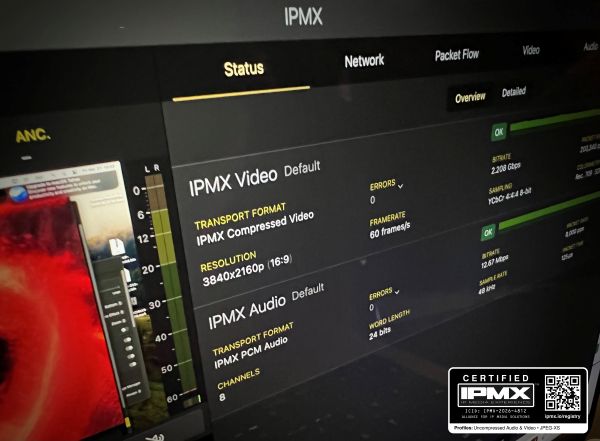
IPMX – Internet Protocol Media Experience – changes that. As an open-standard derivative of ST 2110 adapted for ProAV, it brings broadcast-grade reliability to the spaces where an increasing amount of our media is consumed. Corporate boardrooms. University lecture halls. Hospital surgical suites. Airport departure lounges. Anywhere video matters, but where the infrastructure budget does not include a dedicated network engineering team.
That is a brilliant move for ProAV. But why should broadcast technology companies care?
Simply, it’s because this is an area where we already have answers. And should ideally be willing to share them. The same infrastructure challenges exist everywhere video moves. After all, packet loss does not distinguish between a World Cup final and a quarterly earnings call. The physics of IP remains the same regardless of application.
More importantly, the collaborative, standards-driven philosophy that underpins IPMX – vendors aligning around shared protocols rather than proprietary lock-in – is precisely the approach that has driven broadcast’s own transition to IP. It took years of hard-won lessons, contentious debates, and patient engineering to build the ST 2110 ecosystem. That knowledge should not stay locked inside broadcast facilities. It should flow outward to the industries that are now grappling with the same problems broadcast solved a decade ago.
IPMX isn’t an idea, it’s a reality
If the theory isn’t enough to persuade, the evidence should be. The ProAVers are already hammering at the broadcast door: at NAB 2026 in Las Vegas, corporate media professionals at NAB numbered more than 13,000 – nearly double the 2025 figure – and NAB introduced a dedicated Enterprise Video Strategies track for the first time.
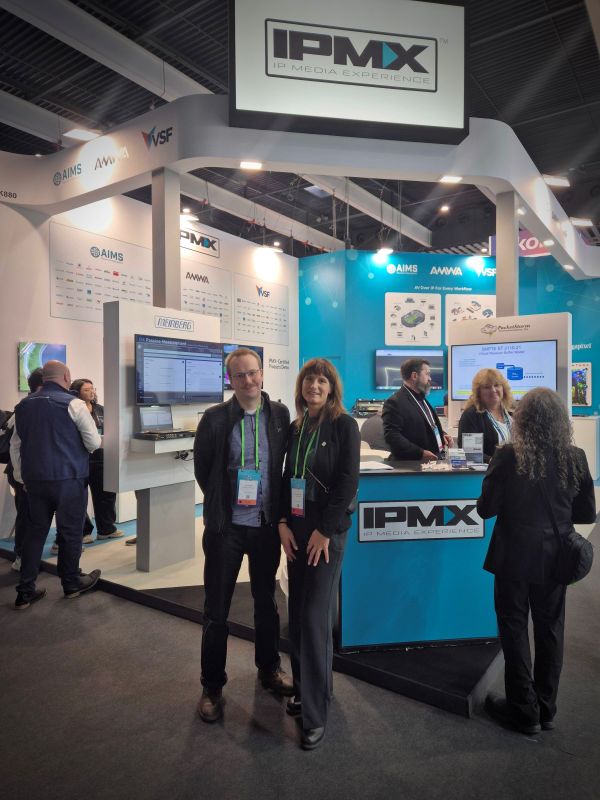
Broadcast manufacturers are taking notice. Critically. In January 2026, the European Broadcasting Union (EBU) headquarters in Geneva hosted the first official IPMX Certification Test Event. Twenty-five engineers from around the world spent five demanding days validating products against the VSF IPMX Test Plan. Ten companies earned certification – Adeas / Nextera, Bridge Technologies, Cobalt, Evertz, intoPIX, Matrox, Megapixel, Panasonic, PlexusAV, and Novastar – representing a total of 48 products.
A Responsibility to Bridge
But this is not about any single product or company. It is about responsibility as a whole. If we as an industry understand how to manage professional media over IP – how to synchronize streams, how to detect packet loss, how to verify timing alignment – we should apply that knowledge beyond the traditional broadcast perimeter. The boardroom deserves the same reliability as the control room. The lecture hall deserves the same predictability as the studio.
Those ten certified IPMXers have led the way. But there are other key players in the broadcast industry who also have a responsibility to take their hard-earned knowledge and offer it to the emerging industries that need it. Not as a competitive advantage. Not as a proprietary lock-in. As a contribution.
Because the transition to IP is not a zero-sum game. When ProAV succeeds in adopting open standards, the entire media ecosystem benefits. Device costs fall. Interoperability improves. Talent moves more freely between industries.
The companies that succeed in the coming decade will be those that build bridges – not between broadcast and ProAV in a transactional sense, but between the accumulated expertise of one industry and the emerging needs of another. They will recognise that the same principles apply everywhere video travels. And they will act accordingly.
After all, the broadcast industry spent two decades learning how to make IP work for professional media. It would be a shame to keep that knowledge to itself.
Latest IAMT News

Globecast Brings Media Orchestration and C-Band Transition Expertise to NAB Show New York 2026
IAMT™ CEO Update: – MediaTech Redefined: Driving Member Momentum and Impact into IBC 2026

Sign-Up Here
Industry news, event updates and more. Sign-up for the IAMT Newsletter.