Dynamic Software Licensing Working Group
Software licensing is slowing innovation across broadcast and cloud workflows. This group is where the industry comes to solve it.

Join the Dynamic Software Licensing Working Group
Software licensing is slowing innovation across broadcast and cloud workflows.
This group is where the industry comes to solve it.
The Dynamic Software Licensing (DSL) Group is a focused, cross-industry initiative building a practical best-practice framework for software licensing in modern broadcast environments – from cloud to hybrid.
By uniting industry leading buyers and vendors from across the media and cloud ecosystem, the group is tackling today’s licensing challenges head-on – transforming shared problems into real-world progress.
The result? A clearer, more flexible and streamlined approach to software licensing and management, designed to accelerate innovation.
This isn’t theory. It’s industry alignment in action.
Why Join:
This is an open initiative to form the best practices that set the standard for the industry.
Have your voice heard and take the opportunity to be part of an ever growing, industry-leading group featuring:
What next:
Meetings take place every other Wednesday on Zoom.
For more information on this group, contact: stan.moote@theiamt.org
This is an IAMT member/Global Alliance only group initiative.
Not an IAMT member yet? Join today and have your voice heard.
Dynamic Software Licensing
An interoperable framework for licensing software in dynamic broadcast and media environments — across on-premises, cloud, hybrid and resilience-oriented topologies. Licensing behaves as a governed runtime capability rather than a fixed activation step tied to a single host or appliance.
Best Practices — Version 1.0.0
The first official release of the IAMT industry best practices document for software-based, dynamic software licensing. Open to everyone — no login required.
The DSL GitHub repository
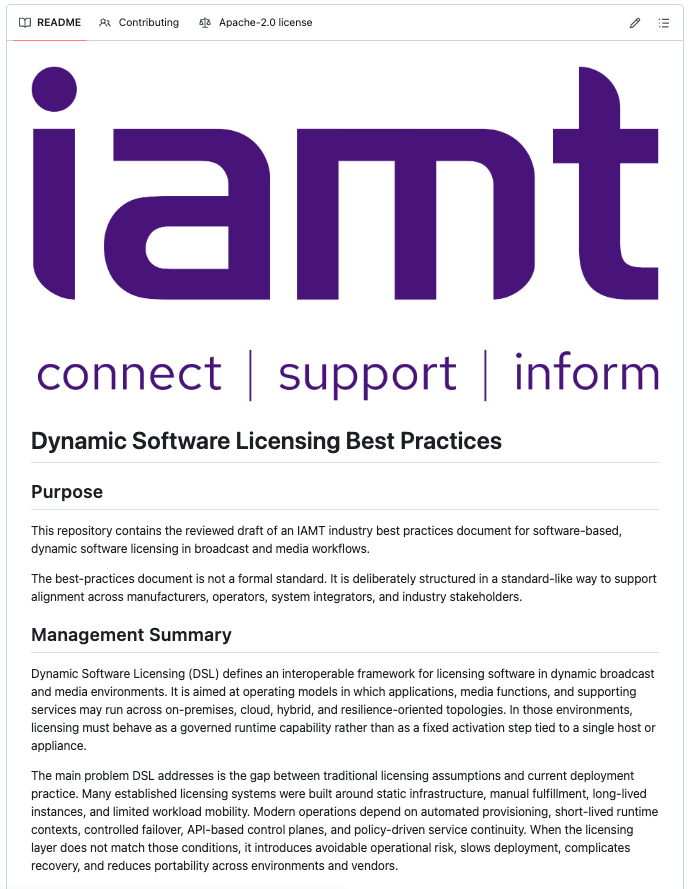
The best practices are developed in the open under an Apache-2.0 licence. The document is deliberately structured in a standard-like way to support alignment across manufacturers, operators, system integrators and industry stakeholders — but it is not a formal standard.
Working group members are invited to join the repository as collaborators.
How the initiative started
Stan Moote (CTO, IAMT) and Noor Hassan (Worldwide M&E Partner Solutions Architect, AWS) on why the industry needs to modernise the way application licensing is managed — and what the working group set out to solve.
Frequently asked questions
How can I contribute to the DSL Group?
The DSL Working Group consists of IAMT members and end-users within the MediaTech community. To contribute you can join the working group. You will then be invited to join the DSL GitHub repository as a collaborator.
Is DSL a formal standard?
No. The repository currently publishes best practices with standard-like structure and traceability, but it is not presented as a certification or formal standards program.
Does DSL require permanent connectivity to a licensing service?
No. The model is designed around signed, locally validatable runtime artifacts with bounded renewal and grace behavior.
Does DSL replace every vendor-specific commercial model?
No. The best practices standardize lifecycle semantics and interoperability patterns, while allowing vendors to retain differentiated commercial offerings.
Does DSL only fit cloud-native deployments?
No. The model is intended to remain platform-agnostic and to support cloud, on-premises, hybrid, and resilience-focused environments.
Why is identity-based binding emphasized so strongly?
Because dynamic workloads, failover, and automation-first operations are difficult to support reliably with static hardware binding.
What is the runtime object in DSL?
The runtime object is the lease and its signed token representation, derived from an entitlement and governed by an effective policy object.