

XroadMedia – Smarter Workflows, Stronger Experiences
Finding the sweet spot between AI and editorial control to build efficient workflows

Tom Dvorak, Co-founder and Chief Commercial Off icer, XroadMedia
There’s never been more pressure to do more with less. Content providers are expected to curate, personalize and distribute massive catalogs of live and on-demand video across millions of devices. Often while navigating tighter budgets, leaner teams and intense competition for viewer attention.
AI has emerged as an important answer to these challenges. It can process vast amounts of behavioral data, identify viewing patterns that humans would never spot and automate countless manual tasks. Used well, AI can dramatically improve efficiency across the entire content discovery workflow.
Services need to combine intelligent automation with human knowledge to create experiences that feel both relevant and intentional.
Changing Workflows, Not the Outcome
Years ago, an editorial team at a streaming service often meant people building homepages by hand, writing row titles one at a time and creating basic statistical recommendations. That model can’t survive a smaller headcount. But cutting editorial investment because budgets are tight treats the wrong problem. Human judgment was never the expensive part. Manual workflows are the slow part and slow doesn’t scale.
Algorithms excel at pattern recognition, but they lack cultural context. A recommendation engine can identify that a user watches high-tempo action movies on Friday nights, but it cannot appreciate why a specific regional drama is culturally resonant this week, or understand the strategic importance of promoting a high-budget original series during its premiere window.
AI is providing the opportunity to fill in the gaps with automation of repetitive tasks. So the hours that teams do have go toward decisions that actually need a person, like brand tone, cultural context, business priorities and the moments when a technically correct recommendation is still the wrong call editorially.
Teams Bring Different Intelligence
Editorial teams bring judgement that cannot simply be learned from historical viewing data. They understand seasonal moments, national events, local audiences and the tone their service wants to create. They know when to prioritize new releases, when to support under-discovered content and when business objectives should outweigh purely predictive recommendations. They know their brand.
This is where the balance becomes critical. AI should help editors make better decisions, not make every decision for them. The strongest personalization strategies combine machine intelligence with editorial oversight, allowing teams to guide experiences while benefiting from the speed and scale that automation provides.
Editorial teams should be able to influence recommendations, apply business rules, promote strategic content and ensure experiences remain aligned with their brand values. Without oversight, automation can create unintended consequences. Viewers may become trapped in recommendation loops, content diversity can suffer and opportunities to introduce audiences to new programming may be missed.
Human guidance ensures that personalization remains balanced rather than purely predictive. It also provides transparency. Editorial teams understand why content is being surfaced and retain the flexibility to adapt recommendations when priorities change.
Efficiency and Control
When we look at where service providers are getting more done with less, there are three main areas that can become more efficient.
The first is workflow automation that removes busywork. Rebuilding a homepage row, scheduling a promotion or running an A/B test used to mean filing a support ticket and waiting days. We built our Piloto management tools so content and product teams can make those changes themselves, easily, without complex training. That’s not replacing anyone. It’s closing the gap between an editorial decision and the moment it reaches a viewer, usually the real bottleneck teams are stuck fighting.
Secondly, every recommendation depends on metadata being accurate and current and keeping it that way has traditionally eaten a huge amount of editorial time. AI-driven metadata enrichment can now maintain that data continuously, which also opens the door to automatically generated row titles and conversational search that would take a team far too long to produce manually at any real catalog size. Tracking how people actually use a service can help automate user experiences, freeing editorial time to interpret what the patterns mean instead of collecting them by hand. Providing the opportunity to optimize strategy based on the trends shown to get the most out of personalization.
The third is real-time personalization that still runs inside boundaries a person sets. Getting more eff icient doesn’t mean editorial teams step back once the system is running; it means their control shows up differently. Personalization should operate inside business rules and priorities that editorial teams defi ne ahead of time, with a way to override that logic without waiting on a development cycle. That’s what lets a lean team keep a service feeling curated while personalization runs continuously, at a scale no one could manage by hand row by row.
Find the Balance
As AI adoption widens, services are realizing they don’t need black-box solutions and can deliver personalized experiences without compromising their brand voice or other business priorities.
Efficiency and editorial quality only seem in tension when automation is treated as a stand-in for judgment rather than an extension of it. What we have learned with our clients and from recent improvements to our back-end tool, Piloto, is that operators want flexibility and tools that are usable and don’t add complexity to the workflow. For example, the AI assistant we are launching at IBC lets editors use simple language in a chat window to create rows and other changes in the UI. This delivers use cases three times faster than when created manually, while still letting editors test and manage however their expertise requires. This is just one example of how personalization can be more customizable.
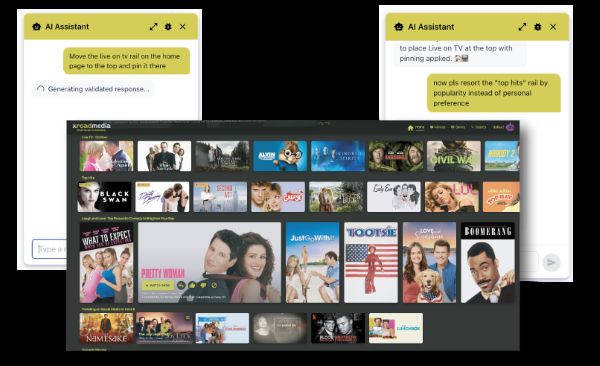
Example of XroadMedia’s AI Assistant in action, on how easily it can be used to create and edit rows within a UI.
Operators under budget pressure don’t have to choose between more AI and more human oversight. Automation has to carry the repetitive load and the people who actually understand the service and its users stay in charge of the decisions that define the personalized user experience.
Latest IAMT News
IAMT™ CEO Update: – MediaTech Redefined: Driving Member Momentum and Impact into IBC 2026

IAMT Executive Summary and Detailed Report from the SMPTE September 2026 Standards Meetings

Sign-Up Here
Industry news, event updates and more. Sign-up for the IAMT Newsletter.