Grabyo – Beyond the Single Broadcast: Orchestrating Live Production for a Multi-Platform World
One Production is No Longer One Output

Josie Waddams, Marketing Manager, Grabyo and Gareth Capon, CEO, Grabyo
For decades, live production followed a relatively linear path: produce the program, prepare the finished content for its intended destinations, then distribute it to the audience.
That model is disappearing.
Today, a single live event may need to serve linear broadcast, OTT, FAST channels, YouTube, TikTok and other social platforms simultaneously. Increasingly, audiences don’t simply expect the same program everywhere. They expect an experience designed for the platform, language, territory and device they are using.
Media organizations aren’t simply managing more distribution endpoints. They’re managing more versions of the content itself.
The question is how production teams can create, manage and distribute all of those experiences without building a separate workflow for every output.
The Multiplication Problem
Alongside a traditional 16:9 program, teams may need to create native vertical streams, regionalized feeds, alternative commentary, multilingual versions, different graphics and sponsorship, live clips, highlights and platform-specific content.
Historically, increasing outputs often meant increasing the infrastructure and resources behind them: another control room, operator, workflow or set of hand-offs between production and distribution teams.
But audience expectations are growing much faster than most production budgets.
The challenge is no longer simply scaling infrastructure. It’s scaling what that infrastructure can create.
For broadcasters, rights holders and publishers, solving that problem creates an opportunity to extract more value from the same live rights, production teams and source feeds.
From Cloud Production to Workflow Orchestration
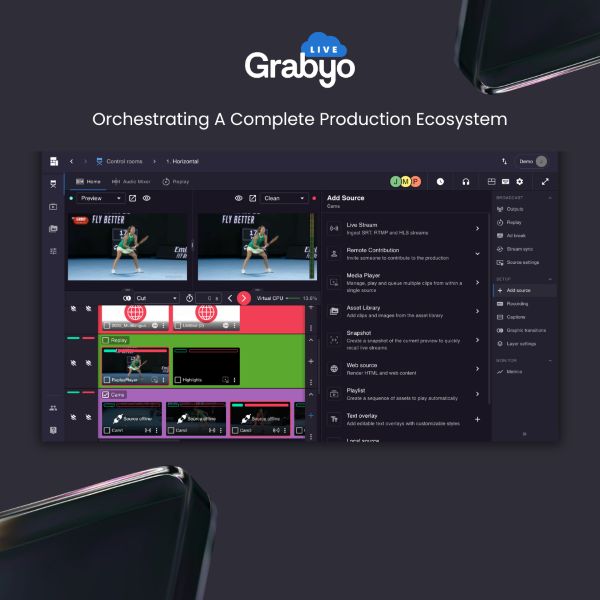
The first phase of cloud production was largely about moving traditional production capabilities into a more flexible environment. Could cameras be switched remotely? Could graphics, audio and replay be managed in the cloud? Could production teams collaborate without being in the same control room?
Increasingly, those questions have been answered.
The next phase is about orchestration.
Instead of asking, “Can we produce this event in the cloud?”, media organizations can ask: “How many audience experiences can we create from this production?”
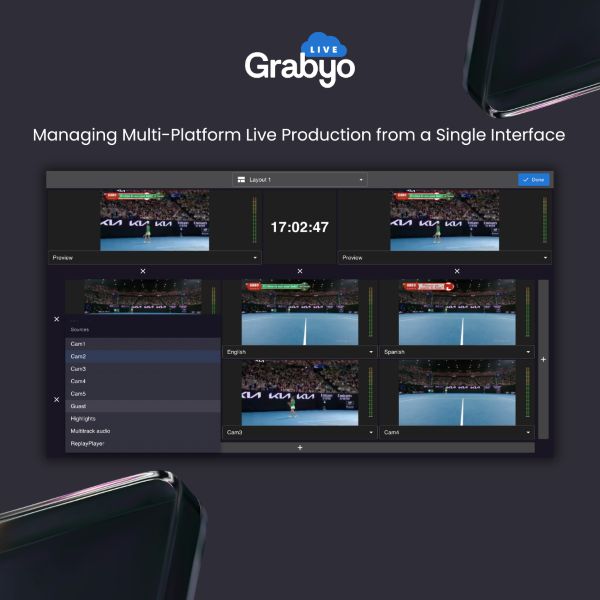
Rather than treating every new destination, format or audience as a separate production chain, cloud-native platforms can enable teams to manage multiple outputs from the same production environment.
At Grabyo, this means enabling operators to create and manage different formats, destinations and audience experiences within Grabyo Live, rather than duplicating an entire workflow whenever another output is required.
Distribution sends one program to more places. Orchestration enables one production to create more programs.
Vertical Video Demonstrates Why This Matters
Vertical video is perhaps the clearest example of why adding more distribution endpoints isn’t enough.
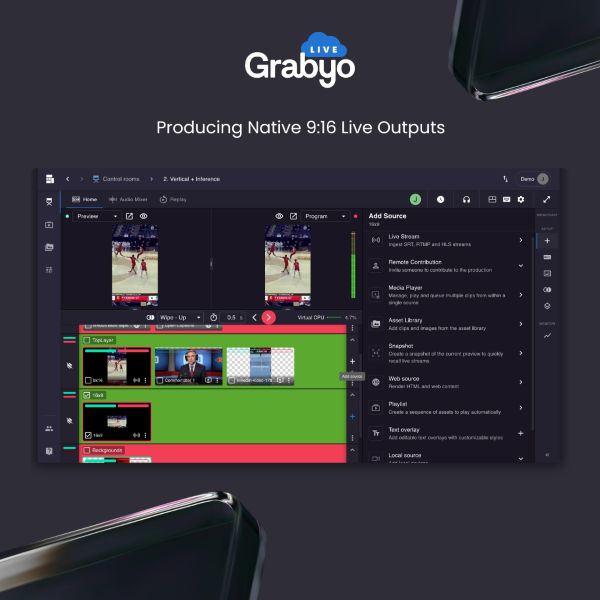
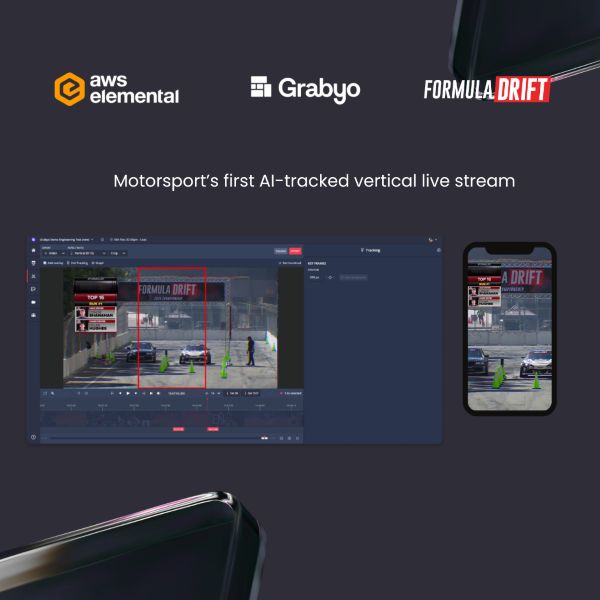
A native 9:16 experience can require different framing, composition, graphics and editorial decisions to a traditional horizontal broadcast. Historically, producing both simultaneously could require additional cameras, operators or a separate workflow.
Production teams can now create simultaneous horizontal and vertical outputs from the same live production. AI-assisted optical tracking can automate elements of reframing, while operators retain editorial control over the final composition.
This illustrates where AI can have the greatest practical impact. Its value isn’t simply in automating something an operator already does. It’s in making an additional output economically and operationally viable in the first place.
Working with Transition Productions and PHXAM, a single 16:9 production was used to create both horizontal and native vertical live experiences. The vertical TikTok livestream achieved three times the peak concurrent viewership of the horizontal YouTube stream.
Audience behavior will vary, but the example demonstrates an important point: adapting the experience to the destination can materially change how audiences engage with the same underlying content.
From Multiple Platforms to Multiple Audiences
Aspect ratio is only one dimension of this shift. The same principle applies to territories, languages, commentary, sponsorship and graphics.
Increasingly, the objective isn’t simply to send the same program to more destinations. It’s to create the most relevant version for the audience receiving it.
Localization provides a good example. Integrating AI-powered technologies such as Lingopal into cloud production workflows means translation and dubbing can happen while an event is live, rather than becoming a separate process after production has finished.
The same principle applies to alternative commentary, regional sponsorship or platform-specific graphics.
Instead of producing a single “master” broadcast and creating different versions downstream, media organizations can create audience-specific experiences as part of the live production itself.
Production, Preparation and Publication Are Converging
During a live event, a production team might be switching the primary program while simultaneously creating alternative outputs, reframing content, generating captions, localizing feeds, clipping highlights and distributing content across social, digital, OTT and broadcast destinations.
Content that once would have been prepared after an event can increasingly be prepared while that event is still happening.
Production, content preparation and publication are becoming parts of the same continuous workflow.
The opportunity isn’t simply to connect an ever-growing number of tools. It’s to reduce the hand-offs between them.
Every additional hand-off adds time, complexity and operational overhead. Bringing production, personalization, preparation and distribution closer together allows organizations to move content from source to audience more quickly while making better use of existing resources.
A Different Measure of Production Efficiency
This ultimately changes the economics of live production.
Efficiency can no longer be measured solely by how cheaply or quickly an organization can produce one broadcast. A more useful question is: how much value can that production generate?
Can the same production support linear and vertical broadcasts? Can it create regional or multilingual feeds? Can live moments become social content while the event is still taking place? Can different versions create additional sponsorship or advertising opportunities?
The most effective workflows will allow the same resources to support more formats, destinations, languages and revenue opportunities without operational complexity increasing at the same rate.
Cloud infrastructure makes that possible. AI can remove specific areas of repetitive work. But orchestration is what brings those capabilities together.
The future of media workflows isn’t simply about producing in the cloud or distributing content to more platforms.
It’s about turning a single production into the right experience for every audience, while the event is still live.
Latest IAMT News
Pebble – What Live Sport Demands From a Playout Platform
Are You Using AI? Are You Working with a Startup?

Sign-Up Here
Industry news, event updates and more. Sign-up for the IAMT Newsletter.