
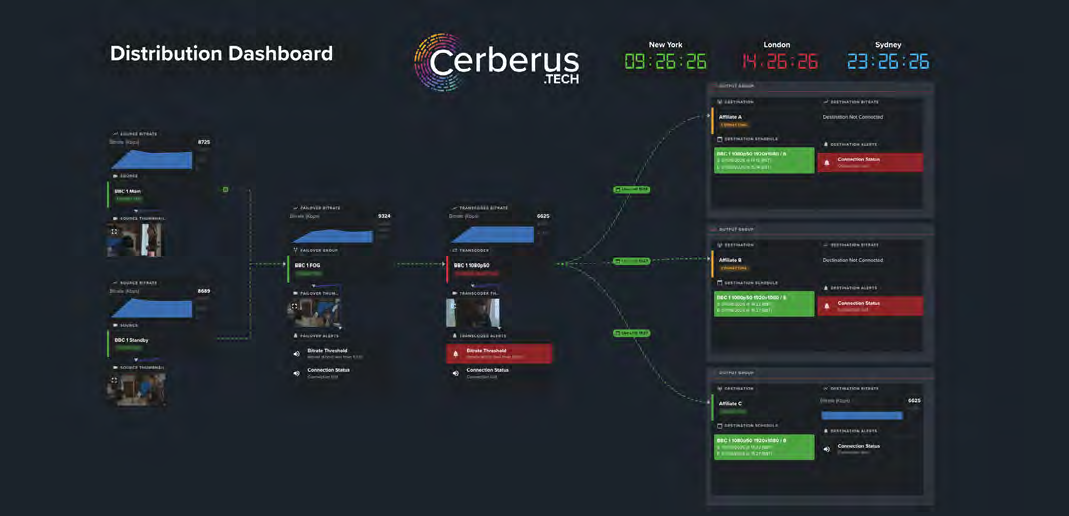
Cerberus Tech – Efficiency Isn’t About Automation. It’s About Eliminating Operational Friction.
For more than a decade, the media technology industry has pursued efficiency with remarkable determination.
Cloud computing has transformed infrastructure deployment, IP has replaced dedicated transport in many workflows, and software-defined services have made it possible to provision resources in minutes rather than weeks. Automation has become a strategic priority, while artificial intelligence is beginning to influence everything from quality control to scheduling and operational decision-making.
These advances have undoubtedly made live video operations more flexible. Organizations can launch services more quickly, scale them more easily and adapt to changing commercial demands without the capital investment once required. Yet for many, there remains an uncomfortable contradiction. Although the technology has become increasingly efficient, operating it has not necessarily become any simpler. That contradiction suggests we may have been measuring efficiency in the wrong places.
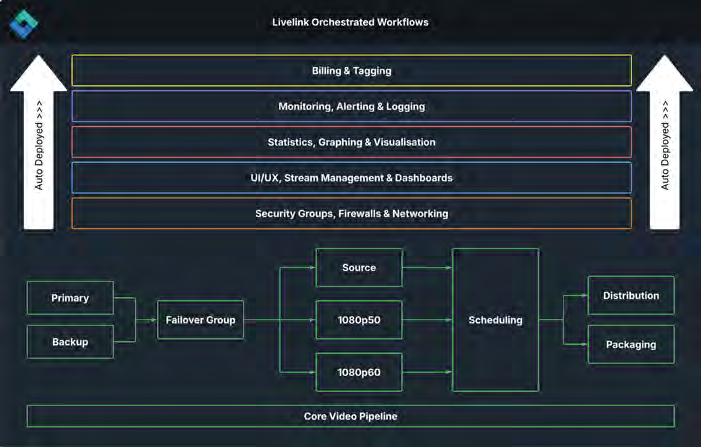
Much of the conversation surrounding efficiency focuses on the performance of individual technologies. We compare cloud providers, evaluate transport protocols, benchmark encoding platforms and assess monitoring solutions. These discussions are important, but they often overlook the operational effort required to combine those technologies into a reliable service. A live workflow is rarely constrained by the capability of any single product. More often, it is shaped by the decisions, processes and coordination needed to make different products work together consistently.
This is not a criticism of the industry’s move towards best-of-breed solutions. On the contrary, organizations now have the freedom to select the technologies that best meet their operational requirements, combining specialist transport, processing and monitoring platforms across multiple cloud providers to balance resilience, performance, cost and technical preference. The consequence, however, is that complexity has changed rather than disappeared. Rather than being embedded within proprietary hardware, it now exists between systems, increasing the engineering effort required to deliver a reliable service.
The operational lifecycle of a live workflow begins long before the first packet of video is transported. Someone must decide how content enters the platform, where it should be processed, how resilience will be achieved, which destinations require delivery, what monitoring should be applied, how users will interact with the workflow and when infrastructure should be created or removed. Every one of those decisions reflects operational intent: the outcome the organization is trying to achieve.
Translating that intent into running infrastructure remains surprisingly manual. Engineers provision cloud resources, configure transport links, establish monitoring, create dashboards, apply security policies, define alerting rules and connect multiple services before the workflow is ready for use. Once an event has finished, those resources must be reviewed and, where appropriate, removed before the process begins again.
None of this is inefficient because engineers lack expertise. Modern live production relies on highly skilled teams capable of designing increasingly sophisticated services. The question is whether those teams are consistently applying their expertise where it delivers the greatest value.
The industry frequently presents automation as the answer to this challenge, and there is no doubt that automating repetitive activities reduces operational effort. Yet there is an important difference between automating individual tasks and orchestrating an entire operational outcome. Automating a cloud instance or transport connection is valuable, but someone still has to understand how those actions relate to every other element of the workflow.
Orchestration addresses a different problem. Rather than asking how individual tasks can be executed more quickly, it asks how an operational objective can be expressed once and implemented consistently every time. As workflows continue to evolve, the challenge is no longer performing isolated technical actions efficiently. It is ensuring that every component required to deliver a service is created, managed and retired as part of a single operational process.
This also invites us to reconsider a familiar debate: should organizations build their own solutions or buy them?
The answer will always depend on strategic priorities, resources and internal expertise. Some organizations will continue to develop proprietary platforms because they provide competitive advantage. Others will adopt commercial products that allow them to move more quickly or reduce operational overhead. Increasingly, many will do both. The more important question is where engineering expertise delivers the greatest value.
Highly experienced broadcast engineers are among the industry’s most valuable assets, yet many continue to spend significant time provisioning infrastructure, connecting services and maintaining consistency across multiple systems. These activities remain essential, but they are not necessarily the highest-value use of specialist expertise. Technology should not seek to replace those engineers. It should enable them to spend more time applying the knowledge that only experienced engineers possess. Reducing operational effort is not about reducing the importance of people; it is about allowing them to focus on the decisions that genuinely influence service quality, resilience and innovation.
This philosophy has increasingly shaped our own work at Cerberus Tech. As we considered the operational challenges faced by customers, it became clear that adding further automation to individual components would only take us so far. The greater opportunity lay in capturing operational intent itself. That thinking led to the development of what we describe as “atomic orchestration”. Rather than treating provisioning, transport, monitoring, processing, security, logging and resource management as separate technical activities, they become part of a single operational action. An engineer defining a live sports workflow is not making a series of discrete technical decisions; they are expressing an operational outcome. The platform translates that intent into every supporting service simultaneously and removes those resources together when the event ends.
The technology itself is only one aspect of that approach. More significant is the consistency it introduces. Operational knowledge no longer exists solely in the experience of individual engineers or within deployment documentation. It becomes embedded within the workflow itself, allowing services to be deployed repeatedly without requiring every decision to be recreated from first principles.
The next phase of operational efficiency is unlikely to be defined simply by faster cloud services, more sophisticated automation or the latest application of artificial intelligence. Those technologies will continue to shape our industry, but their greatest value will be realized when they become part of coherent operational models rather than isolated technical capabilities.
Perhaps that is how we should begin to measure efficiency in the years ahead. Not by how many manual tasks have been eliminated, or how quickly individual systems perform, but by how little effort is required to translate operational intent into reliable, repeatable live services. Organizations that achieve that will not only operate more efficiently; they will create the space for their engineering teams to focus on the problems that truly deserve their expertise.

Cerberus Tech helps broadcasters, rights holders, sports organisations and media companies simplify and scale live media operations. Read more
Latest IAMT News
-
Cerberus Tech – Efficiency Isn’t About Automation. It’s About Eliminating Operational Friction.
nxtedition brings integrated production and agentic AI to CABSAT 2026

Sign-Up Here
Industry news, event updates and more. Sign-up for the IAMT Newsletter.