UTO at IBC 2026: What We Reinforced and What Comes Next
IBC is often described through product launches, technology announcements and packed exhibition halls. For us, IBC 2026 was defined just as much by the conversations we had.
Over four busy days in Amsterdam, we met long-standing clients, partners and industry colleagues, while also connecting with many new faces. These conversations reinforced our understanding of how media organisations are approaching the next phase of change, and gave us additional insights into the upgrades we have been working on across our products and services.
The atmosphere was optimistic, but also more grounded. The questions were no longer only about what new technology could make possible. They were increasingly about what could be implemented, integrated and operated effectively within real media businesses.
That shift was one of the clearest themes to come through at IBC 2026, and one that aligns closely with the direction we have already been building toward.
AI Has Moved Beyond the Presentation
AI was everywhere at IBC, but the conversation around it felt noticeably more mature.
The industry has moved past being impressed by concepts alone. Broadcasters and media companies now want to understand where AI can solve a genuine operational problem, how it will fit into existing workflows and what measurable value it can deliver.
The focus is shifting from experimentation to execution, confirming the approach we have taken with our own AI capabilities.
Clients are asking more practical questions. Can the technology work with the systems and data they already have? Can it reduce repetitive work without introducing new complexity? Can it support better decisions while preserving the necessary level of human control?
A compelling presentation may start a conversation, but it is no longer enough to sustain one. Media organisations want solutions that can move beyond the proof-of-concept stage and perform reliably in the real world.
For technology providers, that means understanding the business and operational context behind the requirement is becoming just as important as the capability of the technology itself, a principle that continues to shape how we build.
Connected Workflows Require Connected Thinking
Another recurring theme was the growing need to connect information across the media lifecycle.
Rights, content, scheduling, distribution and monetisation are closely related, yet they are frequently managed across separate systems and teams. This fragmentation can create duplicated work, inconsistent information and delays in decision-making, a challenge we have been addressing directly through our product roadmap.
Our conversations around RightsU reinforced the increasing importance of making rights information accessible, current and operationally useful. Rights management can no longer remain a static record-keeping activity. It must support timely decisions about how, where and when content can be used.
We also had encouraging discussions around Plenara and the role of better-connected content planning. As audiences and distribution models continue to evolve, planning must account for more platforms, formats and commercial priorities. Teams need a shared view of the content journey before scheduling and execution begin.
The objective is not simply to add another system. It is to help people make informed decisions with greater confidence and less manual reconciliation, which is precisely what we have been building toward.
Partnerships Turn Capability Into Outcomes
IBC once again demonstrated that meaningful progress in media technology rarely happens in isolation.
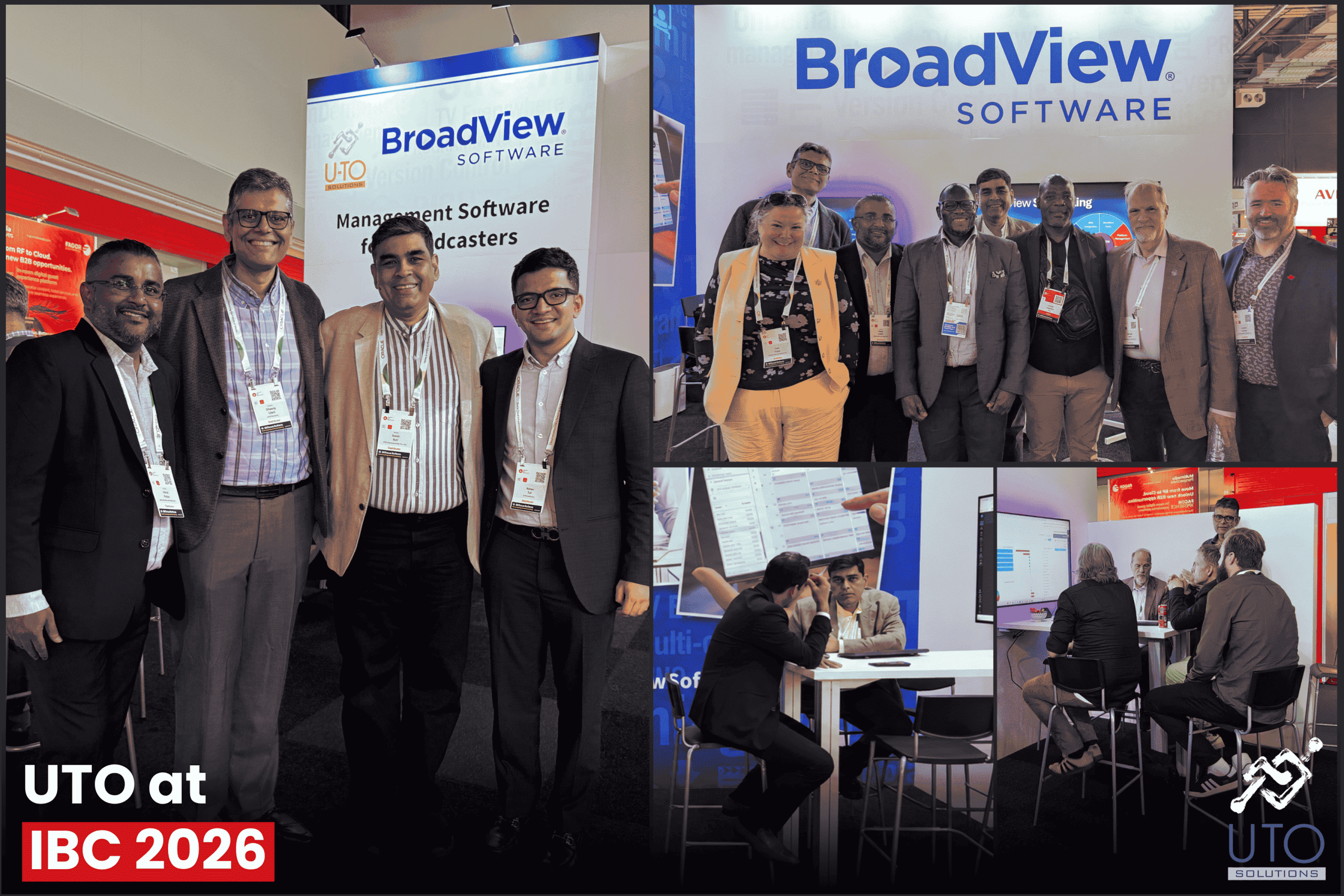
Our association with BroadView continues to bring together complementary expertise and a shared understanding of the operational challenges faced by broadcasters. IBC gave us an opportunity to strengthen that relationship, exchange perspectives and discuss how we can continue supporting media organisations as their requirements evolve.
We also valued our conversations with CRM.COM and Unicast. Strong partnerships allow different capabilities, market knowledge and technical strengths to come together around the needs of the client.
This collaborative approach is especially important as media operations become more interconnected. No single platform or provider can address every requirement independently. Progress depends on partners who understand their respective roles and can work together toward a practical outcome.
IBC provided the right environment to continue these discussions and explore the path ahead.
Technology Must Understand the Business
One of the clearest reminders from our conversations was that technical capability alone does not guarantee successful transformation.
Media organisations are managing a complex mix of legacy infrastructure, new platforms, changing audience behaviour, commercial pressure and evolving operating models. Any technology introduced into that environment must understand more than the immediate technical requirement.
It must also understand the people who will use it, the processes surrounding it and the business decisions it is expected to support.
This is where meaningful transformation often succeeds or fails. A solution may be technically impressive, but if it does not reflect the organisation’s actual workflows and priorities, it risks creating another layer of complexity.
The smarter technology becomes, the more context matters, and it is a principle we continue to build around.
From Conversations to What Comes Next
For UTO Solutions, IBC 2026 was a valuable opportunity to engage, reconnect and share our thinking with the industry.
The discussions reinforced several realities we have long held. AI is becoming more practical and accountable. Rights and content planning need to be connected more closely with day-to-day operations. Partnerships are increasingly essential to delivering complete outcomes. Above all, technology must be shaped around the reality of the business it serves.
We returned from Amsterdam with new relationships, stronger partnerships and a sharper view of the priorities facing broadcasters and media organisations.
We had showcased some of our thoughts on these aspects as part of our interactions at IBC, and we hope to demonstrate these business use cases more coherently in the coming months.
Latest IAMT News
-
UTO at IBC 2026: What We Reinforced and What Comes Next

LiveU Showcases AI-Driven Production, Resilient IP Contribution and Workflow Automation at CABSAT 2026

Sign-Up Here
Industry news, event updates and more. Sign-up for the IAMT Newsletter.