Agama – Making observability accessible across the organization for faster decision-making
Video service providers have spent years investing in observability, analytics and operational tools, and as a result, they now have a lot more information about their services, including networks, apps, devices, delivery platforms and individual viewing sessions.
Extracting value from that information means navigating multiple dashboards and relying on a small group of specialists who understand the platform, the service architecture and how data connects across the whole delivery chain. This can work during normal operations, but it becomes more challenging during a major event, when customers are calling support, management wants answers and different teams are trying to understand the same situation from different perspectives.
Starting with the question, not the tool
That is the idea behind Agama Augmented Intelligence (A2I): making observability easier to use by starting from what the user is trying to understand, rather than from a specific dashboard, metric or application. It represents a significant evolution of the Agama Video Observability and Analytics platform.
A2I brings a set of AI-assisted capabilities into the platform, each aligned with a different user process. Instead of first deciding where to look, users can begin with the operational or business question itself. The platform can then work across the available data, tools and context to investigate the issue, present relevant evidence and explain what it means.
A central capability is continuous AI-assisted service monitoring. Rather than waiting for a user to ask a question, the platform continuously follows the state of video services and supporting infrastructure, checks relevant signals and highlights what deserves attention. It works much like an additional member of the operations team: keeping watch, following developing issues, remembering previous observations and providing regular updates as situations evolve.
Other AI-assisted capabilities are available directly in the user’s working context. A NOC engineer can use an operational analysis assistant to investigate an alarm, a service degradation or an unexpected change in a KPI. A customer care agent can use a support investigation assistant to diagnose an individual subscriber issue, identify the likely cause, explain the findings and recommend appropriate next steps. Product and marketing teams can use a content and engagement analysis assistant to understand which content engages viewers, how audiences use the video service and how behavior changes over time.
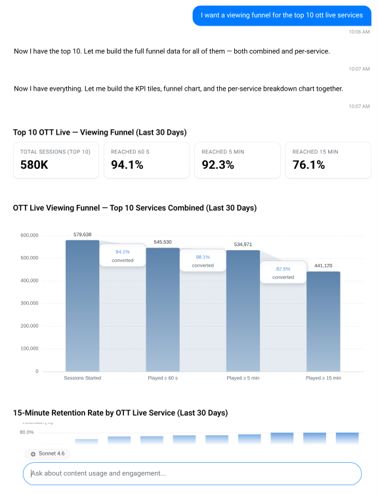
Visual: Example of an A2I interaction, where a natural-language request is turned into a viewing funnel with key engagement and retention insights across OTT live services.
These capabilities are available directly within the services, alarms, KPIs, subscriber views, customer care processes and analytics applications users already work with. The AI therefore becomes part of the workflow rather than a separate destination that users need to learn.
The result is a different way of working with video observability and analytics: keep watch, investigate what changed, understand why, and communicate the result – with AI working as an active part of the operational and analytical team rather than simply another tool to operate.
From investigation to explanation
Let’s consider a live sports broadcast where viewer complaints begin to spike. The Customer Care team needs to know whether the issue is widespread, who is affected and what the root cause is. Previously, the first step was to escalate to NOC engineers, who would investigate across several dashboards before anything reached the frontline. This could involve multiple handovers at the point when time matters most.
With A2I, the first-line team can receive proactive assistance from the AI-assisted service monitoring giving them early insight into who is impacted, when and where. They can ask the platform detailed questions directly: “Are there service degradations affecting mobile users in the last 30 minutes?” The platform retrieves and correlates the relevant data in real time. What previously required escalation, several dashboards and multiple handovers can begin with a single interaction from the person who actually needs the answer.
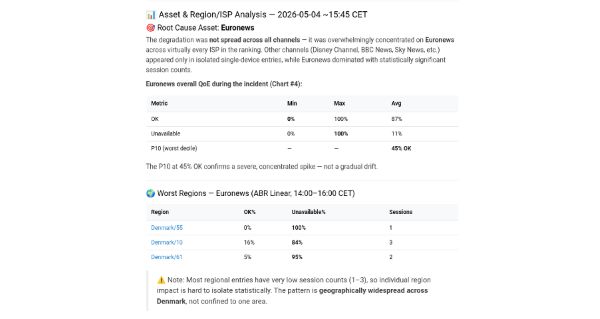
The platform can also show the reasoning behind an investigation. For example, an AI agent can examine whether an issue is connected to a linear service, identify a highly affected asset, compare performance across different internet service providers and determine whether the available evidence points to a network-specific problem or an issue further upstream.
Operational insight useful across the organization
When operational information becomes easier to access, the same data can support more teams across the organization. Operations, Product, Customer Care and Management can work from a more consistent view of service performance, reducing the number of separate interpretations and the need for manual explanations during an incident.
It can also reduce dependence on a few technical specialists for routine questions, allowing those specialists to focus on more complex analysis while other teams retrieve the information relevant to their own responsibilities.
Data privacy, security and deployment flexibility remain important, particularly for operators working in regulated or highly controlled environments. For this reason, A2I is LLM-agnostic and supports cloud-based as well as locally deployed models, giving operators better control over their data, compliance requirements and choice of model provider.
Agama’s Model Context Protocol (MCP) integration also allows external AI systems and applications to interact securely with Agama’s observability capabilities, creating possibilities for automated workflows, custom reporting and operational applications outside the platform’s native interface.
Making things easier instead of adding another layer
Our view is that the role of AI in video operations should not be to introduce another layer of complexity, but to simplify how teams work and make better decisions faster.
The information needed is already available to the teams, but it may be difficult to access, interpret or share quickly enough. By allowing more people to ask direct questions, generate relevant views and understand the reasoning behind the results, A2I creates a more practical connection between observability data and decision-making.
For a video service provider, that connection can mean understanding an incident sooner, aligning teams more quickly and making decisions with greater confidence, at the moment when service quality, customer satisfaction and business performance are most closely linked.
Latest IAMT News
IAMT launches new AI Sovereignty Report
MediaTech Has Outgrown Broadcast: So Has the CTO’s Job

Sign-Up Here
Industry news, event updates and more. Sign-up for the IAMT Newsletter.