
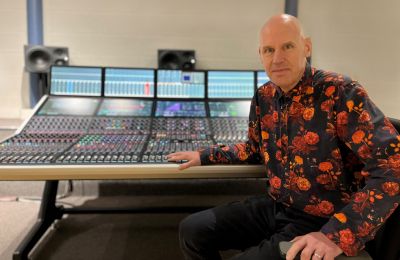
Calrec – Efficiency as a Design Principle, Not Just a Cost Saving
Henry Goodman, Director of Product Management, Calrec
I wrote an article for IAMT’s Q1 2026 Journal that looked at how hybrid workflows are reshaping what’s creatively and operationally possible – blending on-premise, remote and virtual production. The following article asks the harder question: now that broadcasters can build almost any production model they want, how can they adapt to the one which actually makes economic sense for any given job?
The answer is to build a flexible ecosystem that empowers the utilisation of available and future resources. If a broadcaster’s technology can only serve one production model, efficiency becomes a compromise. Provisioning a system for the occasional biggest production, rather than the day-to-day production usage, is not economically sound. As rights costs continue to rise and margins tighten, broadcasters need infrastructure they can scale when a project actually calls for it, rather than sinking capital into hardware for a worst case that may never arrive.
Scale Without Retraining
If a single platform can move between on-premise, remote and virtual production without new hardware or retraining, efficiency stops being a trade-off and becomes an opportunity that is a built-in outcome of the investment itself.
The same logic works at the lower end of the market too. It fills content gaps at tier-two and three sports, where digital-first coverage builds new audiences and revenue that wouldn’t have covered a traditional setup.
Giving broadcasters the technical agility to scale and control everything, while retaining familiar operational environments, so that adapting to a project’s economics doesn’t also mean retraining every operator involved is an incredibly attractive proposition, and is one they are embracing.
Reverse Remote Production
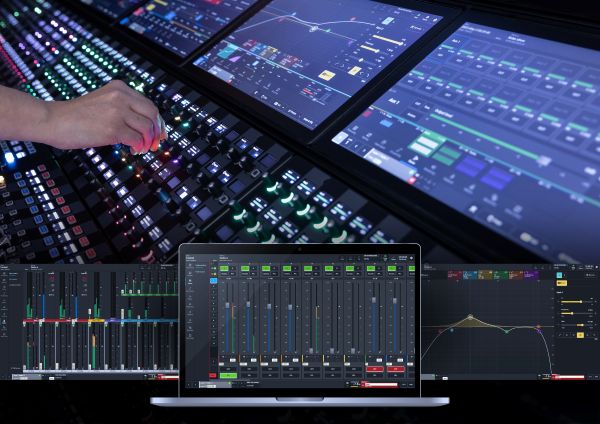
This allows broadcasters to become more innovative, giving them the capacity to develop new production models that would have previously been impossible. High-profile projects like the Summer and Winter Games and the recent World Football Championships have proven that the physical location of an audio controller no longer matters. Crucially, nor does the location of the processing, which can be anywhere – on-premise, at the edge, or totally virtualized, spun up in a software-defined environment as and when needed on a temporary basis, or a blend of all the above.
One company has taken this principle further than most. DMC Production is a perfect example of a company that has engineered a concept built so fully around virtualization that it fundamentally rewrites the relationship between venue, technology and operator, putting control everywhere and complexity firmly in the background.
Working in collaboration with Calrec and Grass Valley, the company recently unveiled two identical software-defined remote production vehicles, built and delivered by systems integrator, Broadcast Solutions. Designed as scalable models for future development, AR 1 and AR 2 represent a unique outside broadcast framework the company describes as “reverse remote production”.
Compact, yet capable of supporting large multi-camera productions, the vehicles are built around a software-based architecture that replaces the traditional hardware-heavy OB model. The guiding principle is simple: all production-critical processing happens at the venue – video switching, replay, signal processing, multiviewers, recording and audio mixing, all running within a pure cloud-native Grass Valley AMPP environment with remote operation from any of DMC Production’s broadcast centers.
Sound at the Source
Instead of backhauling the raw production feeds to a central facility, the remote vehicle becomes the local production edge. The major benefit is bandwidth efficiency; a large multi-camera production can be handled over a lightweight 100 Mbit/s internet connection. In these environments, audio can be challenging, but DMC Production has worked with Calrec to develop an audio network that not only connects everything seamlessly but delivers low latency control with a familiar interface.
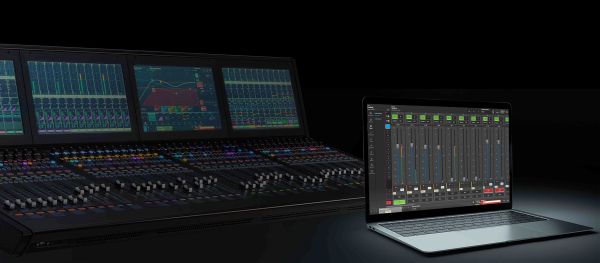
DMC Production has also installed a 48-fader Calrec Argo M console at its remote production facility in Munich, Germany. The ecosystem is connected and managed using Calrec’s True Control 2.0, enabling seamless integration between the control surface and the OB units across any geographic boundaries. It means an audio engineer can manage the entire mix remotely across a low-latency connection while production-critical processing remains in the AMPP-based remote production vehicles at the venue. For DMC Production, this means the cost of covering a job scales with the job itself.
Keeping it Simple
The industry is transforming fast. The need for agile, scalable, future-ready solutions has never been greater, but keeping it all simple is a challenge. Responsible vendors are spending time and money ensuring that the interface is the same as it’s always been but importantly these developments are also encouraging stronger relationships within the vendor community.
The DMC Production project is a clear example. It builds on Calrec’s technology partnership with Grass Valley’s AMPP, which was announced in April 2026. The agreement outlines a dynamic production environment that natively integrates Calrec’s ImPulseV virtual DSP software with Grass Valley’s AMPP cloud-native live production platform. As an interim step, DMC Production is using Calrec’s ImPulse1 processing core until the fully integrated ImPulseV AMPP platform comes online.
Future Proofing Freedom
Sports and live production economics are evolving quickly. Broadcasters are being asked to do more with tighter budgets and smaller teams, while juggling different setups: remote production one day, on-prem the next, virtual the day after. Each comes with its own cost profile, and none of them is affordable to build for in isolation.
This is precisely the gap that Calrec’s connected IP ecosystem closes. Built around the Argo range of consoles, it provides one platform that moves between the different variations of a broadcaster’s workflow, so the cost of the console tracks the scale of the job rather than the other way round, giving broadcasters the flexibility to deploy resources where they’re needed most, while driving greater operational efficiency.
Latest IAMT News
MediaTech Has Outgrown Broadcast: So Has the CTO’s Job

IBC2026 brings global media industry together to turn innovation into action

Sign-Up Here
Industry news, event updates and more. Sign-up for the IAMT Newsletter.