Witbe – Built to hold: Resilience in the World Cup Delivery Chain
Yoann Hinard, COO – Witbe
Match by match, the chain is performing, and the operators carrying the tournament are showing what months of preparation buys you. Resilience is no longer a promise. It is a measurable outcome.
The first matches of the FIFA World Cup are in. The video delivery chain is holding.
Across satellite, cable, OTT, FAST channels, and free-to-air, audiences around the world have watched the opening goals delivered crisp, in the right language, with the right overlays, on the right devices, in the right region. This did not happen by accident. It is the visible result of months of work that nobody outside the operations teams will ever see, and that is the point.
Live sports is the sharpest test of a video delivery chain, but the same principles apply to any high-stakes scheduled-event delivery: elections, market opens, concerts, awards shows. What it takes to be resilient does not change with the genre.
Months of Preparation, Live on Screen
A live sports chain in 2026 is a far more complex thing than the one operators ran five years ago. Multiple CDNs with mid-stream switching. Multi-DRM packaging. Dynamic ad insertion that varies by region and household. Low-latency CMAF and LL-HLS. Blackout enforcement that varies by territory. And a long tail of consumer devices, across apps, set-top boxes, mobile, web, and especially smart-TV native apps, where firmware fragmentation is most acute. Where standardization stops, interoperability has to be tested on real devices, in real conditions.
Each layer was engineered carefully. None of them were engineered together. That gap is where the hard work of the past few months happened. The operators who held up best through the opening week did not solve that complexity by adding more dashboards. They closed the QoS-to-QoE gap. They put visibility where viewers actually live: on the screen, on real consumer devices, in the regions where their audience watches.
On the night, dashboards looked green. They always do. What kept the chain holding was that the operators were not only watching them.
When a decoder stalled briefly on an older smart-TV model during the opening match, the engineering team in that operator’s NOC saw it on the test devices in that region before viewers reached for their phones. The runbook ran. The issue was contained. Most viewers never knew anything had happened, which is exactly the outcome the team had rehearsed for.
At another operator, a multi-audio stream went out in the wrong language partway through a match. Telemetry confirmed audio delivery, as it always does. The test devices showed what the dashboards could not: viewers were hearing commentary in a language they had not selected. The team identified the misrouting and pushed a fix before the final whistle.
Playbooks Have Evolved
A runbook written eighteen months ago referenced a chain that no longer exists. New CDN. Upgraded encoder. Swapped DRM. New ad server. Refreshed device matrix. The operators carrying the tournament knew this, and they updated their playbooks accordingly.
Synthetic test users running on real consumer devices, distributed across the regions where viewers live. Rehearsed failover paths, origin swap, CDN cutover, DRM fallback, regional blackout activation. Independent measurement at the screen, so a vendor disagreement is settled by evidence rather than assertion. None of these were theoretical changes. They were rehearsed weekly through the spring, refined after each drill, and stress-tested before the opening match.
The result is visible in the first week. Wrong regional ads have been caught and remapped within the same break. Decoder stalls on older devices have been identified and routed around. Blackout enforcement has held across territories. Subtitle and audio tracks have arrived on time, in the right language, on the right device. Across the device matrix, and especially on smart-TV native apps, where small variations cause the largest viewer-side impact, the chain has performed.
These were not certainties at the start of June. They are now demonstrable.
Monitor Through to the Final
The tournament has only just begun. The same discipline that delivered the opening week needs to hold all the way through, match by match, to the final. That is the moment where every part of the chain has to come together at once, and getting there in good shape means staying alert to what the chain is doing on screen every day between now and then.
With every match, the same vulnerabilities are still there. Wrong ads ready to misfire. Decoders ready to stall on legacy firmware. Regional caches one BGP change away from degrading. The chain holds because someone is still watching the screen, not because the risk has gone away.
The teams positioned well for that moment are the ones continuing to do what got them through the opening week. Watching the screen, not just the network. Catching local issues before they spread. Adjusting their runbooks based on what they are learning in real time, match by match.
Resilience is not a state that gets switched on before kickoff. It is the discipline of staying awake to what the chain is doing on screen, all the way to the final whistle.
The takeaway is not specific to soccer. Resilience under pressure is something this industry knows how to engineer, and the operators carrying the tournament are showing it can be done.
Witbe wishes you and your viewers a flawless streaming experience through every match, and especially through the final whistle.
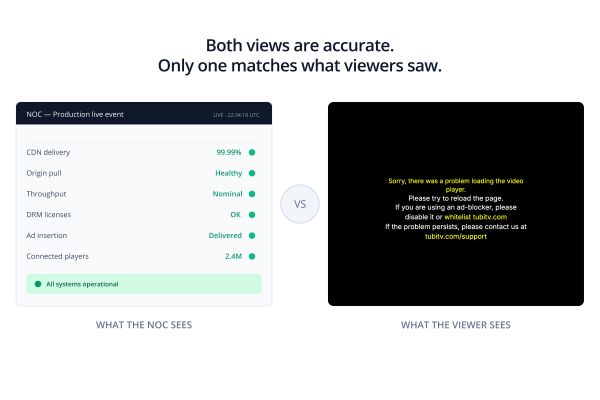
Figure 1. Same break, same moment. The NOC reports every system healthy across CDN, origin, DRM and ad insertion. On the device, the ad break has failed. Resilience depends on watching both views, because only one matches the viewer’s experience.
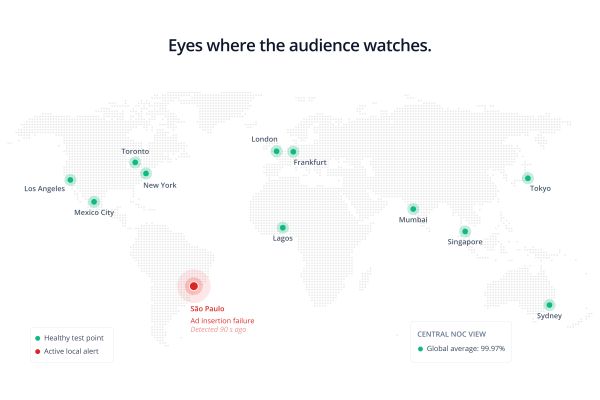
Figure 2. Distributed test devices across viewer regions. The central NOC reads a healthy 99.97% global average; the São Paulo robot has detected a local ad insertion failure that the global metric smooths out. The fix can be pushed before the regional viewer experience degrades.
Latest IAMT News

Globecast Brings Media Orchestration and C-Band Transition Expertise to NAB Show New York 2026
IAMT™ CEO Update: – MediaTech Redefined: Driving Member Momentum and Impact into IBC 2026

Sign-Up Here
Industry news, event updates and more. Sign-up for the IAMT Newsletter.