
PTZOptics – Enterprise AV: From Video Production to Visual Intelligence

Claudia Barbiero, Director of Global Marketing, PTZOptics
For decades, professional AV and broadcast technologies have been confined to solve a familiar challenge: capturing, producing and distributing high-quality video.
Today, those same technologies are finding new opportunities far beyond traditional unified collaboration, media and entertainment. Across manufacturing, healthcare, education, corporate communications and industrial operations, organizations are adopting MediaTech infrastructure not because they want to become broadcasters, but because they need better ways to understand, automate and improve real-world processes.
This shift is creating one of the most significant growth opportunities for Enterprise AV. Cameras, video networks and production technologies are evolving from content creation and distribution tools into intelligent systems that help make decisions, improve efficiency and automate workflows.
The Camera is Becoming a Decision-Support Platform
Historically, the value of a camera was measured by image quality, reliability and control. Those capabilities remain essential, but they are no longer the whole story.
Advances in computer vision, AI and vision language models are enabling cameras to do more than capture images. No longer just image capture devices, cameras are turning into decision-support platforms that help organizations understand operations, identify opportunities and automate responses in real time.
This transition mirrors a broader Industry 4.0 trend. Manufacturing facilities, healthcare organizations, government institutions and enterprise operations are increasingly looking for ways to transform physical environments into measurable, data-driven systems. Cameras are uniquely positioned to support that transformation because they already observe and now that content can be used to interpret visual information, understand context and generate actions based on what they see.
Instead of simply recording events, intelligent video systems can identify workflow bottlenecks, detect anomalies, monitor safety compliance, document processes, generate metadata and trigger automated responses. Video is no longer just content. It is becoming operational data.
Why Industry 4.0 Needs Visual Intelligence
The manufacturing sector offers one of the clearest examples of this shift. Factories have invested heavily in connected machines, industrial networking and sensor technologies. Yet many critical operational decisions still rely on human observation. Quality inspections, safety monitoring, process verification and equipment oversight often depend on personnel manually interpreting visual information.
This creates a significant gap between what machines can measure and what companies can understand. Visual intelligence helps bridge that gap.
A modern AI-enabled camera can support:
- Quality assurance and defect detection
- PPE and safety compliance monitoring
- Production line visibility
- Equipment utilization analysis
- Inventory and material flow tracking
- Process verification
- Predictive maintenance workflows
- Digital twin initiatives
In these environments, the objective is not to produce a broadcast. The objective is to improve operational performance. The same PTZ cameras, IP video workflows and automation technologies developed for professional production and proAV applications can provide the foundation for these new operational technologies, particularly when combined with AI systems capable of understanding visual context.
Enterprise AV is Becoming Operational Technology
This evolution is creating a convergence between media and operational technology.
Manufacturers need robust cameras capable of operating in demanding environments. Healthcare organizations require reliable visual systems that support training, documentation and workflow optimization. Universities need scalable solutions for learning, athletics and campus operations. Corporations increasingly rely on video infrastructure to support communications, training and workplace intelligence.
What these environments share is a need for technologies that are reliable, networked, intelligent and easy to operate. This is where professional AV suppliers have a significant advantage. The industry has spent decades developing technologies designed for continuous operation, low-latency networking, remote management and production, automation and high-quality imaging. Those capabilities are directly applicable to the next generation of enterprise and industrial workflows.
Small Teams Need More Than Automation
Another factor driving adoption is the reality that most organizations are being asked to accomplish more with fewer specialized resources. Traditional automation can help, but only to a point. The next evolution requires systems that understand context.
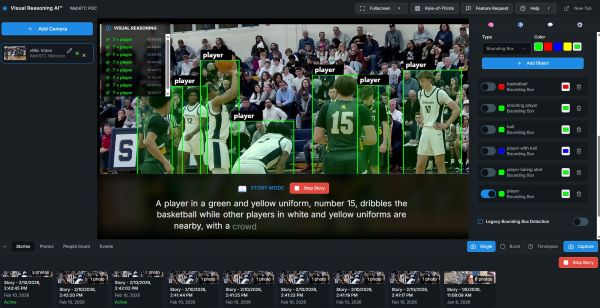
A camera that detects movement knows something happened. A camera equipped with visual reasoning can begin to understand what happened and why it matters. That distinction is important. Context-aware systems can identify whether a worker is following a procedure, whether a machine appears to be operating normally, whether an important event requires escalation or whether a process has deviated from expectations. They can generate meaningful alerts, searchable metadata and workflow triggers without requiring users to constantly monitor video feeds.
But the goal is not autonomous decision-making. The goal is augmenting human expertise with systems that can continuously observe, interpret and assist.
Visual Reasoning is The Next Layer Of Enterprise AV
The emergence of visual reasoning AI represents a natural evolution of enterprise AV. Rather than limiting cameras to tracking motion or detecting predefined objects, visual reasoning systems use vision language models to interpret scenes in ways that are understandable to people. Cameras can describe what they observe, recognize patterns, identify operational events and integrate with broader business workflows.
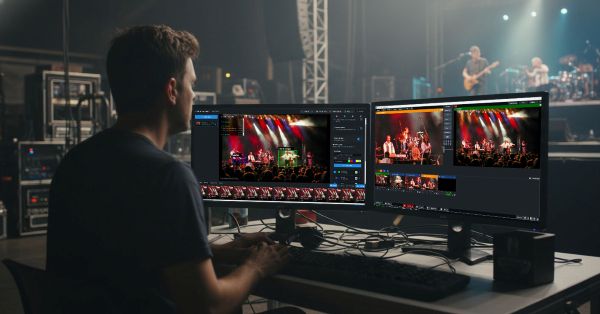
This makes video infrastructure more accessible to non-specialist users because organizations no longer need teams of computer vision engineers to extract value from visual data. A manufacturing manager can ask whether safety procedures are being followed. A healthcare administrator can analyze workflow efficiency. A facilities team can monitor operational compliance. A communications team can automatically identify important moments for content creation. The same visual infrastructure serves multiple business objectives.
The Next Growth Opportunity for Mediatech
The future of enterprise AV is not simply about bringing broadcast-quality production into new markets. It is about bringing the reliability, scalability and intelligence of MediaTech into environments that were never designed around media production in the first place.
As organizations pursue Industry 4.0 initiatives, digital transformation and AI-driven operations, video is becoming one of the richest sources of untapped operational data available. The companies that succeed will be those that recognize a fundamental shift: cameras are no longer just devices for capturing content. They are becoming decision-support platforms capable of connecting visual information to business outcomes.
Latest IAMT News
Globecast Demonstrates Content Exchange Latest Capabilities at SPORTEL Monaco 2026

Beam Dynamics Appoints Brian Mauger as Regional Sales Manager, North America

Sign-Up Here
Industry news, event updates and more. Sign-up for the IAMT Newsletter.