

Yospace – Milano Cortina 2026: Learnings From Another Record-Breaking Ad-Supported Streaming Event

Tim Sewell, Yospace
We’re entering an era where each global streaming event sets new advertising records and reshapes the rules of monetization. This demonstrates an undeniable path forward for broadcasters and rights holders, where ad-supported streaming is a central pillar of their business models.
Behind every record-breaking event is a whole host of technologies and innovations to deliver maximum monetization and the very highest standards of viewer experience. OTT advertising is not simply a case of switching on Dynamic Ad Insertion (DAI) and watching the revenue flow. Rights-holders must be able to support mass-scale, fluctuating audiences, and capitalize on revenue opportunities that can occur at a moment’s notice.
This requires end-to-end architectures that can respond instantly to unpredictable audience behavior, combined with an ability to maximize the value of every ad spot, by collaborating closely with the AdTech ecosystem to ensure the highest possible fill-rates and, if using programmatic, secure the highest possible value from real-time auctions.
Record-Breaking Ad Growth In Live Events
Milano Cortina 2026 provided a strong indication of how quickly live streaming monetization is evolving. Across 17 days of the event, Yospace stitched 5.4 billion one-to-one addressable OTT advertisements. This represents a 35.7% increase over Paris 2024, underscoring the growing importance of ad-supported streaming.
Engagement is also rising. The Games saw an increase of 0.73 ads per stream start, signaling that audiences are not only growing but becoming more engaged. This points to an increase in “armchair viewers” watching on CTV, rather than in shorter bursts on the go.
Such growth represents a huge level of scale and opportunity, with the total amount of addressable ad content inserted amounting to a staggering 3,675 years’ worth. With each major sports event, these record-breaking figures continue to be surpassed.
However, these headline figures only tell part of the story. Unlike other major tournaments that are dominated by tentpole events, such as an athletics final or a football match, Milano Cortina 2026 viewership was driven by aggregated audience behavior across multiple simultaneous streams.
Handling the Unpredictability of Live Events
Live sports are inherently unpredictable. A single moment can transform viewing patterns in seconds.
During the Men’s Ice Hockey Final at Milano Cortina 2026, for example, the USA’s dramatic overtime victory against Canada triggered a sustained spike in viewership that lasted almost 30 minutes after the match finished. Crucially, this surge extended into the subsequent ad breaks, resulting in an unexpected increase in monetizable impressions.
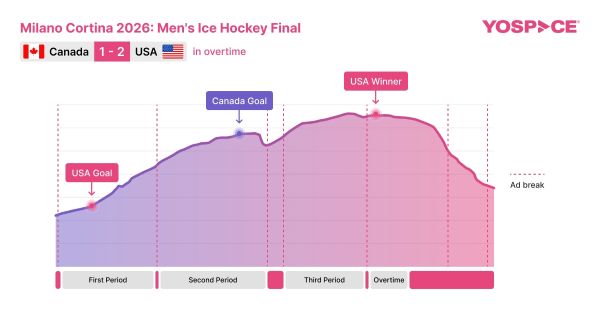
As the diagram shows, initial viewing was sluggish, with many missing the USA’s early opening goal. There followed a steady rise in viewers during the second period, with a quick increase in traffic following Canada’s equalizer. It’s clear to see the drop in viewership at the end of the quarter as viewers readied themselves for some high tension in the third period, followed by the sudden death of overtime.
These are incredibly valuable moments, though capturing this value is not guaranteed. Without the ability to scale while protecting the wider AdTech ecosystem, such spikes can result in a slowdown in response times from SSPs & DSPs translating to missed ad opportunities, degraded user experience, or both at the most valuable moments.
Today broadcasters must appreciate that successful ad insertion isn’t just about scalability, but also about extracting the maximum value from each ad opportunity. This requires intelligent integration with the AdTech ecosystem to ensure high fill rates and, in programmatic environments, to achieve optimal pricing through real-time auctions.
Ad decisioning, particularly in programmatic contexts, doesn’t happen in an instant. If requests are made too quickly or too many are made at once, the decisioning engine cannot process all the requests in time and can’t respond effectively, leading to unfilled inventory and missed opportunities.
Throughout Milano Cortina 2026, an advanced prefetch system was applied to help scale advertising during peak traffic. Prefetch paces ad calls so the AdTech ecosystem isn’t overwhelmed, and has the time it needs to realize the highest value for each ad spot. At the same time, it creates contingency breaks that are held ready for any breaks in play that create extra, unplanned advertising opportunities. Contingency breaks are separated from the planned ad breaks, which are untouched, and offer valuable extra revenue opportunities for rights-holders. Additionally, Yospace’s Orchestrator system was applied across one-off live-event channels (pop-ups) to efficiently maximize ad opportunities and return.
It’s a delicate balance: systems must move fast enough to keep pace with live viewing while also ensuring that they do not undermine the value of the inventory.
Looking Ahead: New Standards Build a Path to Future Monetization
Dynamic Ad Insertion technologies are evolving, and for the first time, will be based on industry standards. This includes a raft of new ad formats currently being ratified by the IAB that promise to open up more ad inventory during these high-value moments, such as L-banners and side-by-side ads. By the time the next edition of the Games comes around, these may well feature.
Meanwhile, Server-Guided Ad Insertion (SGAI), based on specifications and standards from Apple and the SVTA, will efficiently support longer DVR windows while enabling monetization of historic ad breaks. It will also deliver ultra low-latency streams with addressable advertising for the first time.
Lastly, developments in ad measurement are adding a crucial layer of value to OTT advertising. The latest ad measurement SDKs provide advertisers with more granular information than ever before, helping them understand the attribution impact of their spend, build trust, and ultimately encourage them to spend more. Meanwhile, the Common Media Client Data (CMCD) v2 specification helps gather playback data for a consistent, scalable view of ad performance when applying an SDK is not practical (e.g., via syndicated channels).
What These Developments Signal For Los Angeles 2028
The continued growth of ad-supported streaming is inevitable. Each major event sets a new benchmark, and there is little indication that this trend will slow down anytime soon. Looking ahead to the next edition of the Games, Los Angeles 2028, we can expect bigger numbers than ever before, especially around tentpole track and field events.
It’s important to remember that advertising success in streaming isn’t just about switching on ad stitching. It’s also about building intelligent infrastructure that can handle unpredictable audience spikes, maximize the value of the big moments, unlock new opportunities, and measure impact comprehensively across a complex device landscape.
For broadcasters and rights holders, scale alone won’t be the sole driver of more streaming revenue. Rather, the driver of increased revenue will be technology that ensures every moment of live viewing becomes a measurable monetization opportunity, without compromising the viewer experience, even at mass scale.
Latest IAMT News
Globecast Demonstrates Content Exchange Latest Capabilities at SPORTEL Monaco 2026

Beam Dynamics Appoints Brian Mauger as Regional Sales Manager, North America

Sign-Up Here
Industry news, event updates and more. Sign-up for the IAMT Newsletter.