Skyline – From the Digital Era to the Autonomous Era – building the Foundation with DataMiner
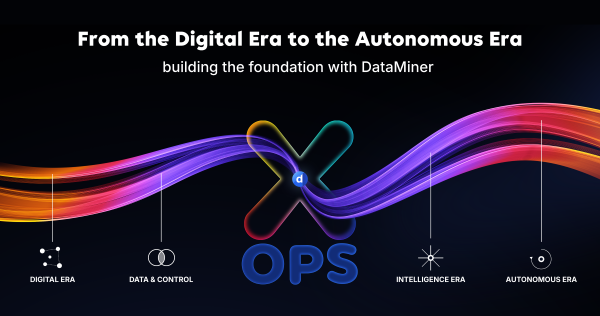
Since software first entered the enterprise, the role of technology in organizations has evolved through distinct eras. Each represents a different way technology supports, enables, and ultimately transforms how organizations operate.
Understanding these eras and their transitions is essential for leaders today. Choices made in one era shape what becomes possible in the next. Only by recognizing this can leaders set the right priorities and guide their organizations successfully through this journey.
Era 1: The Digital Era — the age of point solutions
The Digital Era was defined by the rise of software components, particularly point solutions. These tools were designed to do one thing only. While highly specialized, they offered little flexibility beyond their narrow scope.
The value proposition was clear: gaining efficiency in a specific area. If you had a problem, you would buy a tool to solve it. That model, however, has now reached its end.
Across industries, organizations are phasing out landscapes of isolated tools. What once appeared to be progress has often become operational drag: fragmented data, duplicated capabilities, and expensive integration work.
Despite major investments in integration, results often fell short. A clear realization emerged: a more fundamental change was required.
Era 2: The Data & Control Era — the rise of platforms
As software capabilities advanced and frustration with point solutions grew, a new generation of software emerged: the platform.
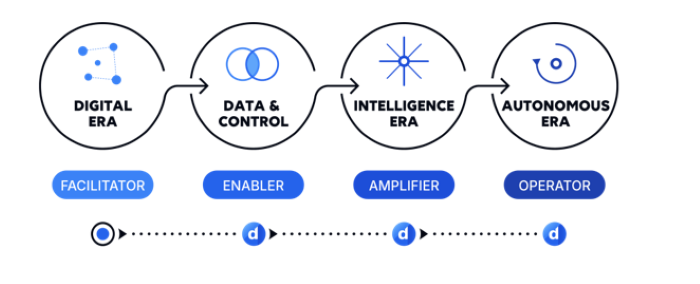
In the Digital Era, software acted as a “facilitator”, performing a specific task. In the Agile Data & Control Era, platforms become “enablers”. Rather than executing a single function, they provide data-and-control capabilities that allow organizations to build and operate many solutions within one environment.
DataMiner is a prime example: a platform built around natively integrated data and control, empowering organizations to design and operate complex solutions without stitching separate tools together.
Data and control are no longer separate functions that must be connected. Instead, they are designed as tightly integrated capabilities at the core of the platform.
Many point solutions that once occupied their own category were absorbed into platform functions, as the value of platforms comes from breadth and interconnectedness.
This reflects a broader technological pattern: convergence. When powerful enabling capabilities emerge, previously separate tools collapse into that new layer, much like the iPhone absorbed cameras, GPS units, and music players.
The maturity of your data-and-control layer
The maturity of your data-and-control layer is the clearest indicator of your operational strength.
Ask a simple question: If someone in your organization needs a real-time dashboard with specific data points and a control action to trigger a workflow, how quickly can it be delivered? Hours, days, weeks, or months? And who must be involved: everyday users or scarce technical experts?
The speed with which ideas become working data-and-control solutions is your maturity score.
What digital transformation was really about
The real goal of digital transformation was always the same: becoming an agile, data-and-control-driven platform operation.
Organizations that succeed build a consolidated ecosystem where data and control are unified. Completing this transformation is increasingly urgent, as the next era is already emerging — and it will be built on this foundation.
Era 3: The Intelligence Era — platforms become amplifiers
The Intelligence Era is defined by the emergence of large language models (LLMs) and generative AI, redefining how organizations interact with data, surface insights, and deliver value.
In this era, platforms no longer wait for human direction. They interpret needs and deliver answers. Combined with a mature data-and-control foundation, the platform becomes the organization’s true scaling engine rather than headcount.
From “facilitator” to “enabler” to “amplifier”, the platform magnifies the value embedded in your data-and-control foundation. Weaknesses, however, are amplified as well. The maturity of the foundation therefore sets the ceiling for what intelligence can achieve.
Time to value: the new imperative
The Intelligence Era shifts focus from continuous value delivery to how quickly anticipated value is realized. Platform maturity determines how fast that value can be delivered.
As technology evolves rapidly and market disruptions accelerate, long-horizon plans carry greater risks. “Time to value” becomes the critical metric.
A new integration layer: agent-to-agent interaction
The Intelligence Era introduces a new integration layer: agent-to-agent interaction, where AI agents communicate, coordinate, and execute workflows autonomously.
When new layers emerge, lower layers gradually become commoditized. Compute, storage, data lakes, and integration infrastructure have already moved from differentiators to table stakes.
The strategic imperative is clear: source commodity infrastructure, through xOps platforms like DataMiner, and focus your best people and resources on what genuinely differentiates you.
Era 4: The Autonomous Era — platforms become operators
Beyond the Intelligence Era, another stage is emerging: the Autonomous Era. Here, the platform evolves again, from “amplifier” to “operator”.
The platform no longer merely amplifies data or responds to queries. Within defined parameters, it acts autonomously — managing workflows, making decisions, and delivering outcomes without human involvement at every step.
This is not science fiction. The foundations of autonomous operations are already visible today. The transition can happen gradually, extending autonomy in controlled increments.
A human-in-the-loop approach will play an important role during this transition. Intelligent systems can execute actions while humans supervise critical steps.
Organizations that succeed in the Autonomous Era will be those building the right foundations today, not those starting the journey when autonomy is already expected.
Conclusion
Organizations must confront this reality: The era of sprawling point‑solution landscapes is over.
Reducing costs and accelerating transformation are not conflicting goals — they are the same objective. The roadmap begins with simplifying and consolidating your tool landscape, replacing isolated tools with DataMiner’s unified data-and-control foundation.
If you have not yet built an agile, data-and-control-driven operation, make it your top priority. Each technological era builds on the previous one, and the strength of the foundation determines what becomes possible next.
The eras are not just a taxonomy of the past. They are a roadmap for the future and a mirror for the present. Where you stand today determines where you can go tomorrow.
The foundation is everything. Build it well.
Latest IAMT News
Globecast Demonstrates Content Exchange Latest Capabilities at SPORTEL Monaco 2026

Beam Dynamics Appoints Brian Mauger as Regional Sales Manager, North America

Sign-Up Here
Industry news, event updates and more. Sign-up for the IAMT Newsletter.