
Qencode – When Infrastructure Thinks: How AI Is Redefining Content Creation and Production
The next wave of AI-driven automation is accelerating video workflows and reshaping what content teams produce, how they produce it, and who gets to produce it at all.
Murad Mordukhay, CEO, Qencode
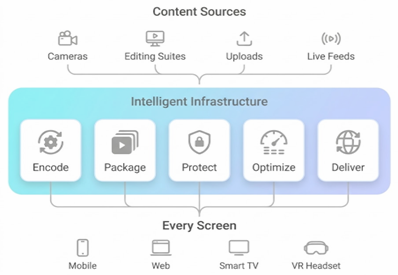
Most of the conversations about AI in the media today center on generative tools like image creation tools, LLMs for copywriting, and generators of synthetic video from text prompts. That technology matters, but it is not where AI is having its most immediate impact on production. The bigger shift is happening inside the infrastructure between a finished piece of content and the moment a viewer presses play.
AI is already embedded in production pipelines across thousands of platforms and millions of assets, making creative decisions at a scale that no human team could match. This is the current state of the industry and its effects extend well beyond efficiency: AI is changing what is possible to create, who can create it, and where creative energy gets spent.
How AI is Making Creative Decisions
The current generation of AI-driven video automation may be doing the same work faster in some cases, but the biggest shift happens when it takes your existing context, makes decisions that require creative judgment, and applies them to every asset in a library.
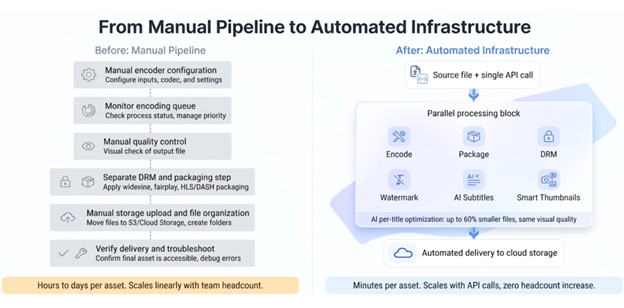
Thumbnails are the clearest example. A thumbnail is arguably the highest-leverage creative decision in digital video, as it determines whether anyone clicks at all. AI-driven thumbnail generation applies computer vision and engagement modeling to every piece of content, evaluating candidate frames for composition, facial expression, emotional resonance, and visual distinctiveness, then surfacing a curated set of strong options. The human still makes the final call, but AI narrows the field from thousands of possible frames to a handful of optimized candidates. Platforms that apply AI-selected thumbnails across their full catalogs report measurable lifts in click-through rates and overall engagement, with improvements that compound across every title, not just the ones with dedicated marketing teams.
Smart cropping may be even more consequential. Most professional content is still produced in widescreen. Most of it is now consumed on vertical phone screens. AI-driven cropping analyzes each frame, identifies the key visual elements like faces, text, action and dynamically reframes content for any target aspect ratio. Several platforms have already used this capability to convert entire horizontal libraries into vertical short-form content, effectively unlocking a “Reels” format for any catalog. Until recently, that required the kind of proprietary reframing pipeline only teams at large social media platforms had the resources to build.
Speech-to-text and automated translation embedded directly in the processing pipeline mean that subtitling and localization stop being separate production decisions. Every piece of content emerges captioned, searchable, and ready for international distribution by default. But the capability now extends beyond transcription. AI-driven subtitle translation converts those captions into multiple languages automatically, and AI dubbing goes a step further, generating localized voiceovers that preserve the tone and pacing of the original audio. A creator producing content in one language can now reach global audiences not just with text on screen but with a voice that speaks theirs. The barrier between a single-market asset and a globally distributed one collapses from a months-long localization project into a pipeline configuration.
AI That Understands What Is in the Video
The capabilities above transform how content is processed and delivered. A newer class of AI goes further: it understands the content itself.
Smart video tagging analyzes video to identify objects, scenes, faces, brands, text overlays, and sensitive material automatically. For platforms managing large libraries or high-volume uploads, this is transformative. Content moderation that once required teams of human reviewers watching hours of footage can now be handled at ingestion, flagging policy violations, identifying brand-safety risks, and categorizing content before it ever reaches a viewer. For advertisers and content owners, automated detection means every asset in a library is tagged and searchable without manual metadata entry. Content that was buried becomes discoverable.
Video intelligence represents the next evolution of this capability. Rather than detecting individual elements in isolation, video intelligence systems analyze content at a semantic level, understanding not just what appears in a frame but what is happening, what the emotional tone is, how scenes relate to each other, and what the content is about in the way a human viewer would describe it. This opens entirely new production workflows. Automated highlight generation pulls the most compelling moments from long-form content without an editor watching the full piece. Content-aware recommendation becomes possible at a depth that metadata tags alone could never support. Personalized clip assembly, where different viewers receive different edits of the same source material based on their interests, moves from research concept to production capability.
The practical impact for content teams is that AI is closing the gap between raw footage and finished, distributed, monetized content. What used to require separate teams for transcription, translation, quality review, content tagging, highlight selection, and format adaptation is converging into a single intelligent pipeline. Each step still happens, but AI handles the execution while humans direct the strategy.
The New Competitive Divide
The infrastructure between a creative idea and an audience is becoming invisible. What remains is the work that was always supposed to be the job: understanding audiences, building content that resonates, and delivering it to every screen and every market at the quality viewers expect.
Small streaming platforms with lean teams are already competing with global giants for viewer attention and more commonly every day, winning real audience share. These stories about successful small teams will be much more common now that AI has leveled the technical field and their creative vision was strong enough to compete on it.
AI will continue to transform content production much more than It already has. We all have the opportunity to capture the creative advantage that this transformation makes possible.
See what an automated video infrastructure looks like in practice at qencode.com.
Latest IAMT News

IAMT CEO, Saleha Williams, to speak on CNN Global Perspectives Doha

Amagi powers KT Studio Genie’s global micro-drama expansion

Sign-Up Here
Industry news, event updates and more. Sign-up for the IAMT Newsletter.