Mediagenix – The Semantic Advantage: How Media Leaders Turn Insight Into Action

Ivan Verbesselt, Chief Strategy & Marketing Officer, Mediagenix
Streaming organizations have never been more data-rich, with ratings curves, completion metrics, churn dashboards, audience segments, and ad performance reports forming an instrumentation layer that is both extensive and increasingly real-time.
Yet in boardrooms and programming meetings, the same questions persist. Why did this title succeed? Can we replicate that success? Where should we allocate the next dollar of content spend? Which parts of the catalog are truly working?
Dashboards describe outcomes. Metadata classifies assets. Neither, on its own, explains causality or guides repeatable action.
In an environment defined by platform fragmentation, margin pressure, and AI experimentation, that gap is becoming strategically material. The next competitive advantage in media will not come from accumulating more data. It will come from structuring meaning.
That is the role of Semantic Intelligence.
The Gap Between Reporting and Replication
Consider a crime drama that overperforms expectations. The headline insight is straightforward: the show worked. The temptation is equally straightforward: commission more crime dramas.
But “crime” is a label, not a strategy.
Was the driver serialized storytelling? A morally complex protagonist? Institutional power dynamics? A strong regional identity? A favorable lead-in? Audience appetite at that moment in the news cycle?
Without understanding the underlying attributes that resonated, replication becomes approximation. In a world where content can represent up to three-quarters of total revenue, approximation is an expensive habit.
The same applies to underperformance. A documentary may struggle on catch-up but thrive on linear. That outcome is often attributed to format or genre. In reality, it may reflect contextual alignment, sequencing, packaging, or platform-specific audience behavior.
Performance data shows what happened. Genre metadata describes what something is. Neither connects performance to meaning.
Semantic Intelligence does.
From Description to Structured Understanding
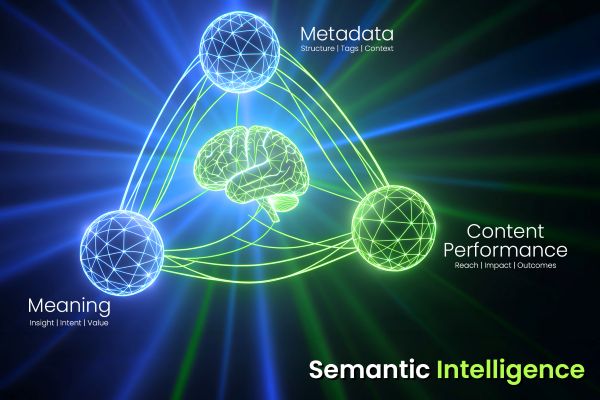
Metadata captures observable attributes such as genre, cast, runtime, and synopsis, while Semantic Intelligence structures the deeper dimensions that truly define an asset, including narrative arcs, thematic depth, tone, pacing, emotional drivers, audience affinities, and contextual relevance.
This structured meaning is organized within an ontology, a living framework that connects content characteristics to audience behavior and performance signals across platforms, enabling classification to evolve into contextual understanding.
When meaning is linked directly to consumption patterns, organizations uncover insights that extend well beyond surface labels. A platform may determine that viewers broadly categorized as “crime fans” consistently engage with serialized institutional drama driven by investigative tension and moral complexity. Such clarity reshapes commissioning strategies, acquisition criteria, marketing positioning, and recommendation logic with far greater precision.
By structuring meaning at this level, organizations enable deliberate replication and materially narrow the gap between insight and execution.
Unlocking Library Value Through Context
For organizations managing extensive catalogs across SVOD, AVOD, FAST, and hybrid environments, the impact is immediate.
Most libraries contain significant latent value, yet that value remains unrealized when thematic relevance, cross-title relationships, and audience affinities are not structured to make opportunity visible. Titles then sit underutilized, not for lack of volume, but for lack of contextual alignment that connects them to the right audience and moment.
Semantic Intelligence enables planners to identify coherent thematic clusters, resurface content for emerging audience segments, and design collections aligned with current consumption trends. It informs rights-aware distribution decisions and supports strategic windowing across platforms.
Library optimization shifts from reactive promotion to portfolio management. Utilization becomes measurable. Investment becomes more precise.
In a fragmented market, that precision translates directly into margin protection.
Platform Context Is Part of Meaning
Linear, on-demand, FAST, and social environments each operate under distinct behavioral dynamics, with consumption patterns shaped by device, time of day, co-viewing context, and session length. As a result, an asset’s meaning is influenced by the platform through which it is experienced, and a long-form documentary that succeeds in primetime broadcast may require thoughtful reframing, excerpting, or thematic repositioning to resonate effectively in digital or social contexts.
Semantic Intelligence integrates platform context directly into the decision layer, enabling adaptive packaging, intelligent sequencing, and targeted distribution strategies that determine where an asset should travel, how it should be presented, and under which conditions it is most likely to resonate. By aligning content with the realities of each environment, performance is reinforced and optimization compounds over time.
Personalization That Understands Intent
Personalization engines have traditionally relied on engagement history and collaborative filtering. These approaches detect behavioral similarity but often lack semantic nuance.
Viewers rarely respond to genre in isolation. They respond to mood, narrative structure, thematic depth, or character archetypes. Without structured understanding, recommendation logic overgeneralizes and reinforces narrow popularity loops.
Semantic Intelligence enables explainable personalization. It aligns content attributes with inferred audience intent, allowing platforms to curate rails and collections that feel coherent rather than algorithmic. Discovery expands beyond the obvious without sacrificing relevance.
Improved discovery drives engagement. Engagement drives retention. Retention drives revenue stability.
In subscription and ad-supported models alike, understanding intent is a financial lever.
The Governance Backbone for AI-Driven Operations
The industry is moving rapidly toward AI-assisted workflows, conversational interfaces, and agent-driven automation, increasing both execution speed and operational complexity.
Without structured semantic context, automation introduces material risk, reducing transparency in decision-making, shifting governance into a reactive posture, and making rights constraints and editorial guardrails more difficult to enforce with consistency and confidence.
Semantic structure provides the foundation for trustworthy automation by embedding contextual guardrails directly into workflows and ensuring that AI systems operate within clearly defined relationships between content, audiences, rights frameworks, and operational policies, thereby aligning speed of execution with enterprise-grade control and accountability.
The objective is to strengthen human judgment with transparent, explainable reasoning that enhances confidence in decision-making, particularly as organizations move from isolated AI experimentation toward scalable, enterprise-wide deployment where semantic architecture provides the structural integrity required for sustained impact.
Building the Real-Time Media Enterprise
A real-time media enterprise evolves beyond performance monitoring into a continuously learning organization that dynamically adapts its portfolio and aligns creative, operational, and financial decision-making through shared intelligence. This capability is built on a compounding cycle in which content generates contextual insight, contextual insight clarifies performance drivers, performance understanding informs optimization, optimization enhances monetization, and monetization guides smarter content investment. When meaning is not structurally embedded, that cycle loses coherence, and intelligence fails to accumulate at enterprise scale.
Semantic Intelligence activates this compounding effect, transforming isolated insights into forward-looking guidance where each decision strengthens the next and operational momentum builds over time. In a market defined by fragmentation, monetization pressure, and accelerating AI adoption, this structural shift becomes foundational to competitiveness.
The organizations that will lead the next decade are those that understand their content, audiences, and performance through a semantic and operational lens, enabling them to convert intelligence into sustained advantage. Moving from metadata to meaning represents a strategic re-architecture of how media businesses learn, decide, and grow, shaping the distinction between data accumulation and durable competitive momentum.
Latest IAMT News
IAMT CEO, Saleha Williams, to speak on CNN Global Perspectives Doha
Amagi powers KT Studio Genie’s global micro-drama expansion

Sign-Up Here
Industry news, event updates and more. Sign-up for the IAMT Newsletter.