
Fabric – The Evolution of Operations Management in the Media Supply Chain

Andy Hooper, Head of Product and GM, EMEA, Fabric
The media supply chain has always been operationally demanding. Managing the continuous flow of content (from production through post, versioning, and delivery) requires coordinating people, assets, systems, and deadlines across organizations that rarely stand still. For decades, the industry met this challenge through specialist software, manual coordination, and an acceptance that operational overhead was simply the cost of doing business.
That acceptance is no longer sustainable. The pressures are well understood: rising production volumes, fragmenting distribution platforms, shrinking margins, and growing audience expectations. What has changed more recently is the clarity of the industry’s response, and where that response is being focused.
From Operational Complexity to Operational Intelligence
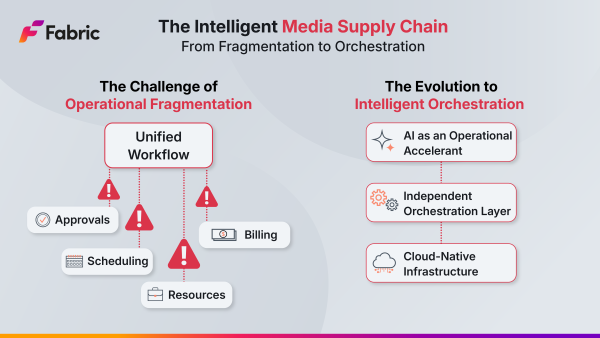
The foundational challenge for most M&E organizations is not a lack of data or capability; it is fragmentation. Scheduling systems do not communicate with asset management. Financial workflows are disconnected from production planning. Metadata exists in silos, inconsistently structured, duplicated across departments, and out of sync by the time it is needed.
This fragmentation has a real cost. Operations teams spend significant time reconciling information, chasing status updates, and managing exceptions that a better-connected system would have caught automatically. The creative and strategic work that drives competitive advantage is often overshadowed by coordination overhead.
The evolution underway is a shift from systems that merely record operations to systems that actively manage them. Platforms capable of connecting media lifecycle management with resource and production scheduling, financial workflows, and transmission operations create a different operational reality. Work becomes visible end-to-end, exceptions surface automatically, and teams spend less time managing systems and more time managing outcomes.
Metadata is increasingly central to this picture. Structured, well-governed metadata is not simply a housekeeping function; it is the connective tissue that allows operational systems, discovery platforms, analytics, and partner integrations to work from a shared understanding of content. Organizations that have invested in bringing their metadata under active management report measurable downstream benefits, including faster time to market, reduced rework, and more reliable delivery. Conversely, those that have not continue to absorb subtle, pervasive costs felt throughout the business.
The Rise of the Orchestration Layer
One of the significant architectural shifts in M&E technology has been the growing consensus around workflow orchestration as an independent function. The traditional model, which relied on tight integration between purpose-built vendor systems, offered predictability but at the cost of flexibility. When business needs changed, the technology stack was difficult to adapt, and vendor dependencies became strategic constraints.
The emerging model places an orchestration layer between the underlying vendor systems and the business processes that depend on them. This layer, which is API driven, composable, and increasingly cloud-native, gives organizations the ability to define and evolve their own workflow logic without being locked into any single vendor’s implementation choices. It provides control, visibility, and the ability to respond to change without dismantling existing infrastructure.
This is not a new concept. The media industry has long been comfortable with middleware and systems integration. What is new is the maturity of the pattern, the availability of modern tooling to implement it, and the growing recognition that orchestration is not a technical detail but a strategic capability. Organizations that own their orchestration logic own their workflows. Those that do not find themselves dependent on vendor roadmaps for operational flexibility.
AI as an Operational Accelerant
Artificial intelligence is entering the media supply chain, serving not primarily to replace human judgment but to extend it. The most immediate and practical applications are in areas where operational teams currently spend disproportionate time: metadata enrichment, schedule optimization, anomaly detection, and reporting.
Automated metadata enrichment, for example, can transform a labor-intensive process into a continuous background function. When metadata quality is maintained at source and updated automatically as content moves through the supply chain, the downstream benefits compound, leading to better discoverability, more accurate reporting, and reduced manual QC cycles.
In scheduling and resource management, AI-assisted tooling can surface conflicts, suggest optimizations, and flag capacity issues before they become operational problems. The value lies not in replacing the scheduler’s expertise, but in giving that expertise better information to work with, faster.
The orchestration layer is increasingly where AI capabilities are being embedded. A workflow orchestration platform that can trigger AI-powered enrichment, surface intelligent recommendations, and route exceptions for human review creates a different operational model. Human attention is directed where it adds most value, while routine process management runs largely autonomously.
Operations teams, freed from the overhead of manual coordination and reactive problem-solving, gain capacity to invest in quality, consistency, and innovation. The time recovered from administrative overhead redirects toward more impactful work.
Infrastructure as Enabler
Underpinning all of this is a shift in how operational software is delivered and maintained. Cloud-native architectures enable a fundamentally different relationship between software vendors and organizations. Features and improvements arrive continuously, avoiding disruptive upgrade cycles. Infrastructure scales with demand instead of requiring extensive capacity planning. Similarly, security and compliance posture improve as a function of platform evolution rather than point-in-time investment.
For organizations carrying the operational and technical debt of long-established on-premise systems, the path to these benefits is rarely a clean cutover. The more common pattern is incremental migration: progressively moving workloads and workflows to modern infrastructure while maintaining operational continuity. This requires vendors committed to managing that transition carefully, and organizations willing to treat the migration itself as a strategic program rather than merely a technical project.
Operations management in the media supply chain is becoming more connected, more intelligent, and more automated. The organizations that will lead in the next phase of industry development are those investing now in the operational and data foundations that make that trajectory possible, not as infrastructure for its own sake, but as the platform from which genuine creative and competitive advantage can be built.
Latest IAMT News
Globecast Demonstrates Content Exchange Latest Capabilities at SPORTEL Monaco 2026

Beam Dynamics Appoints Brian Mauger as Regional Sales Manager, North America

Sign-Up Here
Industry news, event updates and more. Sign-up for the IAMT Newsletter.