Cobalt Digital – A Solution for Live Programming to Cruise Ships
Ciro A. Noronha, Ph.D. CTO, Cobalt Digital
There is always lots to do on a cruise. But sometimes, you just want to escape to your stateroom and watch some TV. One can always build a self-contained VOD system in the ship, but there is also a place for live content. How does that live content get to the ship? This is what we are going to focus on.
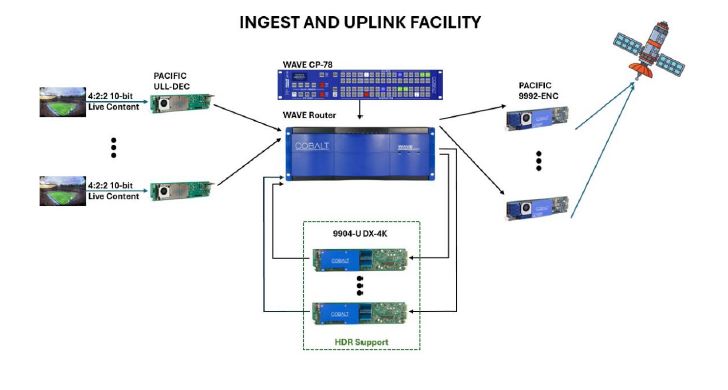
Let us start with the content and where it comes from. These will be high-quality contribution links, encoded at high bit rate, using 4:2:2/10-bit, and often with surround sound. They will come to a central ingest and uplink facility, typically using dedicated data circuits. The ingest and uplink facility is responsible for transmitting the content to the ships.
Live content is transmitted to the cruise ships using bidirectional satellite links, which have the following requirements:
1.
Available bit rates are limited, but acceptable video quality needs to be maintained.
2.
The quality of satellite delivery can change over time (occasional dropped data), so the equipment must be resilient to that.
3.
Content must be protected from unauthorized reception.
Requirement #1 is achieved by decoding the content using a high-end professional decoder, such as the Cobalt PACIFIC ULL-DEC, and then re-encoding it in HEVC 4:2:0/8-bit, using a high-end professional encoder, such as the Cobalt PACIFIC 9992-ENC. The ULL-DEC has support for H.262 (MPEG-2), H.264 (AVC), and H.265 (HEVC) decoding at 4:2:2/10-bit, as well as full support for several types of ancillary data, including Closed-Captioning. The 9992-ENC can take the content, optionally downscale it for transmission (e.g., go from 1080p to 720p), and produce an excellent stream at under 2 Mb/s.
The connection between the ULL-DEC and the 9992-ENC is through a standard SDI signal. The ULL-DEC has a built-in genlock function that allows signals from multiple devices to be aligned to the house sync, and the 9992-ENC has a built-in framesync that ensures a glitch-free switch in the outgoing stream. This is all tied together by the Cobalt WAVE series of SDI routers, which supports RP-168 switching of genlocked signals. The WAVE router is compatible with all the major control systems. Another control option is the WAVE series of control panels, which include the CP-84L panel with back-lit LCD buttons, and the cost-effective CP-78 panel.
Requirement #2 is achieved by using the Reliable Internet Stream Transport (RIST) protocol over the satellite link for delivery to the cruise ship. Using retransmissions, RIST can recover from lost and corrupted packets and offers retransmission throttling to avoid overloading the link. RIST is built into the 9992-ENC, avoiding the need for a separate gateway. Additionally, RIST can provide NULL Packet Deletion, which further optimizes the bandwidth without compromising stream compliance.
Requirement #3 is also achieved by using RIST, in Main Profile mode. RIST supports multiple encryption and authentication suites, up to AES 256 with ECDSA authentication. This ensures that content is protected in flight and is only accessible at the destination. RIST encryption and authentication are also built into the 9992-ENC, making it a one-stop solution for the transmission side.
The full ingest and uplink diagram is displayed in Figure 1.
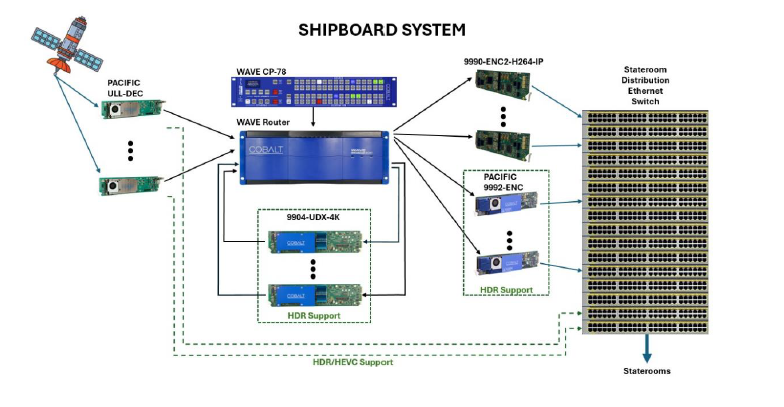
Now let’s look at the ship. The staterooms have set-top boxes driving the TVs. In modern ships, these set-top boxes are connected over IP using an internal ship network. Live content is made available using IP multicast. Often, for cost reasons, these set-top boxes only support H.264 (AVC). Therefore, the incoming H.265 (HEVC) RIST stream may need to be converted to a UDP multicast in AVC format, to be compatible with the stateroom set-top boxes.
The ULL-DEC is the ideal choice to receive the content on the ship:
1.
It has built-in RIST support, including packet recovery, encryption and authentication.
2.
It can decode and output the content over SDI, including re-insertion of all the ancillary data.
3.
It can output a clean copy of the stream in UDP/multicast if desired.
If the stateroom set-top boxes support HEVC and can directly decode the satellite feed, the ULL-DEC can put a standard clean UDP multicast stream directly into the ship network.
If the stateroom set-top boxes only support AVC, the SDI output of the ULL-DEC can be re-encoded and transmitted as a multicast.
The shipboard diagram is displayed in Figure 2.
All of this gets good-quality video from the ground contribution links to the ship. But what if you want to roll out HDR?
Figure 1: Ingest and Uplink Facility
Figure 2: Shipboard System
Let’s go back to your 4:2:2/10-bit contribution links. Some of these may have HDR content in PQ10 or HLG formats. Whether an incoming signal is HDR normally does not matter to a decoder; all that is required is for the decoder to mark the VPID in the SDI signal with the correct format. The ULL-DEC can do this automatically or manually. Now you have properly marked HDR signals on SDI. The question then becomes how to support a mixture of HDR and SDR set-top boxes and TVs in the ship staterooms.
The best solution is to use SL-HDR1 standard, which takes in the HDR signal, and generates an SDR signal with additional metadata to reconstruct the original HDR content. If the receiving device does not understand SL-HDR1, it plays the SDR version; if it does, it plays the HDR version. The Cobalt 9904-UDX-4K card can generate such a signal, and the 9992-ENC can transport it.
The ship is now receiving an HEVC 4:2:0/10-bit signal with SL-HDR1 metadata. What does it do with this signal? We have the following scenarios:
•
For ships equipped with legacy AVC SDR set-top boxes, no change is needed.
•
For ships that have HEVC set-top boxes with SL-HDR1 support, the PACIFIC ULL-DEC will simply relay the original stream clean stream. Again, no changes are needed in this case.
•
For ships that have other forms of HDR support (e.g., HLG), the Cobalt 9904-UDX-4K can be used for conversion.
Latest IAMT News
IAMT CEO, Saleha Williams, to speak on CNN Global Perspectives Doha
Amagi powers KT Studio Genie’s global micro-drama expansion

Sign-Up Here
Industry news, event updates and more. Sign-up for the IAMT Newsletter.