
IABM Standards Monitoring Group – SMPTE Projects
IABM Standards Monitoring Group – SMPTE Projects
How to use this page:
The project reports below contain:
- status updates from the telecons we attend between meetings
- documents we want SMG members to review so that we can submit any comments into the document development process.
The IABM report from the most recent quarterly meeting round provides project background information. The report (December 2025 report, SMG projects index) should be read together with information provided below on each project:
View the report here.
These projects aim to build on the success of microservices in e-commerce, applying the concept to media processing.
It was realized that much expertise in this area lies outside the SMPTE Standards community and external outreach resulted in formation of the Open Services Alliance (OSA).
Work has recently transferred to the SMPTE Rapid Industry Solutions (RIS-OSA) group.
RIS-OSA works in an agile framework and develops draft documents that are then submitted to SMPTE for standardization. The standardization projects below have followed this path. Other topics being developed are Global Service Repository, Privacy and Security.
A project, Best Practices for Live Stream Distribution, was approved April 2025. The SMPTE work has not started yet (Catena has been the priority). This project aims to establish best practices to simplify and secure the area of live stream distribution (B2B) between content producers/providers and streaming platforms.
A progress report covering all of the SMPTE Microservices group's projects was given at the December 2025 SMPTE Standards meetings.
ST 2125: IMF Registration Service API |
|
|---|---|
|
IMF is widely adopted in our industry, but we lack any standardized method of interacting with IMF packages using microservices. Update This package developed very swiftly and has been posted for some time as a Public Committee Draft on GitHub here (still available, though the comment period has now closed – there are 2 issues). Documents for review:
Use the GitHub link above. As the comment period is closed, any comments you may have should be sent to paul.treleaven@theiabm.org for raising in the group. |
ST 2126: Microservice Status Reporting and Logging |
|
|---|---|
|
A major challenge in building media solutions around multiple microservices is that status reporting is done in a wide variety of ways, making it very difficult to sort through and determine the real status of the overall jobs being accomplished by these services Update This document was published on 11th October 2025 and the project will be closed. |
ST 2133: Job Processing Architecture |
|
|---|---|
|
Aims to overcome variations in existing Job Processing Architectures that cause interoperability problems. Update The document is posted on GitHub for public Committee Draft review, until 3 July 2026. Documents for review: Use the GitHub link above. Comments can be left under "issues". Documents for review:
Use the GitHub link above. As the comment period is closed, any comments you may have should be sent to paul.treleaven@theiabm.org for raising in the group. |
ST 2138 suite: Catena control system Projects |
|
|---|---|
|
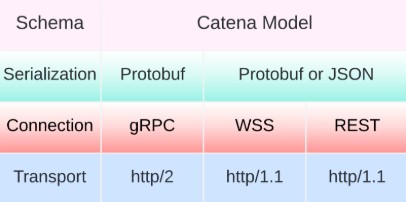
Catena was passed over to SMPTE for document development at the beginning of June 2025. The functions of the document suite are illustrated below.
|
ST 2138-10 – Catena Model |
|
|---|---|
|
This document specifies schema for plug-and-play communication and control of media services and devices across cloud, on-premises, and hybrid cloud/on-premises platforms. This document also defines a number of Access Scopes that reflect how media production equipment is used in a variety of use cases. This document is applicable to the Catena model architecture shown in the figure above. Update The document is posted for a public Committee Draft review period on GitHub here – ending no earlier than March 2, 2026 and no later than September 1, 2026. Documents for review: Use the GitHub link above. Comments can be left under "issues". As of 2026-01-08, there were 6 comments (all from the proponent). |
ST 2138-11 – Catena gRPC Connection method |
|
|---|---|
|
This document defines a connection method using gRPC for implementation of the Catena data model, defined in ST2138-10 This document is applicable to gRPC connection, as shown in the figure above. Update The document has been revised to allow referencing ST 2138-19 for Protocol Objects. The revised version of ST 2138-11 was submitted for Technical Committee review; a step required before the document can continue to Public Committee Draft status. This document completed its review period 2 December 2025 with 35 comments. When the comments are addressed, a Public Committee Draft review period will be requested (when that happens, it will be accessible from this SMPTE page). Documents for review: ST 2138-11 (draft before comments resolved) |
ST 2138-12 – Catena REST Connection method |
|
|---|---|
|
This document defines a connection method using REST to establish Catena connections. This document is applicable to REST connection, as shown in the figure above. Update The document has been revised to allow referencing ST 2138-19 for Protocol Objects. The revised version of ST 2138-11 was submitted for Technical Committee review; a step required before the document can continue to Public Committee Draft status. This document completed its review period 2 December 2025 with 26 comments. When the comments are addressed, a Public Committee Draft review period will be requested (when that happens, it will be accessible from this SMPTE page). Documents for review: ST 2138-12 (draft before comments resolved) |
ST 2138-13 – Catena WSS Connection method |
|
|---|---|
|
This document defines a connection method using WSS to establish Catena connections. This document is applicable to WSS connection, as shown in the figure above. Update This work has not started yet; priority is being given to the gRPC and REST connection methods. |
ST 2138-19 – Catena Protocol Objects |
|
|---|---|
|
At the Drafting Group meeting on 9 July 2025, the proponent sought views on removing the protocol objects from the three connection method documents (-11,-12,-13) and creating another document, ST 2138-19, specifically for them. Then, all connection methods could reference that document. The proposal was agreed. Update The document (copied below) was posted for 2 week Technical Committee review that closed 2nd December 2025 with 43 comments to resolve. When the comments are addressed, a Public Committee Draft review period will be requested (when that happens, it will be accessible from this SMPTE page). Documents for review: ST 2138-19 (draft before comments resolved) |
ST 2138-50 – Catena Authenticity, Integrity, Access Control, Confidentiality, Availablilty (was called Security) |
|
|---|---|
|
A key part of any cloud-oriented control protocol must be security. This document defines the secure framework requirements of the Catena suite. Update This document completed its Technical Committee review period 16 September 2025 with 17 comments, all of which have been addressed. A Public Committee Draft review period will now be requested (when that happens, it will be accessible from this SMPTE page). ST 2138-50 (draft before comments resolved) |
This topic began with the ST 2140-1 project below, focusing on MXF. But it was recognized that a thorough analysis of how C2PA (etc) could be applied to media workflows was needed. So the project approval for a Study group project was launched at the end of June 2025.
A progress report covering all of the SMPTE Microservices group's projects was given at the December 2025 SMPTE Standards meetings.
ST 2140-1 Descriptive Metadata Scheme for Identity and Integrity (facilitates C2PA in MXF) |
|
|---|---|
|
This SMPTE Drafting Group was formed towards the end of 2024. ST 2140-1 will address Architecture, Data Model, Representations and Bindings. Suitable UML tooling is being selected. There was a pause in work while the study group got moving. It has resumed meetings and the EBU has contributed three very useful powerpoint documents focusing on aspects of the data to be included in DMS II (documents below). There is no draft standard to review yet. There is associated work in JPEG Trust. The C2PA spec is being revised to version 2 to accommodate more broadcast-related requirements. Update Documents for review: EBU tutorial on Bindings |
Study Group on Content Provenance and Authenticity in Media |
|
|---|---|
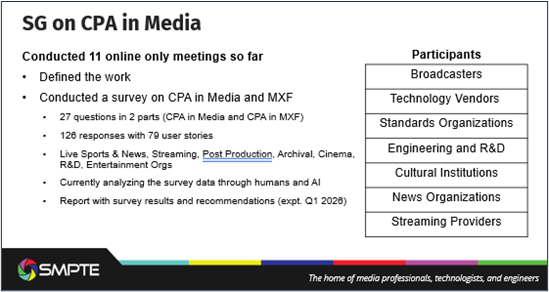
Scope: Identify content provenance and authenticity technologies, areas of work and activities in other professional media organizations and make recommendations where SMPTE can update existing or create new standards to support the flow of content provenance and authenticity information. Gather use cases and requirements. Summarize those findings and recommendations in one or more study group reports. The problem to be solved is: Content provenance and authenticity technologies are being developed or now available to ensure that consumers can trust media content. This is done by binding temper resistant provenance information (manifest) or a reference to it to a piece of media. This manifest or reference needs to travel with the content through the whole production and distribution process. This manifest needs to be updated in each content processing step. SMPTE defined a large set of standards for image formats, compression system, interface and content exchange which are broadly used in professional media production and distribution workflows. It needs to be investigated how SMPTE standards are affected by these content provenance and authenticity technologies and what needs to be done to enable SMPTE standards to bind, carry, preserve or extract a manifest from a piece of content. A report could provide valuable recommendations for the next steps. The Study Group may choose to publish multiple reports to allow for more agility. Especially to address urgent needs in the industry. Update The SG has held many meetings from 14 July 2025 through to the end of 2025 and it reported progress during the SMPTE Media Technology Summit in October. Documents for review: None yet |
The ST 2094 suite has been around for several years. It was introduced when high dynamic range came along and methods for creating SDR from HDR (and vice-versa) were needed. The existing parts are:
- SMPTE ST 2094-1, Dynamic Metadata for Color Volume Transformation — Core Components, specifies a “core” set of common metadata items and provide a framework for the specification of applications.
- SMPTE ST 2094-10, SMPTE ST 2094-20, SMPTE ST 2094-30 and SMPTE ST 2094-40 define individual applications. Each application document specifies a metadata set that fully defines a color volume transformation.
- SMPTE ST 2094-2 specifies metadata essence comprising KLV and MXF representation of individual metadata sets defined in the application documents.
Both projects below have been launched in the light of using the existing documents for some years and dealing with problems arising.
ST 2094-50 – Dynamic Metadata for Color Volume Transformation – Broadcast Application
This standard specifies the metadata for color volume transform for broadcast application. It is a specialization of the content-dependent transform metadata entries and processing blocks of the generalized color volume transform model defined in the SMPTE ST 2094-1 Core Components standard.
It includes parameters to composite multiple sources of HDR and SDR content together, and parameters to guide static or scene-adaptive tone mapping of HDR content parameterized by the target display’s HDR headroom capabilities.
Update
The document was posted for Public Committee Draft review here. The review ended in October 2025 – site can be viewed, but commenting has ended). The group has held several meetings to consider how to deal with the GitHub comments received (currently 64 closed, 3 open). Many issues raised have been accepted and dealt with in the draft document. Issues such as co-existence with tone mappers and including linear interpolation as well as cubic interpolation are under discussion.
Next meeting 14th January.
Document for review:
ST 2094-50 (PCD document)
ST 2094-60 – Dynamic Metadata for Color Volume Transformation – Dynamic Range Conversion Characterization
Live production workflows, such as sports events, use diverse, complex pipelines to deliver HD, UHD, SDR, and HDR content. Diverse conversion tools are used in production to convert SDR content to HDR content, and HDR content to SDR content. The different solutions available in the market are all incompatible, in various aspects. This document provides a way to characterize and select conversions appropriately, to improve interoperability among the different technologies.
Update
This document (see below) passed DP vote 6 November 2025 and is close to publication.
Document for review:
ST 2094-60 DP Vote document
Summary
The core documents are:
- ST 2059-1 – Generation and Alignment of Interface Signals to the SMPTE Epoch – think of this as definitions for a time receiver.
- ST 2059-2 – SMPTE Profile for Use of IEEE-1588 Precision Time Protocol in Professional Broadcast Applications (now in revision) – think of this as definitions for a time transmitter.
There are also two other documents in the 2059 suite:
- EG 2059-10 – Engineering Guideline that explains the overall concept and architecture of the ST 2059 suite
- RP 2059-15 on PTP device monitoring in ST 2059-2 Systems
This work defines the items to be queried and the messages to use when monitoring PTP devices in systems.
SMPTE Profile for Use of IEEE-1588 Precision Time Protocol in Professional Broadcast Applications – ST 2059-2 Revision |
|
|---|---|
|
After ST 2059-2 was published, v2.1 of IEEE1588 (Precision Time Protocol) was published in 2019. This project is underway to revise ST 2059-2 to reference the new IEEE1588 version and to define a way to support features that have changed and added whilst maintaining backwards compatibility. Update It is posted on GitHub for a Public Committee Draft period to encourage testing here. A Linux implementation including the new method is available to assist testing. Public review period ending no earlier than October 31, 2025 and no later than August 8, 2026. Document for review: Progress summary December 2025 meeting – see WG report slides 2-3 (same report covers other 2059 projects noted below). |
ST 2059 -1 and -2 Interoperability Testing and Best Practices |
|
|---|---|
|
The plugfests were introduced to assure interoperability and uncover any ambiguities in the standards. The last interop testing was done as part of a “dirty hands” session organized by JT-NM in Feb/Mar 2019. The reports below have been presented at quarterly meetings but not yet collated into an official report. In addition to organizing interops, it has expanded its role to write “best practice” documents for ST 2059 networks – see the linked review document below. The group was working on defining popular media network topologies that it can then test at the next face-to-face interop. Its plans were developed in a publicly-accessible spreadsheet. Update Documents for review: PTP Best Practices for Professional Media Over Managed IP Networks – RP 2059-14 Reports from earlier interops: JT-NM session – Main report – Additional items Progress summary December 2025 meeting – see WG report slides 4, 5 (same report covers other 2059 projects). |
UTC Aligned Timecode – ST 12-4 |
|
|---|---|
|
Develop algorithms and methods to accurately relate the timecode date, time, and metadata to PTP referenced time for both integer and fractional frame rates. This project is under this working group because it was originally proposed to modify ST 2059-2 to carry a modified TLV based on this technique. Update The document passed an extended FCD ballot 30th September 2025 with 29 comments to resolve. At the time of the December meeting, four comments were resolved. Documents for review: ST 12-4 draft (FCD version) |
This Joint Task Force between SMPTE and ETC (Entertainment Technology Center) has reviewed AI and ML in Media applications. Its report, published late 2023 here (free download) identified areas that would benefit from standards as well as areas of concern.
Update
The group’s report has been revised to cover changes that have occurred in this fast-moving area and the revision has been published here.
The group has initiated three SMPTE Standards projects, see below. It has met a few times to discuss the ST 2143 document and agree requirements.
Presentation from the December 2025 meeting round, covering the projects.
ST 2141 Metadata Generated by LLMs: Contextual and Versioning Standards |
|
|---|---|
|
Awaiting completion ST 2143 |
ST 2142 Embeddings as Metadata: Contextual and Non-Human Readable Fields |
|
|---|---|
|
Awaiting completion ST 2143 |
ST 2143 AI Model Metadata and Creation of a Centralized Model Registry |
|
|---|---|
|
A draft has been started, but it is not ready for review yet. |
TLX has been developed as a replacement for ST 12 timecode that overcomes ST 12 limitations such as support for higher frame rates and time ranges greater than 24 hours. It also provides extensibility for features that become necessary in the future.
The group made a decision to develop a “minimum viable” label that should satisfy a large number of industry needs and thus encourage implementations.
Progress
The TLX project groups hold weekly telecons, alternating between comment resolution on TLX Parts 1-3 and development of Part 4. An associated document, Compatible Time Labels as Descriptive Metadata (DMS-TLC), is a normative reference for Part 4 and was published at the end of May 2025.
The 3 core standards completed a public Committee Draft period and passed FCD ballot 26 December 2022. The revised Part 1 was reballoted at FCD and passed 26 September 2024 with 43 comments to resolve.
- More details on Parts 1-3: Progress summary December 2025 meeting – see WG report slides 6-10 (same report covers 2059 projects)
- More details on Part 4 / DMS-TLC work: Progress summary DMS-TLC December 2025 meeting
Extensible Time Label – Structure – ST 2120 Part 1 |
|
|---|---|
|
This standard describes the structure of extensible time labels (TLX) and the relationship to media essence. UpdateThe document (below) has just passed DP vote. It will be submitted for Standards Committee Audit. Document for review: |
Extensible Time Label – Items – ST 2120 Part 2 |
|
|---|---|
|
This document defines TLX items and their structures. This part is really the “core” Part of the suite. A JSON schema is included as an element of this document. Update36 comments, 11 addressed. Document for review: ST 2120-2 First FCD ballot package (awaiting Part 1 stabilization before being taken any further) |
Extensible Time Label – Profiles – RP 2120 Part 3 |
|
|---|---|
|
This document lists the currently-Registered TLX Profiles. For each Registered TLX Profile, this document specifies a unique profile name and corresponding constraints for TLX labels, including item and attribute presence and values. A JSON schema is included as an element of this document. Update25 comments, 22 addressed. Document for review: RP 2120-3 First FCD ballot package (awaiting Part 1 reballot result before being taken any further) |
Extensible Time Label – TLX in MXF and KLV – ST 2120 Part 4 |
|
|---|---|
|
This document will be implemented as a distinct scheme under ST 2134, see below. UpdateCan start now that ST 2134 is published. However, waiting for 2120-2 comment resolution and reballot. May need ST 2135 to publish, as it is likely needed as a reference. |
This study group was formed in 2024 to study whether SMPTE standards can produce any documentation that will improve sustainability in the media industry.
Update
The group has sent an enquiry letter to a number of organizations, requesting ideas on improving sustainability in media operations. The submissions have been analyzed in the group meetings and responses drafted, where necessary.
The current activity is drafting the group’s report. There is still some way to go.
Document to review:
Engineering Report draft
The group holds 1-2 telecons per month.
Presentation from September 2025 meeting This is the most recent presentation. It gives a good explanation of the techniques being used.
RP 2130: Camera Resolution Measurements |
|
|---|---|
UpdateThe document is now at FCD ballot, see below. With just a few hours left before the ballot closes, there were 29 comments. Document for review: RP 2130 FCD draft |
This large suite of documents (12 published Parts) covering a variety of essence types transported over IP, has been in use for many years in facility interconnects and live production. Continuing work involves minor revisions and two new parts on specialized subjects.
See quarterly meeting report above for background on the whole suite; only those parts in development or revision are covered below.
Update
A project is underway to produce a suite of Protocol Implementation and Conformance Statements (PICS) for most of the 2110 suite documents (see below).
NEW 2110 SUITE DOCUMENTS IN DEVELOPMENT
VPID and SDP use in ST 2110-40 – RP 2110-44 |
|
|---|---|
|
There is no guidance on the precedence of VPID -vs- SDP information if both are present, nor is there guidance on whether or when to send (or not send) VPID information within 2110-40 output streams. This document will recommended practices regarding the sending and receiving of VPID information within ST2110-40 streams, including the interplay and precedence of such information relative to SDP information associated with the related video signals. UpdateThis project came about when broadcasters began to experience discrepancies between equipment implementations during large sports events. The document is still being drafted; the key points have been agreed in the drafting group. |
Timing Planes – RP 2110-11 |
|
|---|---|
|
While 2110 documents describes device interfaces they do not address inter-essence timing alignment at a system level.
UpdateThe RP has been started, but work has been interrupted by a couple of hiatuses. Document for review: None (though a document is in development and will be added when it is shared with the group) |
NEW PICS DOCUMENTS FOR THE 2110 SUITE
ST 2110 Protocol Implementation and Conformance Statements (PICS) |
|
|---|---|
|
Like a checklist for suppliers to specify supported features of the associated 2110 document. UpdateThis set of documents have been close to ready for publication for some while now. However, resolution of a comment – and maybe proponent's workload – has held up progress towards publication for a while. Each document in the 2110 suite has its own PICS – numerically 100 higher than the related document. e.g. ST 2110-20 has PICS number RP 2110-120. Parts 110 120 121 122 124 130 131 140 141 143 have all been FCD balloted – the italicized ones passed second FCD ballot 8 April 2025 with comments to resolve. Documents for review in zip: It is difficult to identify the latest state of this large family of documents, as there has not been any progress for some while in the group. If anyone has a particular interest in these documents, I'll obtain the latest ones I can find. |
REVISIONS TO 2110 SUITE DOCUMENTS
PCM Digital Audio – ST 2110-30 Revision |
|
|---|---|
|
This minor revision will change the AES67 reference to the 2018 version that contains its own PICS. A few other small changes that have been discovered while writing the 2110-130 PICS will be made. Update This document progressed to publication, and this project will close. It will be removed from this page at the next edit. |
Fast Metadata – ST 2110-41 Revision |
|
|---|---|
|
Around the time of the June 2024 meeting, an error had been found in an Annex of the newly-published ST 2110-41. At that meeting, a way forward was agreed. An advisory note has been published and this revision implements that approach. The revision passed FCD ballot 14th October 2025 with 28 comments to resolve (mostly out of the limited scope of this revision project, though the DG may accept easy ones). Document for review: ST 2110-41 (FCD ballot version) |
This project is about defining an “alternate mode”, that is now registered with USB-IF, allowing the transfer over a USB-C pair of a pulse for use as a sync signal. This introductory presentation was given at the June 2024 SMPTE standards meeting round.
ST 2139 – Signal Sync Alternate Mode
This standard defines the Alternate Mode for the transfer of a media sync signal over USB-C interfaces.
Update
ST 2139 has been published and the project is closed. The project will be removed from this page at the next edit.

IABM standards representative: paul.treleaven@theiabm.org
Links to SMPTE Standards resources
SMPTE’s meeting outcome reports
The most recent reports can be found about halfway down this page.
SMPTE’s Technology Committee structure
Links to SMPTE general resources
Event Calendar
SMPTE Conferences….
IABM standards representative: paul.treleaven@theiabm.org
Links to SMPTE Standards resources
SMPTE’s meeting outcome reports
The most recent reports can be found about halfway down this page.
SMPTE’s Technology Committee structure
Links to SMPTE general resources
Event Calendar
SMPTE Conferences….