LucidLink – The Architecture Has to Match: How Enterprise Production Is Catching Up

Rupert Watson, VP GTM, EMEA, LucidLink
Investment in corporate studios is being driven by a simple realization: enterprises now produce the volume of content a mid-sized broadcaster used to, and outsourcing every piece of it is neither fast enough nor cost-effective. At LucidLink, we see this shift accelerating as more enterprises move to cloud-native workflows that give distributed teams instant access to shared media from anywhere in the world.
The business case typically comes down to three things: speed to market, consistency of brand and message across regions, and the ability to repurpose a single production into multiple assets for different channels and audiences. For many organizations, internal production has become a core operational capability.
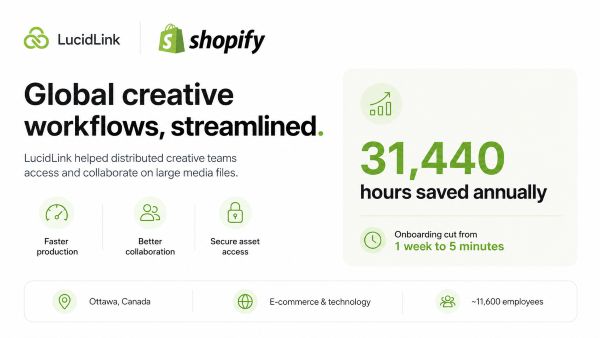
Shopify is a good example of a LucidLink customer that is doing this. Its internal creative team includes more than 120 producers, editors and directors of photography collaborating on shared media assets. At that scale, content production starts to look remarkably similar to a professional media operation.
A Different Design Assumption
Traditional broadcast infrastructure was designed around a centralized environment. Teams worked in the same facility, media remained on local storage, and workflows were built around fixed signal chains and shared physical infrastructure.
Enterprise production starts from a different assumption. Contributors, editors, producers and reviewers are distributed across multiple offices, cities and time zones. The challenge is no longer moving media through a building; it is enabling people to collaborate efficiently regardless of location. The architecture increasingly centers on network connectivity, shared access to media and identity management rather than physical infrastructure.
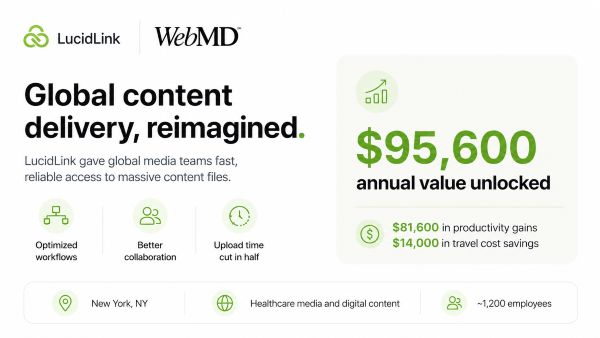
Healthcare publisher WebMD provides a useful illustration, and is another LucidLink customer. Its video team operates across New York, Atlanta, Paris, The Hague and Munich, producing more than 200 videos each month. Before 2020, workflows relied heavily on file transfers, VPNs and remote access to office workstations. The answer was not simply moving storage into the cloud, but enabling teams to work directly from shared media regardless of location, with editors accessing footage immediately without waiting for files to be copied or transferred.
The Three Layers That Matter
The workflows that separate efficient enterprise production from chaotic ones come down to three foundational layers.
The first is a shared media layer where contributors work from the same source files without copying, syncing or transferring data. If an editor is waiting for a large upload before they can begin work, every downstream process slows with it.
The second is a project and review layer that keeps versions and approvals visible to all stakeholders in real time.
The third is an identity and governance layer. Enterprise content carries real sensitivity: unreleased product footage, executive communications ahead of earnings, confidential healthcare material. Governance cannot be an afterthought bolted onto a production workflow designed for a smaller, co-located team.
Rethinking Approvals
The old model of sending a watermarked MP4 to legal, brand and communications in sequence is collapsing under velocity and volume. There simply is not time for serial review on the amount of content enterprises now produce.
The evolution is towards parallel review where stakeholders comment directly within the context of a project, with clear ownership of which approvals are blocking and which are advisory. This works far better when reviewers are looking at the same live media rather than at copies.
Solving the Version Control Challenge
One of the most persistent challenges in enterprise production is version control. Many organizations still manage content through duplicated files, shared drives and complicated naming conventions. The result is familiar: multiple versions circulating simultaneously, with uncertainty over which one is current.
A more mature approach is to maintain a single master asset and generate channel-specific versions from that source as needed. As production scales, standards such as IMF (Interoperable Master Format) become increasingly relevant. Widely used in broadcasting and streaming, IMF enables multiple language versions, aspect ratios and platform deliverables to be created from a single master.
But standards alone do not solve the challenge. This is where LucidLink fits into the picture, allowing editors, producers and stakeholders to work from the same centrally managed media while maintaining version integrity across regions and production workflows.
Live and On-Demand as a Single Workflow
Another significant shift is taking place between live production and post-production. Historically these were treated as separate workflows. Today, organizations increasingly view live and on-demand content as outputs from the same production process. Town halls, product launches and corporate events are designed with downstream content creation in mind from the outset. Clean feeds, graphics and metadata are captured into shared storage, allowing editors to begin work almost immediately after an event concludes.
WebMD demonstrated this during the pandemic, launching a daily program despite the absence of a central production facility. Content captured in the field became instantly available to distributed editors, merging live production and post-production into a single workflow.
Shopify experienced a similar transformation. Once Adobe validated LucidLink as a supported workflow for Productions over the internet, more than 100 marketing and communications staff were able to collaborate on shared media in a way that previous approaches had struggled to deliver.
Broadcast Lessons for Enterprise Production
The broadcast industry spent decades refining the infrastructure required to produce high-quality content at scale. Enterprise organizations are now building many of the same capabilities, but under very different assumptions.
The defining characteristic of modern enterprise production is that distributed collaboration is the default, not the exception. Studios remain important, production values continue to rise and content volumes continue to grow. But success increasingly depends on whether the underlying architecture reflects how people actually work. Enterprise content creation has reached broadcast scale. The architecture has to match.
Rupert Watson is VP GTM, EMEA at LucidLink, which provides cloud-native file streaming for media and enterprise production teams. lucidlink.com
Latest IAMT News
Globecast Brings Media Orchestration and C-Band Transition Expertise to NAB Show New York 2026
IAMT™ CEO Update: – MediaTech Redefined: Driving Member Momentum and Impact into IBC 2026

Sign-Up Here
Industry news, event updates and more. Sign-up for the IAMT Newsletter.