NETGEAR – AV-over-IP and Broadcast IP: Convergence — or Shared Foundations?

John Henkel, Product Marketing Director, NETGEAR
The industry has spent years discussing convergence between broadcast and commercial AV, often framing the two as distinct markets gradually moving toward one another. But the reality of professional media delivery today suggests that AV over IP and broadcast IP already share common foundations — and those commonalities may well be more important than any differences.
Rethinking Convergence
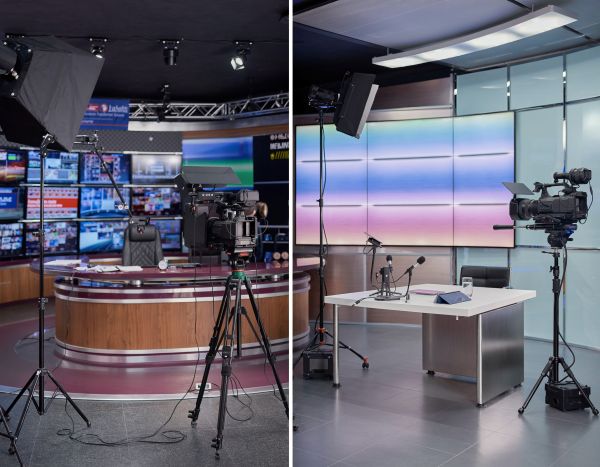
While traditional over-the-air broadcasting continues to draw viewers, it no longer defines the boundaries of professional media delivery. Streaming platforms deliver live events on a global scale. Corporate town halls reach international audiences with multicamera production. High school sports are streamed in real time with graphics and commentary.
Across all these use cases, audiences expect reliable, high-quality video and audio, delivered without interruption. And for each use case, the underlying architecture relies on managed IP networks. So, though market categories may differ, broadcast and commercial AV share IP as a common substrate. It’s time to move the conversation from “convergence” to “commonalities.”
IP as the Common Substrate
Audio moved to IP first. Technologies such as Dante, AES67, and Ravenna have been deployed across broadcast and commercial AV environments for well over a decade. Video followed, with SMPTE ST 2110 becoming the reference architecture for uncompressed professional broadcast production, while NDI gained widespread adoption in pro AV and live event workflows.
These protocols differ in compression model, bandwidth consumption, and typical deployment scale. But they share something fundamental: they run on managed IP networks. The same underlying networking principles apply across environments. Multicast traffic management ensures that streams are delivered only where needed. VLAN segmentation isolates traffic and maintains predictable performance. IGMP queriers control multicast group membership and regulate stream distribution. Deliberate switch configuration preserves stability and prevents unintended behavior. And scalable Ethernet fabrics accommodate growth without introducing instability.
Whether supporting transport of ST 2110 essences in a national broadcast facility or NDI feeds in a corporate production studio, the network layer behaves according to the same rules. And that means that — though the content types and production scales differ — broadcast engineers and AV integrators are increasingly solving the same kinds of network design problems.
Scalability: A Shared Structural Shift
One of the most significant commonalities introduced by IP is the way systems scale: horizontally, without the defined capacity limits of traditional systems. Additional endpoints are accommodated simply by adding another switch. Higher bandwidth requirements or longer cable runs can be addressed by upgrading uplinks or modules. A facility can build one studio today and expand to three next year without redesigning the entire routing core.
This expansion model applies equally across broadcast facilities, OB trucks, corporate studios, and event venues. The scalability logic is consistent regardless of vertical, reinforcing how IP-based infrastructure now supports a wide range of production environments with the same architectural approach.
Reliability: A Shared Performance Standard
“Broadcast-grade” has long implied a higher reliability standard than commercial AV, but a lot has changed in the past decade. Today, a streamed live event may reach more viewers than a local broadcast. A corporate production may carry brand implications comparable to a network telecast. In short, the potential reach and impact of non-broadcast offerings have grown tremendously.
At the same time, the definition of “broadcast quality” itself has evolved. Viewers have grown accustomed to commentators joining from remote or home studios, field reporters contributing over IP links, and user-generated or mobile footage appearing alongside traditional camera feeds. The technical quality of individual sources may vary, and audiences will accept that variability as long as the overall experience is stable and watchable. Whether watching a national broadcast, a global corporate town hall, a live concert, or a regional sports stream, audiences have little tolerance for dropped audio or frozen video.
Alignment across viewer expectations translates to alignment across engineering standards, network performance requirements, monitoring strategies, and configuration discipline. All these elements contribute to a shared goal of performance grade.
ST 2110 and NDI: Contextual, Not Competitive
The intersection of ST 2110 and NDI workflows deserves more attention than it has so far received in the “convergence” conversation. Whereas ST 2110 is designed for deterministic, uncompressed production environments where timing and fidelity are paramount, NDI provides efficient, compressed transport that enables flexible, cost-effective workflows. These differences can be complementary, given the many commonalities.
Both ST 2110 and NDI operate on managed IP networks, depend on correct multicast behavior, and require properly configured switches. (As a function of compression and encoder/decoder behavior rather than IP, latency can be tuned to match the requirements of any given use case.) A high-school sports production, a podcast studio, and a Tier 1 live sports broadcast may have very different requirements. But they can share a common switching infrastructure.
With proper configuration, a single network can support multiple protocols, multiple use cases, and multiple performance tiers. This reduces the need for separate hardware silos or dedicated switch islands for each format. What once required physical separation can now be handled through disciplined network design.
Mixed Environments: The Operational Reality
Few facilities transition to IP all at once. Existing facilities are typically hybrid — integrating SDI-to-IP gateways, adding IP-based studios, or deploying IP in OB vehicles while maintaining legacy cores. In these cases, the network becomes the unifying layer between legacy and IP workflows. Multiple formats can exist on the same network, and the emphasis shifts from format purity to network design discipline. Precision in configuration becomes more important than strict adherence to any single protocol ecosystem.
Each protocol requires specific switch parameters. Multicast handling, VLAN tagging, bandwidth management, and traffic isolation must be correctly aligned. Manual configuration is possible, but it leaves room for human error — especially as environments grow more complex. That’s why profile-based approaches, developed and validated through collaboration with device manufacturers are being used to reduce the likelihood of misconfiguration. They enable repeatable, predictable deployments across diverse environments.
From Convergence to Commonality
If broadcast and pro AV now share IP-based network architecture, uniform performance expectations, horizontal scalability models, and protocol coexistence within managed fabrics, then convergence is a present condition.
As the focus shifts from “convergence” to “commonality,” the conversation moves from disruption and identity to architecture and execution. Engineers across broadcast and AV see that infrastructure decisions ripple across multiple verticals, network design is a strategic foundation rather than an implementation detail, and configuration practices gain long-term value across different use cases.
To move forward in this IP-enabled reality, both broadcast engineers and AV integrators need cross-disciplinary literacy and a common language around networking fundamentals. Recognizing the power of commonality, they can leverage ongoing training and education to take full advantage of IP for any use case or environment.
Latest IAMT News
Meet the Emerging Talent Behind the IAMT Talent Portal

NDTV Adopts Amagi’s AdFlow Orchestrator, Unlocking Monetization Opportunities on FAST and Connected TV

Sign-Up Here
Industry news, event updates and more. Sign-up for the IAMT Newsletter.