Media-Anywhere Launches AirFrame.One
Global Creative Collaboration on Media That Never Moves
Amsterdam, Netherlands – 1 April 2026 – A director in Amsterdam, a video editor in London, a colourist in New York. Today, getting that team editing with the same native-format media means moving files, generating proxies, synchronising storage, putting everyone behind the same VPN, or streaming virtualised desktops from centralised infrastructure. These are all variations of the same compromise: either the media travels to the creative, or the creative travels to the media.
Today’s solutions for editing in the cloud are a lift-and-shift, not a transformation. AirFrame.One is built on a fundamentally different premise: whether the editor is on a laptop in Amsterdam or on a virtualised workstation in the cloud, the media never moves.
The problem has been architectural: media has never been truly addressable in place from the moment it is captured. Until now, it has landed in one location and had to be pushed, copied, transcoded, and transferred to wherever it was needed next.
Media-AnywhereTM today announces AirFrame.OneTM, the first product environment built on the principle that media should be ingested once into cloud storage, be addressable from that moment, and never be required to move.
AirFrame.One is the product interface and commercial front door to AirFrameTM, Media-Anywhere’s media-native infrastructure platform. Media enters cloud storage at the point of ingest and remains there as an addressable web resource. No downstream workflow requires it to move. AirFrame’s architecture is designed in alignment with the MovieLabs 2030 Vision, the industry’s own definition of what production infrastructure should look like.
Most production workflows are push-based: content is copied from source to destination just in case it is needed, moving through a chain of transfers, transcodes, and staging locations before it reaches the creative tool. AirFrame inverts that model. Every frame of content is assigned a unique URL and made available as an addressable web resource over standard web protocols. Applications request exactly the frames they need, at the moment they need them – the same pull-based architecture that powers video streaming at internet scale, extended back through the entire production chain to the point of ingest. The media never moves. There are no shadow copies, no rogue versions, no synchronisation lag.
The concept of time-addressable media, assigning persistent addresses to moments in a stream rather than treating content as files, is gaining traction across the industry, particularly in near-live production workflows, where chunk-based architectures introduce an inherent latency floor. AirFrame’s frame-level addressability extends that principle to true real-time applications, from live multiviewers to monitor walls, as well as across post production and long-form archive, treating live, near-live, and recorded media as temporal states of the same addressable resource rather than separate workflow domains. The concept of frame-level addressability at the heart of AirFrame was first formally proposed by Media-Anywhere co-founder Dr. Richard Cartwright in the AMWA Agile Media Blueprint in 2018, predating the MovieLabs 2030 Vision by a year and articulating the same architectural conclusions independently.
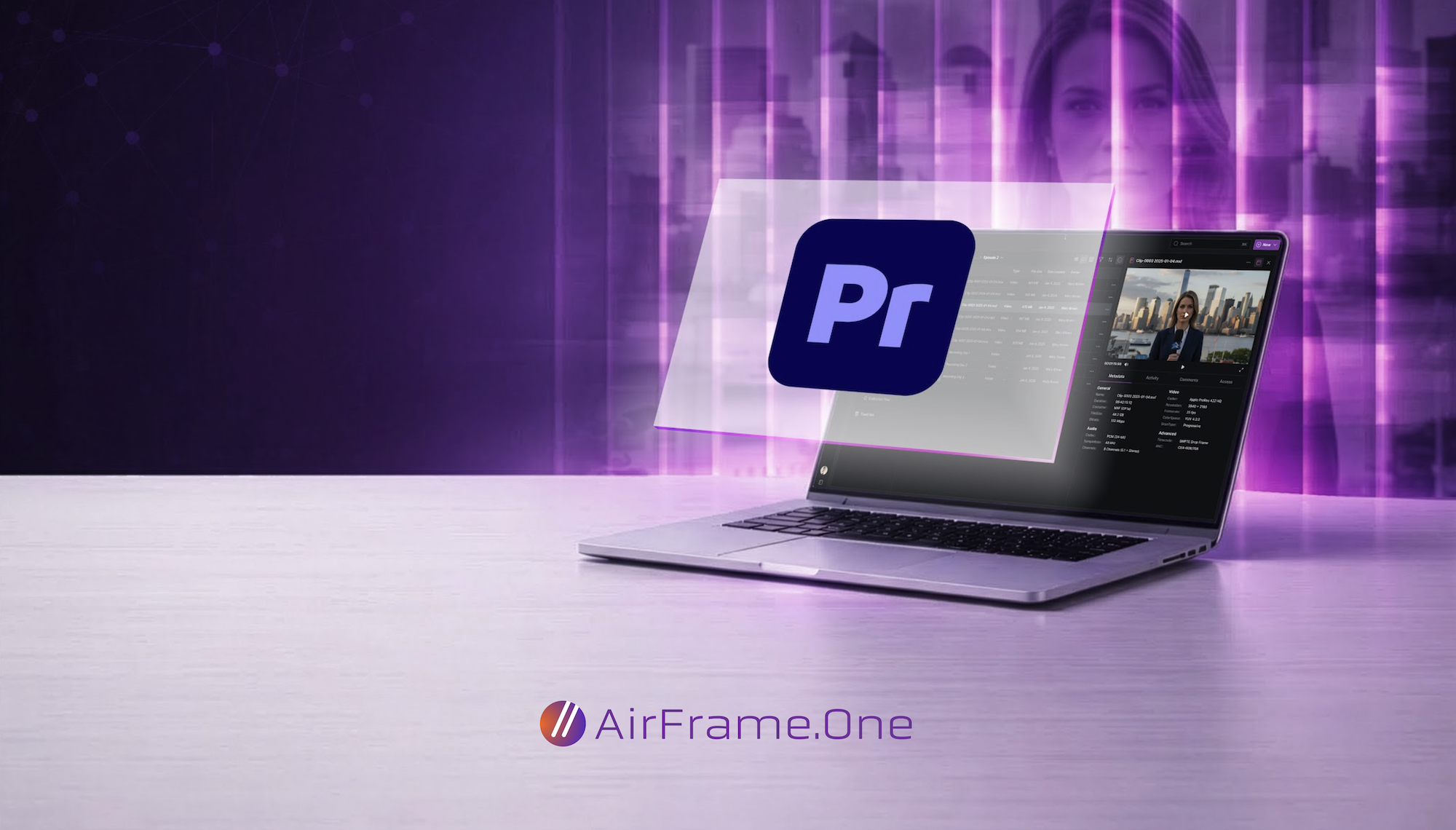
The first module in AirFrame.One is Media Access. It gives distributed editorial teams controlled access to a shared media estate through both a web portal with a WebCodecs player, and a dedicated panel inside Adobe Premiere. Editors browse media through a familiar folder-style view, organised by tags rather than a replicated file system, select clips, and press Link to Project, making native-format media immediately available in the Premiere timeline from any location.
Unlike virtual file systems that present centrally stored media as a locally mounted drive – effectively making the cloud behave like a legacy file server in a different building – AirFrame does not stream or replicate files to the workstation. Only the relevant frames are downloaded by the client at the moment they are needed. Recently accessed frames may be cached locally in encrypted form to ensure responsive playback; this cache is managed automatically and becomes inaccessible without valid credentials. The application comes to the media. The media does not come to the application.
Access is rights-based: users see only the media they are authorised to see. Permissions, user groups, and SSO integration are managed centrally from the AirFrame.One portal. Every frame request is independently authenticated and encrypted, creating an auditable zero-trust model in which access is verifiable at every point in the workflow. There are no mounted volumes, no shared network drives, no VPN dependencies. When access is revoked, encryption keys are invalidated and any locally cached frames become permanently inaccessible, automatically, with no administrative action required. AirFrame.One supports governance at a frame-level granularity no file-based system can deliver, offering the ability to restrict access to individual frames within a clip rather than the clip as a whole.
“Object storage changed the scalability and economics of media infrastructure, but not the operational model of post production,” said Peter Bruggink, CEO of Media-Anywhere. “AirFrame.One changes that. It gives enterprises a managed way to expose media directly to editorial workflows, while the underlying system remains media-native instead of file-bound. We are not making cloud storage behave like an old file server. We are making programmable media infrastructure operational.”
“Our AVROTROS production teams have long wanted to work with media efficiently and completely location-independently, without the need to move files, in native-format media, without proxies, and with the ability to add media on location that is instantly available. AVROTROS has the ambition to establish a cloud-native post-production environment and is piloting AirFrame.One to turn these ambitions into reality,” said Mechteld Honig, Head of Audiovisual Facilities at AVROTROS, one of the Netherlands’ leading public broadcasters.
“What AirFrame gives platform architects is a model where access is the foundational concept, not location,” said Gerbrand de Ridder, Chief Solutions Architect at Media-Anywhere. “Because AirFrame operates on the same architectural principles as a content delivery network, it scales the same way. Large numbers of editors across different continents can work with the same media simultaneously. The infrastructure doesn’t need to know where they are. It only needs to know whether they’re authorised.”
Media Access is the first in a planned series of AirFrame.One modules, with future releases extending the platform into live and file-based ingest, distribution, playout, web browser based editing, and AI-assisted creative workflows. What launches today is the entry point to a fundamentally different operating model for media: web-native, programmable media infrastructure, built for the web from the ground up, not adapted from a legacy architecture that predates it.
AirFrame.One is available now. Contact Media-Anywhere to discuss deployment and enterprise onboarding at www.airframe.one.
Media-Anywhere will be demonstrating AirFrame.One at NAB Show 19-22 April, Las Vegas, and is taking appointments for private demonstrations. Reserve meetings using this link.
Latest IAMT News

IAMT Dynamic Software Licensing Group Launches Public GitHub Repository
IAMT Annual Conference & Awards 2026: first speaker announced

Sign-Up Here
Industry news, event updates and more. Sign-up for the IAMT Newsletter.