
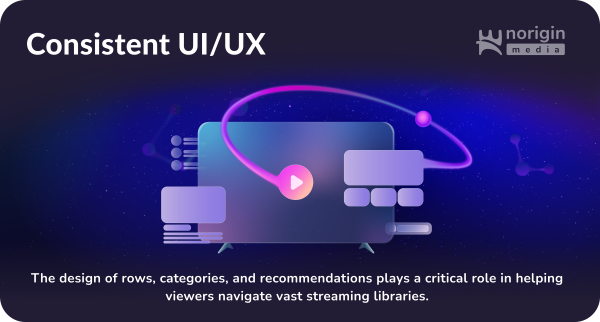
Norigin Media – If Viewers Can’t Find Content, It Doesn’t Exist
UI/UX design is emerging as the next frontier of creativity in the age of AI-generated content across TV apps and platforms.

Ajey Anand, CEO & Co-Founder, Norigin Media
The media industry is racing to automate content creation with AI, but the part that determines whether that content is ever consumed is still being overlooked. The channels that deliver such content are now apps and app stores across a highly fragmented platform ecosystem.
AI and automation are rapidly transforming the way content is created and distributed. Tools that assist with scripting, editing, visual effects, localization, and generative visuals are already reshaping production workflows. These technologies are helping studios, broadcasters, and streaming platforms create more content faster than ever before. At the same time, modern engineering tools are accelerating how this content is packaged and delivered.
As automation accelerates content creation, another challenge is emerging: how audiences discover and interact with that content.
The media industry has spent decades optimizing production pipelines, yet the viewer experience (particularly on large screens) remains one of the most critically overlooked parts of the content journey.
As content libraries continue to expand, the success of creative work increasingly depends on how effectively platforms orchestrate the final step of the experience: the viewer interface.
A New TV Era: Where Content Outpaces Discovery
With thousands of titles competing for attention, viewers often face a paradox of choice. Finding the right content quickly and effortlessly has become just as important as producing it.
It’s no longer just a question of what content gets made, but where, how, and on which screen it is discovered and consumed. Multiple content ecosystems coexist – from social media to premium streaming – with AVOD platforms gaining significant momentum.
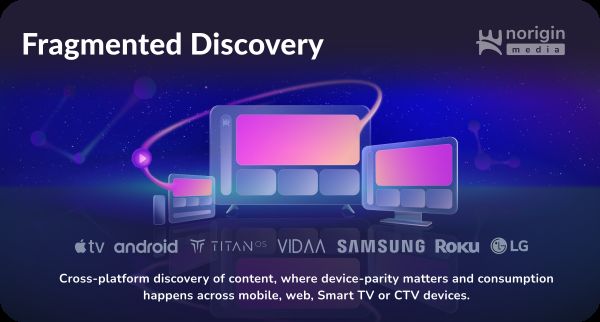
Fragmented Discovery Problems
Viewers today rarely consume content on a single device. A show might be discovered on a phone, added to a watchlist on a tablet, and finally watched on a TV.
This cross-platform behavior creates new challenges. It’s no longer enough to design discovery experiences for one screen. The UX needs to feel intuitive and consistent across mobile, web, and CTV environments.
Streaming services compete not only through exclusive content, but also through how easily viewers can discover it. Recommendation systems, interface design, and browsing experiences all play a role.
UI/UX design has become a new creative layer in the media ecosystem. The way content is organized into rows, categories, and recommendations shapes the viewer’s journey. A well-designed interface can surface hidden gems, while a poorly designed one can bury great content.
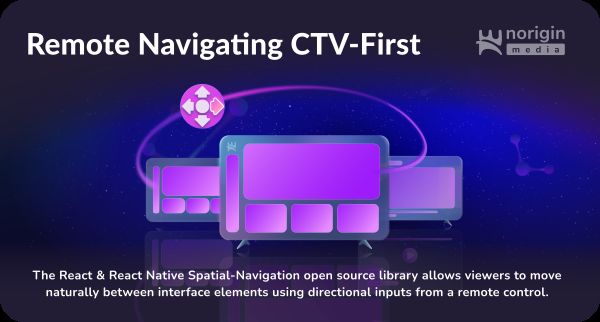
TV in the Living Room: A “CTV-First” UI/UX Approach
While content is consumed across multiple devices, the living room TV remains the primary destination for long-form viewing.
Designing for the TV screen introduces unique interaction challenges. Instead of touchscreens or keyboards, viewers navigate using simple directional remote controls.
This seemingly simple interaction model creates a surprisingly complex design problem.
TV interfaces must support:
- Moving efficiently between rows, menus, and content grids
- Maintaining smooth performance across a wide range of platforms
- Supporting intuitive browsing across increasingly large content catalogues
One approach that has become essential in this environment is spatial navigation, a system that allows users to move naturally between interface elements using directional inputs.
In many cases, the entire viewing experience depends on just a few buttons on a remote control.
By mapping how focus moves across the screen, spatial navigation helps create a browsing experience that feels responsive and intuitive, even when viewers are navigating hundreds of titles.
When implemented effectively, it reduces friction and helps viewers discover content more quickly.
In this context, navigation is not just functional, it is foundational to content discovery.
Consistent UI/UX Across Fragmented TV Platforms
While frameworks such as React Native or Flutter help simplify cross-platform development, the CTV ecosystem remains highly fragmented across Samsung Tizen, LG webOS, Android TV, and others.
Each platform introduces its own technical requirements, performance limitations, and certification processes. Maintaining high-quality apps requires careful orchestration between design, engineering, and distribution teams.
Automation is increasingly involved here too. Streamlined testing, deployment, and certification pipelines allow development teams to maintain and update TV apps more efficiently.
As content production accelerates, the infrastructure required to deliver that content across platforms must evolve just as quickly.
Automating The Next Creative TV-Frontier
Automation will continue to reshape every stage of the media pipeline, from production and post-production to distribution and localization. Creative teams will have access to increasingly powerful tools that allow them to produce content at unprecedented scale.
But as the volume of content grows, the challenge facing the industry will not simply be creating more content – it will be helping audiences navigate it.
In an era where AI can generate content faster than ever before, the real competitive advantage may no longer be production – it may be discovery. And that brings the industry back to the question we started with: If viewers can’t find the content, does it really exist at all?
Because in the end, creativity doesn’t stop when production wraps. It does not even end when content is consumed. AI helps accelerate both the creation and engineering processes – while technology becomes more standardized and platforms remain fragmented.
And as the industry continues to explore previously hyped innovations – 3D, augmented reality, and even holograms – we are left with a fundamental question: are devices or app stores even relevant?
It all starts when someone presses PLAY.
Latest IAMT News

Globecast Demonstrates Content Exchange Latest Capabilities at SPORTEL Monaco 2026

Beam Dynamics Appoints Brian Mauger as Regional Sales Manager, North America

Sign-Up Here
Industry news, event updates and more. Sign-up for the IAMT Newsletter.